
Sensors and Actuators in Embedded Systems
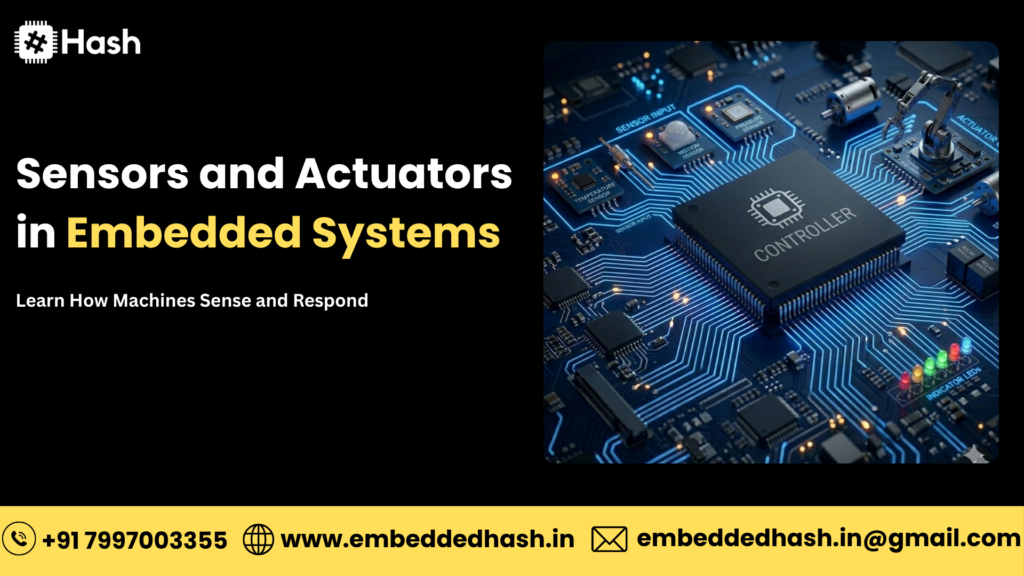
Table of Contents
Sensors and Actuators in Embedded Systems
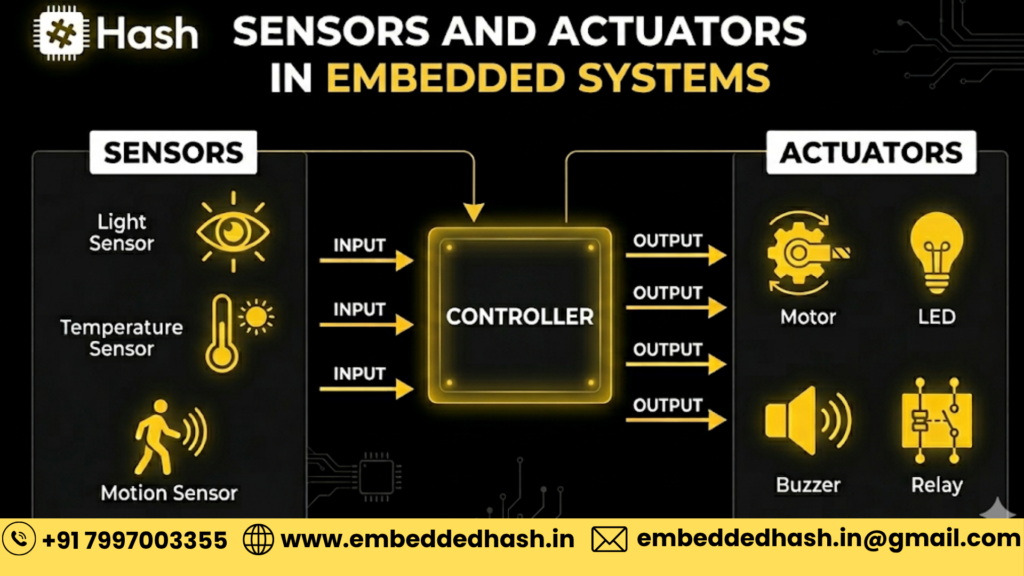
Sensors and Actuators in Embedded Systems are essential components that allow electronic devices to interact with the physical world. Sensors act as input devices by detecting real-world changes such as temperature, light, motion, or pressure and converting them into electrical signals. Actuators, on the other hand, work as output devices by receiving signals from a microcontroller and performing physical actions like movement, switching, or control operations. Together, they follow a simple input–process–output cycle where data is collected, processed, and acted upon. Sensors and actuators are widely used in smart homes, industrial automation, healthcare devices, and IoT systems, making them highly important for beginners who want to understand how modern embedded systems work and build real-world applications.
What Are Sensors and Actuators in Embedded Systems?
What are Sensors?
Definition
Sensors are devices that help embedded systems understand the real world by detecting changes such as temperature, light, motion, or pressure. These changes are converted into electrical signals and sent to a microcontroller, which processes the data and decides the appropriate action. Sensors play a key role in making modern devices smarter, more efficient, and responsive.
Types of Sensors
-
Temperature Sensors
Temperature sensors measure heat levels in the environment and convert them into signals for systems. They are widely used in ACs, refrigerators, and smart homes for accurate temperature control.
-
Motion Sensors
Motion sensors detect movement by sensing changes in surroundings. In 2026, they are commonly used in security systems, automatic lights, and smart devices to improve safety, automation, and energy efficiency.
-
Light Sensors
Light sensors measure brightness levels and help devices adjust accordingly. Smartphones use them to automatically control screen brightness, improving user comfort and saving battery life in different lighting conditions.
-
Pressure Sensors
Pressure sensors measure force applied on a surface and convert it into signals. In 2026, they are used in medical devices, vehicles, and industrial systems for accurate monitoring and safety.
-
Proximity Sensors
Proximity sensors identify objects that are nearby without needing direct contact. By 2026, they are commonly used in touchless systems, smartphones, and automation to enhance safety, cleanliness, and overall user experience.
How Sensors Work
- Input (Detect Physical Change)
Sensors begin by sensing changes in the environment, such as temperature, light, or motion, which serve as the initial input for embedded systems. - Signal Conversion (Electrical Signal)
The detected change is then transformed into an electrical signal, enabling the system to interpret real-world conditions and respond accurately in modern devices. - Processing (System Action)
This signal is sent to a microcontroller, where it is analyzed and used to decide the appropriate action, supporting intelligent automation in embedded systems.
Real-World Examples
- Smartphone Brightness Adjustment
Light sensors in smartphones automatically adjust screen brightness based on surroundings, improving visibility and saving battery life in everyday usage. - Smart Thermostats
Temperature sensors in smart thermostats monitor room conditions and adjust cooling or heating automatically, ensuring comfort and energy efficiency in homes across India. - Fitness Trackers
Motion sensors in fitness trackers monitor steps, movement, and activity levels, helping users track health and fitness goals easily with smart wearable devices.
What are Actuators?
Definition
Actuators are devices that convert electrical signals into physical actions such as movement, force, or motion. They allow embedded systems to interact with the real world by performing tasks like turning devices ON/OFF, moving motors, or controlling mechanical systems.
Types of Actuators
- Motors (DC, Servo, Stepper)
Motors convert electrical energy into movement, widely used in fans, robots, and automation systems, enabling precise control and motion in modern embedded applications. - Relays
Relays act as electrically controlled switches, allowing systems to turn devices ON or OFF safely, commonly used in home automation and industrial control systems. - Hydraulic Actuators
Hydraulic actuators use fluid pressure to create strong mechanical movement, often used in heavy machinery, construction equipment, and industrial applications requiring high force. - Pneumatic Actuators
Pneumatic actuators use compressed air to produce motion, making them fast and reliable, commonly used in factory automation and packaging systems.
How Actuators Work
- Receive Signal
Actuators receive electrical signals from a microcontroller or control system, which tells them what action to perform in an embedded system. - Convert Energy
The actuator converts electrical energy into mechanical, hydraulic, or pneumatic energy, depending on its type, enabling movement or physical force generation. - Perform Action
Finally, the actuator performs the required physical action like moving a motor, opening a valve, or switching a device ON or OFF.
Real-World Examples
- Automatic Doors
Actuators open and close doors automatically when sensors detect people, commonly seen in malls, hospitals, and offices across India. - Robotic Arms
Motors act as actuators in robotic arms, enabling precise movement for tasks like manufacturing, assembly, and even medical procedures in advanced systems. - Smart Irrigation Systems
Actuators control water flow in irrigation systems based on sensor data, helping farmers in India save water and improve crop efficiency using smart agriculture.
Difference Between Sensors and Actuators
|
Feature |
Sensors |
Actuators |
|
Role |
Input devices |
Output devices |
|
Function |
Collect data from the environment |
Perform physical action based on data |
|
Purpose |
Detects changes (temperature, motion, etc.) |
Convert signals into movement or force |
|
Direction of Flow |
Real world → System |
System → Real world |
|
Output Type |
Electrical signals (data) |
Physical action (motion, force, switching) |
|
Energy Conversion |
Physical → Electrical |
Electrical → Physical |
|
Dependency |
Work independently to sense data |
Work after receiving instructions |
|
Accuracy Focus |
High precision in measurement |
High efficiency in execution |
|
Speed |
Fast detection of changes |
Fast response to commands |
|
Real-Life Analogy |
Human senses (eyes, ears, skin) |
Human muscles |
|
Examples |
Temperature sensor, light sensor |
Motor, relay, valve |
How Sensors and Actuators Work in Embedded Systems
Input–Processing–Output Cycle
Embedded systems follow a simple cycle to function effectively:
- Sensor collects data
Sensors detect real-world conditions like temperature, light, or motion and send this information as electrical signals to the system. - Microcontroller processes data
The microcontroller analyzes the received data and decides what action should be taken based on programmed instructions. - Actuator responds
ctuators perform the required action, such as turning a motor, switching a device ON/OFF, or adjusting system behavior.
Example System: Smart AC System
A smart air conditioner clearly shows how sensors and actuators work together:
- Sensor detects temperature
The temperature sensor continuously monitors room temperature. - Controller processes
The system compares current temperature with the desired setting. - Actuator adjusts cooling
The actuator controls the compressor or fan to increase or decrease cooling automatically.
Why Sensors and Actuators Are Important
Key Benefits
- Automation
Sensors and actuators enable automatic operation of devices without human intervention, making systems smarter and reducing manual effort in homes, industries, and daily life. - Accuracy
Sensors provide precise data from the environment, while actuators respond accurately, ensuring reliable performance in applications like medical devices, automotive systems, and smart technologies. - Efficiency
These components help optimize energy and resource usage by working only when needed, improving overall system performance and reducing wastage in modern embedded systems. - Real-Time Decision Making
Sensors continuously monitor conditions, and actuators respond instantly, allowing systems to make quick decisions in real-time, which is critical for safety and automation.
Industry Applications
- Healthcare Devices
Sensors monitor patient data like heart rate and temperature, while actuators assist in devices like ventilators and automated medical equipment used in hospitals across India. - Automotive Systems
Sensors detect speed, distance, and engine conditions, while actuators control braking, steering, and engine functions, improving safety and performance in modern vehicles. - Industrial Automation
Factories use sensors to monitor processes and actuators to control machines, increasing productivity, reducing errors, and enabling smart manufacturing systems. - IoT Systems
In Internet of Things (IoT) devices, sensors collect real-time data, and actuators perform actions, enabling smart homes, agriculture, and connected systems widely used in 2026.
Conclusion
Sensors and actuators are the backbone of embedded systems, enabling machines to sense their environment and respond with intelligent actions. They play a crucial role in automation, smart devices, and modern technologies used across industries in 2026. If you are starting your journey in embedded systems, understanding these components will help you build practical, real-world projects and strengthen your technical foundation. Start learning with simple projects like temperature monitoring or automation systems, and gradually explore advanced concepts to build a successful career in embedded systems.
Frequently Asked Questions
Sensors collect information from the environment, while actuators perform actions based on that data. Together, they help embedded systems interact with the real world in 2026.
A sensor is an input device that detects changes, while an actuator is an output device that performs actions, making both essential parts of embedded systems in 2026.
Sensors detect physical changes like temperature or light, convert them into electrical signals, and send them to a microcontroller for processing and decision-making in embedded systems.
Common examples include smartphone light sensors, motion sensors in security systems, and temperature sensors in ACs, all widely used in everyday devices across India in 2026.
Actuators are used to perform physical actions like moving motors, opening valves, or switching devices ON and OFF, enabling automation in embedded systems in 2026.
Sensors collect data from the environment, the system processes it, and actuators perform actions based on that data, completing the input–output cycle in embedded systems.
Common types include temperature, motion, light, pressure, and proximity sensors, each designed to detect specific environmental changes in embedded systems used in 2026.
Types include motors, relays, hydraulic actuators, and pneumatic actuators, each used to perform different physical actions in automation, robotics, and embedded systems in 2026.
Sensors collect real-time data from the environment, enabling IoT devices to monitor conditions, make smart decisions, and automate processes efficiently in connected systems in 2026.
A smart AC system uses sensors to detect temperature and actuators to adjust cooling automatically, providing comfort and energy efficiency in homes across India in 2026.
Basic electronics, programming in C, understanding microcontrollers, and hands-on project experience are essential skills to start learning embedded systems and build a strong career in 2026.
Sensors are input devices because they collect data from the environment and send it to the system for processing in embedded systems and smart devices in 2026.
Actuators are output devices because they receive signals from the system and perform physical actions like movement or switching in embedded systems and automation in 2026.
Yes, beginners can start with simple projects like temperature monitoring or automatic lights, helping them understand practical concepts and gain confidence in embedded systems in 2026.
Microcontrollers act as the brain of embedded systems, processing sensor data and controlling actuators, enabling devices to perform tasks automatically and intelligently in modern systems in 2026.


 embeddedhash.in@gmail.com