
ARM Architecture in Embedded Systems
- ARM Architecture in Embedded Systems is widely used for developing efficient, low-power, and high-performance embedded devices. It provides a flexible processor architecture suitable for applications such as IoT devices, automotive systems, smartphones, and industrial controllers. ARM-based processors are known for their speed, energy efficiency, and compact design.
- Learning ARM architecture helps students understand processors, instruction sets, memory management, and embedded system development. It is an important concept for anyone building a career in embedded systems and electronics. Understanding ARM architecture can also support practical skills in microcontrollers, firmware, and real-time applications.
Table of Contents
ARM Architecture in Embedded Systems
ARM architecture in embedded systems refers to a highly efficient processor design based on RISC (Reduced Instruction Set Computing), which uses simple instructions to perform tasks quickly and with low power consumption. In 2026, ARM is widely used in devices such as smartphones, IoT gadgets, automotive systems, medical devices, and smart electronics. Its ability to deliver high performance while consuming less energy makes it ideal for battery-powered and real-time applications. One of the main reasons beginners prefer ARM is its simple design, scalability, and strong industry demand. It is used in both small embedded devices and complex systems. Learning ARM architecture helps students and early professionals build a solid foundation for careers in embedded systems, firmware development, and IoT technologies.
What is ARM Architecture?
Definition
ARM stands for Advanced RISC Machine. It is a type of processor architecture based on RISC (Reduced Instruction Set Computing), which means it uses simple instructions to perform tasks quickly and efficiently. In 2026, ARM is widely used in embedded systems because it is designed for low power consumption and high efficiency, making it perfect for modern smart devices.
Key Features of ARM Processors
ARM processors are popular because they offer:
- Low power usage – ideal for battery-powered devices like smartphones
- High performance per watt – more output with less energy
- Compact design – fits easily into small electronic devices
- Scalability – used in everything from small IoT devices to advanced systems
Major Benefits:
- Improves battery life in portable devices
- Reduces overall system cost
- Ensures faster and efficient processing
- Supports a wide range of applications and industries
ARM vs Other Architectures
Feature | ARM Architecture | x86 Architecture (Intel/AMD) |
Design Type | RISC (Simple instructions) | CISC (Complex instructions) |
Power Consumption | Very low (energy-efficient) | Higher power consumption |
Performance Focus | Performance per watt | High raw performance |
Usage | Embedded systems, mobiles, IoT devices | Desktops, laptops, servers |
Heat Generation | Less heat | More heat |
Battery Life | Longer battery life | Shorter battery life |
Examples (2026) | Smartphones, smartwatches, smart TVs | PCs, gaming laptops, workstations |
Why ARM Architecture is Important in Embedded Systems
Role of ARM in Embedded Devices
ARM architecture plays a key role in modern embedded systems. It is widely used in microcontrollers and microprocessors, which act as the “brain” of devices. ARM processors enable real-time processing, meaning they can quickly respond to inputs—essential for applications like automotive systems, medical devices, and smart electronics in 2026.
Benefits for Embedded Systems
ARM offers several advantages that make it ideal for embedded applications:
- Energy efficiency – consumes less power, perfect for battery devices
- Cost-effectiveness – reduces overall system cost
- Flexible design – can be used in small to complex systems
Why Companies Prefer ARM
Companies choose ARM because it is:
- Widely adopted across industries like IoT and automotive
- Supported by a strong ecosystem of tools, documentation, and developers
How ARM Architecture Works
Working Principle
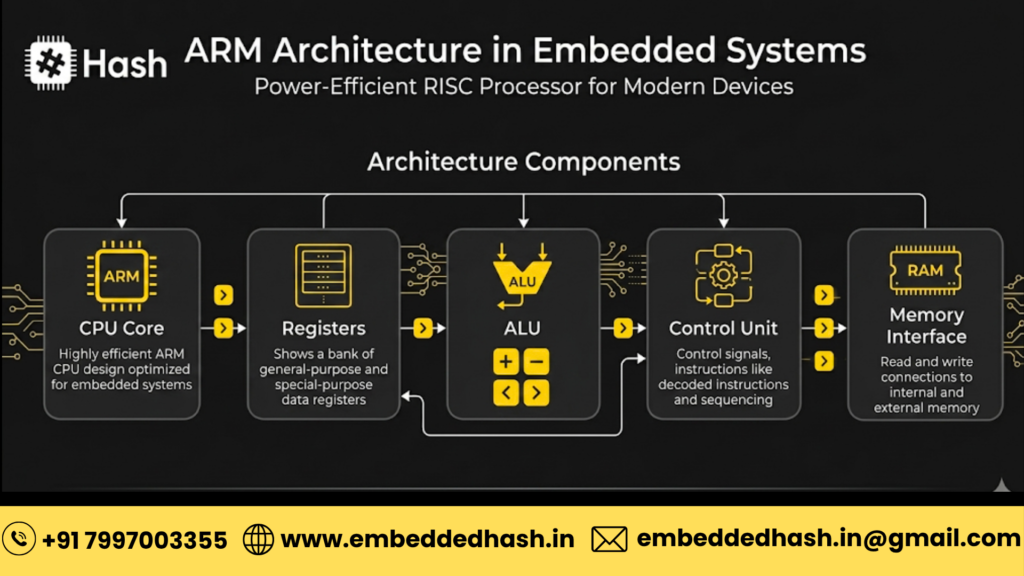
ARM processors work using a simple cycle: fetch → decode → execute. First, the processor fetches an instruction from memory, then decodes it to understand the required action, and finally executes it. Because ARM is based on RISC (Reduced Instruction Set Computing), it uses simple and efficient instructions, allowing devices to run faster while consuming less power—making it ideal for smart and portable devices in 2026.
ARM Processor Components
An ARM processor includes several important components that work together to perform tasks efficiently:
- Registers
Small, high-speed storage units inside the processor that temporarily hold data and instructions for quick access. - ALU (Arithmetic Logic Unit)
Responsible for performing all mathematical calculations (like addition, subtraction) and logical operations (AND, OR, comparisons). - Control Unit
Acts as the “manager” of the processor, controlling and directing how data moves and how instructions are executed step by step. - Memory Interface
Connects the processor to the system memory (RAM/ROM), allowing data to be transferred between the CPU and memory.
Instruction Set Overview
- Load/Store Architecture
Data is first loaded into registers from memory, processed inside the CPU, and then stored back to memory. - Conditional Execution
Instructions are executed only when specific conditions are met, improving efficiency and reducing unnecessary operations. - Pipeline Processing
Multiple instructions are processed in stages (fetch, decode, execute) at the same time, increasing overall speed and performance.
Types of ARM Processors
ARM Cortex Series Explained
- Cortex-M (Microcontrollers)
Cortex-M processors are designed for simple, low-power embedded systems. In 2026, they are widely used in IoT devices and small electronics where energy efficiency and basic control tasks are important. - Cortex-A (Application Processors)
Cortex-A processors are used in high-performance devices like smartphones and tablets. In 2026, they support advanced features such as apps, graphics, and multitasking with smooth user experience. - Cortex-R (Real-Time Systems)
Cortex-R processors are built for real-time applications that need fast and reliable responses. In 2026, they are commonly used in automotive systems and robotics for safety-critical operations.
Use Cases for Each Type
- Cortex-M → IoT, Embedded Control
In 2026, Cortex-M is used in smart sensors, home automation, and wearable devices, where low power consumption and efficient control make it ideal for everyday embedded applications. - Cortex-A → Smartphones, Tablets
Cortex-A powers modern smartphones and tablets, enabling smooth app performance, multimedia processing, and multitasking, making it essential for consumer electronics in 2026. - Cortex-R → Automotive, Robotics
Cortex-R is used in automotive safety systems and industrial robots, where real-time processing and reliability are critical for handling time-sensitive and mission-critical operations.
Real-World Applications of ARM in Embedded Systems
Everyday Examples
ARM architecture is used in many devices we interact with every day. In 2026, most smart gadgets depend on ARM processors because they provide fast performance with low power consumption, making devices efficient and long-lasting.
- Smartphones
ARM processors help smartphones run apps, make calls, play games, and handle multitasking smoothly without draining the battery quickly. - Smart TVs
They power streaming apps, user-friendly interfaces, and voice control features, giving a smooth entertainment experience. - Wearables (Smartwatches)
ARM enables features like fitness tracking, heart rate monitoring, and notifications while using very little power.
Industrial & Advanced Applications
- ARM is also widely used in critical and advanced systems where reliability and speed are important.
- Automotive Systems (ABS, Airbags)
ARM ensures quick, real-time responses, improving safety in modern vehicles. - Medical Devices
Used in devices like ECG monitors and portable diagnostic tools for accurate and efficient performance. - IoT and Smart Homes
Powers smart lighting, security systems, and connected home devices.
Advantages of ARM Architecture in Embedded Systems
- Low Power Consumption
ARM processors use less energy, making them ideal for battery-powered devices like smartphones, wearables, and IoT systems. - High Performance per Watt
They deliver strong performance while consuming minimal power, ensuring efficient operation. - Cost-Effective Design
ARM-based systems are affordable, reducing overall product development and manufacturing costs. - Scalability
ARM architecture can be used in simple microcontrollers as well as complex processors, making it flexible for different applications. - Compact Size
Its small design makes it suitable for embedded devices with limited space. - Wide Industry Adoption
ARM is widely used in industries like automotive, healthcare, and consumer electronics. - Strong Ecosystem Support
Developers benefit from extensive tools, documentation, and community support.
Challenges of ARM Architecture in Embedded Systems
- While ARM architecture offers many advantages, it also comes with a few challenges that beginners should understand, especially in 2026.
- Limited High-End Performance
Compared to architectures like x86, ARM may offer lower raw performance for heavy computing tasks such as high-end gaming or complex simulations. - Learning Curve for Beginners
Understanding low-level concepts like registers, memory handling, and embedded C programming can be challenging initially. - Hardware Dependency
ARM development often depends on specific hardware boards, which can make learning and testing slightly difficult without proper setup. - Debugging Complexity
Debugging embedded systems can be tricky due to limited resources and lack of direct visibility into hardware operations. - Compatibility Issues
Some software designed for other architectures may not run directly on ARM without modification. - Toolchain Variations
Different ARM vendors provide different tools and environments, which can confuse beginners.
Conclusion
- ARM architecture is the backbone of modern embedded systems in 2026, powering everything from smartphones to smart devices. It is a high-demand skill for anyone aiming to build a career in electronics or software development.
- If you’re in Hyderabad, this is the right time to start learning ARM through hands-on training, real-world projects, and practical experience. Building strong fundamentals now can open doors to exciting career opportunities in embedded systems and IoT.
Frequently Asked Questions
ARM architecture is a processor design focused on low power and high efficiency. In 2026, it is widely used in embedded systems, smartphones, and smart devices.
ARM is used because it consumes less power, delivers good performance, and reduces cost. In 2026, it is ideal for small electronic devices and battery-powered systems.
ARM is better for embedded systems due to power efficiency, while Intel processors focus on high performance. In 2026, ARM dominates low-power and portable embedded device applications.
Cortex-M processors are used in microcontrollers for IoT devices, sensors, and automation. In 2026, they are popular for low-power, real-time embedded system applications worldwide.
Start with C programming, learn microcontrollers, and practice on ARM boards. In 2026, hands-on projects and training courses help beginners understand ARM concepts easily and effectively.
ARM processors are used in smartphones, smart TVs, automotive systems, and industrial devices. In 2026, they power most smart and connected devices due to efficiency.
No, ARM architecture is beginner-friendly. With basic programming and electronics knowledge, learners in 2026 can easily understand concepts through step-by-step learning and practical experience.
RISC stands for Reduced Instruction Set Computing. In ARM, it uses simple instructions for faster execution, improving efficiency and reducing power consumption in embedded systems in 2026.
Jobs like embedded engineer, firmware developer, and IoT developer require ARM skills. In 2026, these roles are in high demand across electronics and software industries globally.
In 2026, entry-level embedded engineers in Hyderabad earn around ₹2.5L to ₹5L annually. Salaries increase with skills, experience, and hands-on knowledge in ARM-based systems.
Cortex-A is used in smartphones and supports operating systems, while Cortex-M is used in microcontrollers for simple tasks. In 2026, both serve different embedded applications.
Yes, coding is essential for ARM architecture. In 2026, C programming is widely used to develop embedded applications, control hardware, and build efficient ARM-based systems.
Industries like automotive, healthcare, IoT, and consumer electronics use ARM processors. In 2026, ARM powers smart, connected, and energy-efficient devices across multiple sectors globally.
Yes, freshers can learn ARM architecture with proper guidance. In 2026, structured courses, projects, and practice help beginners build strong skills in embedded systems development.
In 2026, you can learn ARM architecture in Hyderabad through embedded systems institutes offering practical training, projects, and internships to help beginners gain real-world experience.


 embeddedhash.in@gmail.com