
Difference Between VLSI and Embedded Systems
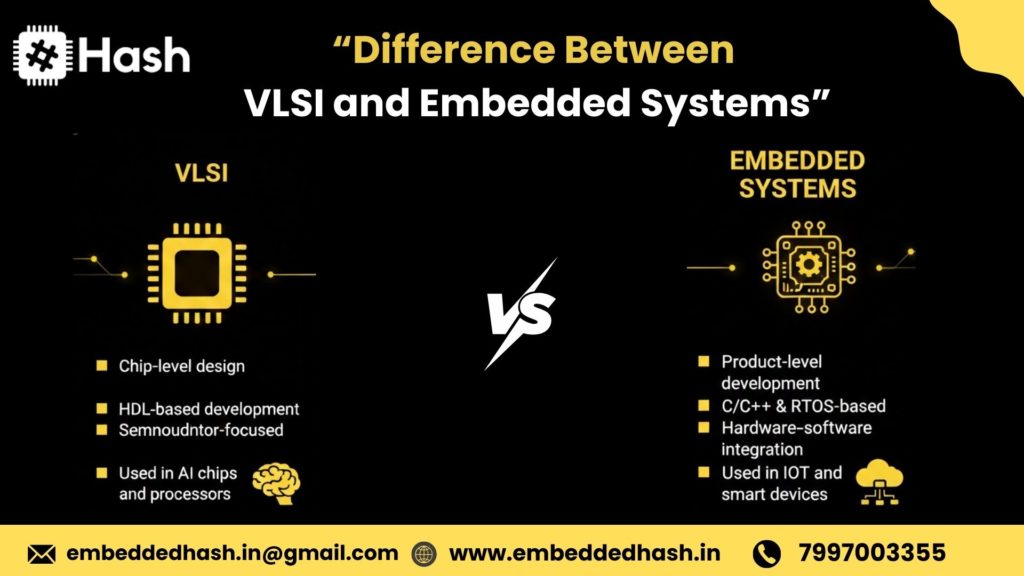
VLSI focuses on chip design and semiconductor fabrication, while Embedded Systems focuses on programming and integrating hardware with software inside real-world products.
What Is VLSI?
What Does VLSI Mean?
VLSI stands for Very Large Scale Integration.
In simple terms, VLSI is the technology used to design and place millions to billions of transistors on a single semiconductor chip.
Earlier, electronic circuits were built using separate components like resistors and transistors. With VLSI, all these components are integrated into one compact integrated circuit (IC). This is how modern processors, memory chips, and system-on-chips (SoCs) are made.
In 2026, VLSI plays a critical role in powering smartphones, AI processors, automotive ECUs, 5G devices, and high-performance computing systems. Almost every smart electronic product today depends on VLSI-designed chips.
What VLSI Engineers Do
VLSI engineers work on chip-level design, not on complete products like boards or devices. Their responsibilities are divided into specialized domains:
- RTL Design – Writing hardware description code (Verilog or VHDL) that defines how a chip should function.
- Verification & Validation – Testing and verifying chip logic to ensure it works correctly before manufacturing.
- Physical Design – Converting logical designs into physical layouts that can be fabricated on silicon.
- Timing & Power Analysis – Optimizing chip speed, power consumption, and thermal performance.
In India, VLSI roles are considered highly specialized and skill-intensive, requiring strong fundamentals in digital electronics and semiconductor concepts.
Where VLSI Is Used in India
India is rapidly becoming a global semiconductor design hub in 2026. VLSI engineers are in demand across:
- Semiconductor companies like Intel and Qualcomm with major design centers in Bangalore and Hyderabad.
- Chip design startups working on AI accelerators, EV chips, and RISC-V processors.
- Fabless design centers and manufacturing initiatives, including projects backed by Tata Electronics.
For Indian students and professionals, VLSI offers high-paying, future-oriented careers, especially as India pushes for semiconductor self-reliance.
What Is Embedded Systems?
Embedded systems are everywhere around us, even if we don’t notice them. From smartphones and washing machines to electric vehicles and medical equipment, embedded systems quietly control how these products work. In 2026, embedded systems form the foundation of modern electronics, especially in countries like India where manufacturing, EVs, and automation are growing fast.
For beginners, embedded systems may sound complex, but the idea is simple:
they are small computer systems designed to perform a specific task efficiently and reliably. Unlike general-purpose computers, embedded systems are optimized for performance, safety, and real-time response.
In India, embedded systems play a major role in sectors such as automotive, consumer electronics, healthcare, and industrial automation, creating strong career opportunities. Understanding what embedded systems are and how embedded engineers work is the first step for students planning a future-proof career in 2026 and beyond.
What Are Embedded Systems?
Embedded systems are dedicated computer systems built into a larger product to control specific functions. Unlike laptops or desktops, they are not meant for multiple tasks. Instead, they focus on one job and do it extremely well.
An embedded system typically combines hardware, firmware, and real-time software. The hardware includes microcontrollers or processors, sensors, and communication interfaces. Firmware is the low-level code that starts the system, and real-time software ensures the system responds within strict time limits.
For example, the control unit inside a car’s airbag system must respond in milliseconds. This is where embedded systems are essential.
In India, embedded systems are widely used in EV controllers, smart meters, medical monitors, and industrial machines. Organizations like ISRO and Indian manufacturing companies rely heavily on embedded systems for mission-critical applications.
What Embedded Engineers Do
Embedded engineers design, develop, and maintain embedded systems that interact directly with hardware. Their role sits between software engineering and electronics engineering, making it a highly skilled and valuable profession in 2026.
One of the core responsibilities is microcontroller programming, usually in C or C++. Engineers write efficient code that controls hardware like sensors, motors, and displays. They also work on driver development, which allows the software to communicate with hardware components.
Another important task is RTOS-based system design. In real-time systems, tasks must run within strict deadlines. Embedded engineers configure and optimize RTOS kernels to ensure predictable system behavior.
Hardware debugging is also a daily activity. Engineers use tools like oscilloscopes, logic analyzers, and debuggers to identify issues at both software and hardware levels. This hands-on debugging skill is something AI tools still cannot fully replace.
In India, embedded engineers work in automotive companies, electronics firms, startups, and defense organizations. Companies like Tata Motors and EV startups actively hire embedded talent for vehicle control systems, battery management, and infotainment platforms.
Where Embedded Systems Are Used in India
Embedded systems are deeply integrated into India’s growing technology ecosystem. One of the largest application areas is automotive and electric vehicles (EVs). Embedded controllers manage motor control, battery management systems (BMS), charging, and vehicle safety features.
In consumer electronics, embedded systems power smart TVs, washing machines, air conditioners, and wearable devices. Indian consumers increasingly demand smart and energy-efficient products, increasing embedded system adoption.
Medical devices are another critical area. Embedded systems are used in patient monitors, infusion pumps, diagnostic equipment, and portable health devices. Reliability and real-time performance are especially important here, making embedded engineering a trusted career path.
Industrial automation is rapidly expanding in India due to initiatives like smart factories and Industry 4.0. Embedded systems control PLCs, robotics, sensors, and automated production lines.
Cities such as Bangalore, Hyderabad, Chennai, and Pune have become major hubs for embedded system jobs. From MNCs to startups, demand for embedded engineers continues to grow, making embedded systems a stable and future-proof field in 2026.
Why VLSI and Embedded Systems Are Often Confused
Many students and beginners in India often confuse VLSI and Embedded Systems, especially in 2026 when both fields are growing rapidly. The confusion usually happens because both domains work closely with electronics, hardware, and chips, and both are part of the broader electronics and semiconductor ecosystem. From the outside, they may look similar, but in reality, they operate at very different levels of abstraction and responsibility.
Another reason for confusion is academic exposure. In many Indian engineering colleges, subjects like digital electronics, microprocessors, and basic VLSI concepts are taught together. As a result, learners assume that VLSI engineers and embedded engineers do the same type of work. However, the career paths, daily tasks, tools, and skills required are very different.
Understanding this difference is important for students who want to choose the right career path in 2026, especially with rising demand in EVs, IoT, semiconductor manufacturing, and embedded AI across cities like Bangalore, Hyderabad, and Chennai.
Common Misconceptions
One common misconception is that both VLSI and embedded systems deal with hardware, so they must be the same. While this is partially true, they work at different abstraction levels. VLSI focuses on chip-level design, whereas embedded systems focus on system-level application.
Another misunderstanding is that both need electronics basics, so the skillsets are identical. In reality, VLSI applies electronics at a transistor and logic gate level, while embedded systems apply electronics to control real-world devices like sensors, motors, and displays.
Key Conceptual Difference
The simplest way to understand the difference is this:
VLSI builds the chip, deciding how transistors and logic are designed inside silicon.
On the other hand, embedded systems use the chip to create practical products like smart meters, medical devices, automotive controllers, and IoT systems. This core difference defines everything—from tools and workflows to job roles and career growth in India in 2026.
How VLSI and Embedded Systems Differ
Aspect | VLSI | Embedded Systems |
Level of Work | Works at the silicon and IC design level, focusing on chip architecture and fabrication logic. | Works at the product and device level, integrating hardware with real-world applications. |
Programming Languages | Uses HDL languages such as Verilog and VHDL for circuit design and verification. | Uses C, Embedded C, and C++ for firmware development and hardware control. |
Hardware Interaction | Interaction with hardware is indirect and mostly simulation-based. | Direct interaction with hardware peripherals like sensors, motors, and controllers. |
Debugging Approach | Debugging is done through simulations, timing analysis, and waveform inspection. | Debugging is hardware-based using debuggers, logic analyzers, and oscilloscopes. |
Learning Curve | Steep learning curve due to complex design concepts and tools. | Moderate learning curve, easier for beginners to start and build projects. |
Job Openings in India | Limited openings but offers high-paying roles in niche semiconductor companies. | Abundant job opportunities across automotive, IoT, EV, and industrial sectors. |
“What is VLSI?”, “Why learn VLSI or Embedded Systems?”, and “How to learn them?”
Question | VLSI | Embedded Systems |
What is it? | Chip design technology focused on ICs and processors | Device-level system design using hardware + software |
Why learn it? | Access to high-end semiconductor and chip design careers | Strong demand across automotive, IoT, medical, and industrial sectors |
How to learn it? | Electronics fundamentals, HDL (Verilog/VHDL), EDA tools | Electronics basics, C programming, microcontrollers, RTOS |
Simple Explanation
VLSI (Very Large Scale Integration) is mainly about designing chips like processors, controllers, and SoCs.
Engineers work at the silicon level, focusing on logic design, timing, power, and performance.
In India, VLSI is popular because of the semiconductor push in 2026, especially in Bangalore and Hyderabad.
Embedded Systems, on the other hand, focuses on building complete working devices.
This includes writing firmware in C, interfacing sensors, controlling motors, and sometimes using an RTOS.
Embedded engineers are needed in EVs, smart appliances, medical devices, robotics, and IoT products.
India-Focused Insight (2026)
- VLSI suits students aiming for chip design roles in semiconductor companies and research labs.
- Embedded Systems is better for those who want broader job options, faster entry-level roles, and industry flexibility in India.
In short:
VLSI = chip-level depth
Embedded Systems = system-level breadth
Tools & Technologies You’ll Use (2026-Ready)
In 2026, both VLSI engineering and embedded systems engineering rely on modern, industry-grade tools.
Understanding these tools is critical for job readiness in India, especially for roles in Bangalore, Hyderabad, and Chennai.
This section explains the exact tools beginners and freshers are expected to know, written in simple terms.
VLSI Tools & Technologies (2026 Skill Stack)
VLSI engineers mainly work with hardware description languages and EDA tools to design and verify chips.
In India, companies in semiconductors, automotive ICs, and AI hardware expect strong fundamentals in these areas.
Verilog / SystemVerilog
Verilog and SystemVerilog are used to describe digital circuits at RTL level.
In 2026, SystemVerilog is preferred because it supports verification, assertions, and testbench design.
VHDL
VHDL is still used in defense, aerospace, and legacy semiconductor projects in India.
It is common in government and research organizations like ISRO-related vendors.
EDA Tools (Simulation & Synthesis)
EDA tools help convert HDL code into real silicon designs.
Engineers use them for simulation, synthesis, and verification, which are core VLSI job requirements.
Timing, Power & Physical Design Concepts
Modern chips must meet speed, power, and area constraints.
Knowledge of timing analysis and low-power design is essential for 2026 semiconductor roles.
Embedded Systems Tools & Technologies (Industry-Ready)
Embedded systems engineers design solutions where hardware and software seamlessly converge.
In India, embedded roles are growing fast in EVs, IoT, medical devices, and industrial automation.
Embedded C / C++
Embedded C is the foundation language for microcontroller programming.
C++ is increasingly used in automotive and complex embedded applications in 2026.
Microcontrollers (ARM, ESP, STM32)
Popular platforms include ARM-based MCUs, ESP controllers from Espressif Systems, and STM32 from STMicroelectronics.
These are widely used in Indian startups and MNC projects.
RTOS (FreeRTOS Concepts)
RTOS helps manage real-time tasks, scheduling, and interrupts.
In 2026, RTOS knowledge is critical for automotive and IoT embedded jobs.
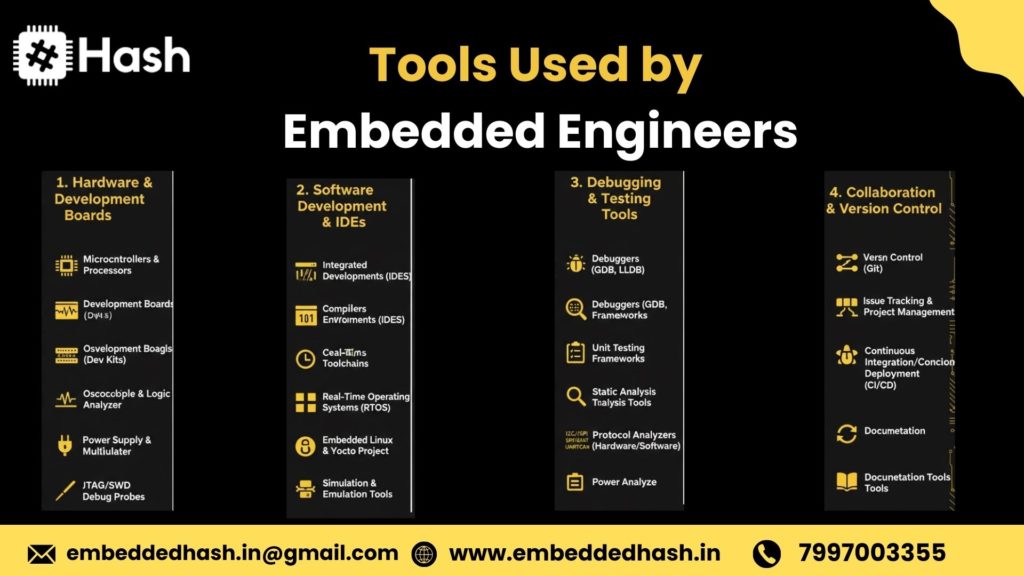
Debuggers, Oscilloscopes & Logic Analyzers
These tools help engineers find hardware-software issues.
Hands-on debugging skills are highly valued in Indian embedded interviews.
Communication Protocols (UART, SPI, I2C, CAN)
Protocols allow devices to talk to sensors, displays, and other controllers.
CAN is especially important for EV and automotive projects in India.
Career Scope in India (2026 Outlook)
In 2026, students searching for VLSI vs Embedded Systems career scope in India want one clear answer: Which field gives better jobs, faster entry, and long-term stability?
This section answers that exactly, using India-specific industry trends, hiring patterns, and future demand.
VLSI Career Scope in India (2026)
The VLSI career scope in India is strong but highly specialized in 2026.
VLSI roles focus on chip design, verification, physical design, and semiconductor manufacturing, which naturally creates a high entry barrier.
Most VLSI jobs require:
- Strong electronics fundamentals
- Advanced knowledge of digital design and semiconductor physics
- Hands-on experience with EDA tools
Because of this, fewer roles exist compared to embedded systems, but those roles are deeply specialized and high-value. Companies do not hire in bulk; they hire very selectively.
However, demand is rising due to India’s semiconductor push in 2026. Government-backed chip manufacturing, global fabs entering India, and increased chip design outsourcing have improved opportunities—especially in Bangalore, Hyderabad, and Noida.
For freshers, breaking into VLSI is harder without:
- A strong academic background
- Internships or industry projects
- Specialized VLSI training
That said, once inside, career growth is excellent. Salaries are high, roles are stable, and global exposure is common.
Embedded Systems Career Scope in India (2026)
The embedded systems career scope in India is wider, more flexible, and more beginner-friendly in 2026.
Unlike VLSI, embedded systems are used across multiple industries, which creates a large and continuous job market.
Embedded engineers are required in:
- Automotive and EV companies
- IoT and smart devices
- Industrial automation
- Medical electronics
- Consumer electronics
This wide usage makes faster entry possible for freshers. Many students start embedded careers with basic C programming, microcontrollers, and hands-on projects, without needing advanced degrees.
In terms of long-term stability, embedded systems remain strong because hardware-based products cannot run without firmware. Even in the AI era, embedded engineers are needed to:
- Integrate AI models on devices
- Optimize performance on limited hardware
- Ensure real-time and safety behavior
For users searching “Is embedded systems a safe career in India in 2026?”, the answer is clearly yes.
Which Is Better for You?
If you are a student or fresher in India (2026), choosing between VLSI vs Embedded Systems can feel confusing.
Both are strong career paths, but they suit very different personalities, learning styles, and career goals.
This section helps you decide what is better for you, not what is trending.
Choose VLSI If You:
You love semiconductor physics, electronics theory, and chip-level design.
VLSI is ideal if you enjoy subjects like CMOS, digital logic design, timing analysis, and fabrication concepts.
You are comfortable with a longer learning curve.
VLSI roles often require deeper academic understanding, tool expertise, and patience before landing your first role.
You are aiming for core hardware or semiconductor companies.
In India, VLSI opportunities are strong but competitive, usually concentrated in Bangalore, Hyderabad, and Noida.
This path suits students who prefer research-oriented, design-heavy, and highly specialized work.
If you are okay with fewer but high-value job openings, VLSI can be rewarding in the long term.
Choose Embedded Systems If You:
You enjoy coding combined with real hardware interaction.
Embedded systems is perfect if you like C programming, debugging boards, and seeing software run on real devices.
You want faster job entry after graduation.
In India, embedded roles are more widely available across startups, service companies, and product firms.
You prefer product-based, application-driven work.
Embedded engineers work on EVs, IoT devices, medical equipment, consumer electronics, and industrial systems.
This path is ideal if you want practical skills, quicker employability, and flexible career growth.
In 2026, embedded systems also blends well with AI, robotics, and edge computing
Conclusion — Will AI Replace Embedded Software Engineers?
Choosing between VLSI and Embedded Systems is not about which field is better — it’s about which layer of technology excites you and matches your long-term goals. In 2026, both domains are growing in India due to advancements in semiconductors, EVs, IoT, AI hardware, and smart manufacturing. What matters most is where you want to start and how you want to grow.
Embedded Systems clearly stands out for those who want faster entry, broader job roles, and flexibility across industries like automotive, consumer electronics, healthcare devices, and industrial automation. It also acts as a strong foundation for moving into AIoT, robotics, or embedded Linux later.
On the other hand, VLSI is a specialized and academically intensive domain. It is ideal for learners who are deeply interested in chip design, semiconductor physics, and core hardware engineering. With India’s push toward semiconductor manufacturing and fab investments, VLSI offers high-value but niche roles that demand patience, strong fundamentals, and long-term commitment.
Frequently Asked Questions
VLSI focuses on chip design and semiconductor fabrication.
Embedded systems focus on programming and controlling hardware using microcontrollers.
Embedded systems currently offer more entry-level jobs in India.
VLSI has fewer roles but strong demand for highly skilled engineers.
Yes, VLSI is generally harder due to complex electronics and physics concepts.
Embedded systems are more practical and easier for beginners to start with.
Yes, but it requires strong fundamentals in digital electronics and VLSI tools.
The transition is possible but needs structured re-skilling.
Yes, embedded systems remain a safe and future-proof career in 2026.
EVs, IoT, medical devices, and automation drive steady demand.
Yes, Hyderabad has strong VLSI scope due to semiconductor and chip design companies
VLSI usually pays more at senior and specialized levels.
Embedded systems offer steady salary growth with broader job availability.
Basic semiconductor knowledge is helpful but not mandatory.
Embedded engineers mainly focus on microcontrollers, firmware, and debugging.
Yes, freshers can learn VLSI without a master’s degree.
However, advanced roles prefer strong academic and tool-based expertise.
Both are good, but embedded systems offer faster job entry in Bangalore.
VLSI suits students targeting core semiconductor design roles.
Yes, basic coding is required in VLSI.
Languages like Verilog, SystemVerilog, and scripting tools are commonly used.
Yes, embedded systems are suitable for IT students.
Learning C programming and hardware basics helps bridge the gap easily.
Embedded systems have more job openings in Chennai.
The city has strong demand in automotive, industrial, and electronics sectors.
If you want to Learn more About Embedded Systems, join us at Embedded Hash for Demo Enroll Now


 embeddedhash.in@gmail.com