
What Is Embedded Systems Engineering?
Embedded Systems Engineering is the discipline of designing, building, and integrating hardware and software to create dedicated, task-specific computing systems. It combines microcontrollers, firmware, sensors, and real-time software to power devices such as medical equipment, cars, and IoT devices. It is among the fastest-growing engineering careers in India and worldwide.
Table of Contents
ToggleWhat Is Embedded Systems Engineering? A Complete Career and Technology Guide
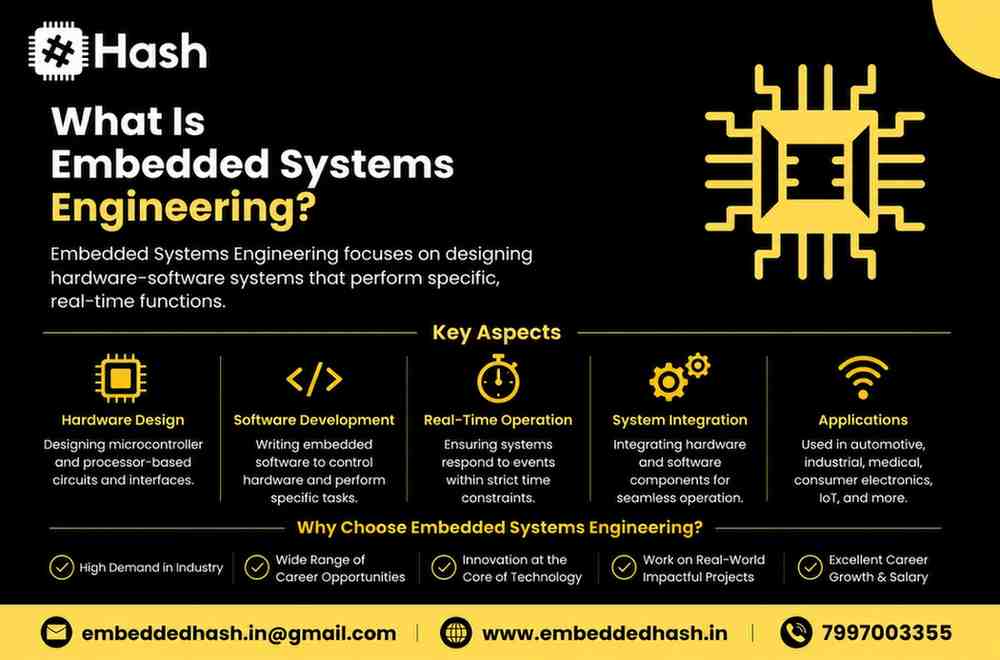
If you have ever wondered how your smartwatch tracks your heartbeat, how a car’s anti-lock braking system reacts in milliseconds, or how a washing machine knows exactly when to stop spinning, the answer lies in one discipline: embedded systems engineering. So, what is embedded systems engineering, exactly? In simple terms, it is the branch of engineering that designs dedicated computing systems built into larger devices to perform specific functions, rather than general-purpose computing tasks, as in a laptop or smartphone.
It’s important to separate two closely related terms: “embedded systems” and “embedded systems engineering.” An embedded system is the actual product — the microcontroller-based circuit board inside your microwave or car. Embedded systems engineering, on the other hand, is the entire engineering process — including hardware design, firmware development, software integration, testing, and deployment — that brings that embedded system to life. One is the outcome; the other is the discipline that creates it.
In today’s technology-driven world, almost every physical object around us is becoming “smart.” From connected refrigerators to autonomous vehicles, embedded systems engineering is the invisible backbone of modern automation, robotics, healthcare devices, and the Internet of Things (IoT). As industries race toward digital transformation, the demand for skilled embedded systems engineers has skyrocketed — both in India and globally.
India, in particular, has become a global hub for embedded systems development, thanks to its strong electronics and semiconductor ecosystem, government initiatives like “Make in India” and the Production Linked Incentive (PLI) scheme for semiconductors, and the presence of global tech giants setting up R&D centers in cities like Bengaluru, Hyderabad, and Pune. This has opened up enormous career opportunities for engineering graduates, electronics enthusiasts, and software developers who want to specialize in this hands-on, hardware-meets-software field.
In this comprehensive guide, we’ll break down everything you need to know — from the fundamentals and core components to skills, salaries, career paths, top hiring companies, certifications, and future trends. Whether you’re a student exploring career options or a professional looking to upskill, this guide will help you understand exactly what embedded systems engineering is and how to build a thriving career in it.
What Is Embedded Systems Engineering?
Embedded systems engineering is the field of engineering focused on designing, developing, and maintaining specialized computer systems that are embedded within larger mechanical or electrical systems to perform dedicated functions. Unlike general-purpose computers, embedded systems are built to do one job — or a small set of related jobs — extremely reliably and efficiently.
Core Concepts
At its core, embedded systems engineering revolves around the tight integration of hardware and software. A microcontroller or microprocessor acts as the “brain,” running firmware (low-level software) that controls sensors, actuators, and communication interfaces in real time. Engineers must think about constraints that don’t typically affect regular software development, such as limited memory, power consumption, real-time response requirements, and physical durability.
Objectives
The primary objectives of embedded systems engineering include:
- Building reliable, efficient, and cost-effective dedicated computing solutions
- Ensuring real-time or near-real-time performance for safety-critical applications
- Minimizing power consumption for battery-operated or energy-constrained devices
- Achieving seamless integration between hardware components and software logic
- Maintaining long-term stability, since embedded products often run for years without a reboot
Components of Embedded Systems Engineering
The discipline brings together several specialized areas:
- Hardware engineering — circuit design, PCB layout, component selection
- Firmware development — writing low-level code that directly controls hardware
- Software integration — connecting firmware with higher-level applications or cloud services
- Testing and validation — ensuring the system performs reliably under all conditions
- Embedded Hash and other specialized training providers play a growing role here, helping engineers gain the practical, project-based exposure that classroom theory alone cannot provide.
Hardware and Software Integration
What makes embedded systems engineering unique compared to other engineering fields is this hardware-software integration. An engineer doesn’t just write code or just design circuits — they must understand how the two interact. A poorly optimized piece of firmware can drain a battery in hours; a poorly designed circuit can make even the best-written code unreliable. This is why embedded engineers are often described as “full-stack” professionals of the physical world.
How Embedded Systems Engineering Works
Understanding how embedded systems engineering works requires looking at the full product development lifecycle, from concept to deployment.
Hardware Design
The process typically begins with hardware design — selecting the right microcontroller or microprocessor, designing the printed circuit board (PCB), choosing sensors and actuators, and planning power management. Engineers use tools like Altium Designer, Eagle, or KiCad to design schematics and PCB layouts.
Firmware Development
Once the hardware design is ready, engineers write firmware — the low-level code that directly controls the microcontroller’s registers, peripherals, and timing. This is usually done in Embedded C or C++, since these languages offer the speed and memory control that resource-constrained devices require.
Software Integration
Many modern embedded systems connect to the cloud, mobile apps, or larger networks. This stage involves integrating the firmware with higher-level software layers, communication protocols, and sometimes operating systems like Embedded Linux or a Real-Time Operating System (RTOS).
Testing and Validation
Embedded systems often operate in safety-critical environments — think pacemakers, airbags, or industrial machinery — so rigorous testing is essential. Engineers perform unit testing, hardware-in-the-loop (HIL) testing, stress testing, and compliance testing to ensure reliability under real-world conditions.
Deployment and Maintenance
Finally, the system is deployed into the product, whether that’s a car, a medical device, or a smart home gadget. Maintenance includes firmware updates (often over-the-air), bug fixes, and performance optimization throughout the product’s lifecycle.
Why Embedded Systems Engineering Is Important
Embedded systems engineering sits at the heart of nearly every technological advancement shaping our daily lives.
- Automation — Factories, warehouses, and even homes rely on embedded controllers to automate repetitive tasks with precision.
- Smart devices — Smartwatches, fitness trackers, and smart speakers all run on embedded systems.
- Consumer electronics — TVs, washing machines, air conditioners, and kitchen appliances depend on embedded controllers for “smart” features.
- Healthcare — Devices like insulin pumps, ECG monitors, and ventilators are powered by embedded systems engineered for precision and safety.
- Automotive — Modern vehicles contain dozens of embedded controllers managing everything from engine performance to infotainment and driver-assistance systems.
- Aerospace — Flight control systems, navigation, and communication equipment all rely on highly reliable embedded engineering.
- Industrial automation — Programmable logic controllers (PLCs) and industrial sensors use embedded technology to keep factories running smoothly.
- IoT — The entire Internet of Things ecosystem is built on embedded devices that sense, process, and transmit data.
Without embedded systems engineering, the connected, automated world we live in simply wouldn’t exist.
Applications of Embedded Systems Engineering
Embedded systems touch nearly every industry. Some of the most prominent applications include:
- Automotive systems — engine control units, ADAS (Advanced Driver Assistance Systems), infotainment systems
- Medical devices — patient monitors, diagnostic imaging equipment, wearable health trackers
- Consumer electronics — smart TVs, gaming consoles, home appliances
- Robotics — industrial robotic arms, service robots, autonomous drones
- Smart homes — smart thermostats, security cameras, voice-controlled assistants
- Telecommunications — routers, base stations, network switching equipment
- Industrial automation — PLCs, SCADA systems, factory robotics
- Aerospace — avionics, satellite systems, navigation equipment
- Defense — radar systems, communication equipment, surveillance devices
- Agriculture — precision farming sensors, irrigation controllers, drone-based crop monitoring
This sheer breadth of applications is exactly why embedded systems engineers are needed across virtually every industry sector.
Core Components of Embedded Systems Engineering
A solid embedded systems engineering foundation requires understanding the building blocks that make up every embedded product.
- Hardware — The physical circuitry, including the microcontroller, PCB, and connectors.
- Software — Application-level code that may run on top of an operating system.
- Firmware — Low-level code stored in non-volatile memory that directly interacts with hardware.
- Sensors — Components that detect physical phenomena like temperature, motion, or light and convert them into electrical signals.
- Actuators — Components that convert electrical signals into physical action, such as motors or relays.
- Communication protocols — Standards like UART, SPI, I2C, and CAN that allow components to exchange data.
- Memory — Includes RAM for temporary data and flash/ROM for storing firmware permanently.
- Power management — Circuitry and software techniques that regulate power consumption, critical for battery-powered devices.
Mastering these components is the first real step toward becoming a competent embedded systems engineer.
Skills Required for Embedded Systems Engineering
To succeed in this field, engineers need a blend of programming, electronics, and problem-solving skills:
- Embedded C — the foundational programming language for most embedded projects
- C++ — used for more complex, object-oriented embedded applications
- Python — increasingly used for scripting, automation, and prototyping
- Data structures — essential for writing efficient, memory-conscious code
- Electronics fundamentals — understanding circuits, voltage, current, and components
- Digital electronics — logic gates, flip-flops, and digital signal concepts
- Microcontrollers — hands-on knowledge of chips like 8051, AVR, PIC, and ARM-based MCUs
- ARM processors — the dominant architecture in modern embedded devices
- RTOS (Real-Time Operating Systems) — for managing multitasking in time-critical applications
- Linux — many embedded products run Embedded Linux, especially in IoT and networking devices
- Device drivers — writing software that allows the OS to communicate with hardware
- Debugging — using tools like JTAG, oscilloscopes, and logic analyzers to troubleshoot issues
- PCB basics — understanding how circuit boards are designed and laid out
Technologies Every Embedded Systems Engineer Should Learn
Beyond core skills, staying current with evolving technologies is essential:
- Embedded C and C++ for firmware development
- Python for scripting and test automation
- ARM Cortex processors, the industry standard for modern microcontrollers
- STM32 development boards, widely used in industry and prototyping
- Arduino for beginner-friendly hardware experimentation
- Raspberry Pi for Linux-based embedded projects
- RTOS platforms like FreeRTOS and Zephyr
- Linux for embedded operating system development
- IoT protocols and cloud connectivity (MQTT, HTTP, CoAP)
- CAN protocol, dominant in the automotive industry
- SPI, I2C, UART communication interfaces
- VLSI for chip-level design knowledge
- Robotics frameworks and control systems
- Edge computing for processing data closer to the source
- Artificial Intelligence and Machine Learning at the edge (TinyML)
- Automotive embedded systems, including AUTOSAR architecture.
Roles and Responsibilities of an Embedded Systems Engineer
A typical day for an embedded systems engineer might include:
- Designing embedded hardware schematics and selecting components
- Writing and optimizing firmware in C or C++
- Developing and testing device drivers
- Debugging hardware-software interaction issues using lab equipment
- Optimizing code for performance, memory usage, and power efficiency
- Conducting system-level and unit testing
- Documenting designs, code, and test results for compliance and team collaboration
- Supporting product maintenance, including firmware updates and field issue resolution
These responsibilities require a balance of analytical thinking, patience for debugging, and strong attention to detail.
Career Opportunities in Embedded Systems Engineering
The field offers a wide variety of specialized career paths, including:
- Embedded Software Engineer — develops application-level embedded code
- Firmware Engineer — focuses on low-level hardware-control code.
- Embedded Linux Engineer — specializes in Linux-based embedded systems
- IoT Engineer — builds connected, sensor-driven devices.
- Robotics Engineer — develops control systems for robots and automation.
- Automotive Embedded Engineer — works on vehicle electronics and ADAS.
- BSP (Board Support Package) Engineer — bridges hardware and operating systems
- Device Driver Engineer — writes drivers that connect hardware to software.
- FPGA Engineer — designs programmable hardware logic
- Validation Engineer — tests and certifies embedded products before release
Industries Hiring Embedded Systems Engineers
Embedded systems engineers are in demand across nearly every technical industry:
- Automotive
- Healthcare
- Aerospace
- Semiconductor
- Consumer electronics
- Industrial automation
- Defense
- Telecommunications
- Energy
- Robotics
This cross-industry demand is one of the biggest advantages of choosing embedded systems engineering as a career — it offers flexibility to work in sectors ranging from medical technology to space exploration.
Top Companies Hiring Embedded Systems Engineers in India
Some of the leading companies actively hiring embedded systems engineers in India include:
- Qualcomm
- Intel
- NVIDIA
- Texas Instruments
- Bosch
- Tata Elxsi
- HCLTech
- Wipro
- Infosys
- TCS
- Honeywell
- Siemens
- Continental
- Samsung
- LG
- NXP
- STMicroelectronics
- AMD
- Analog Devices
These companies span semiconductor design, automotive electronics, consumer technology, and industrial automation — reflecting just how broad the embedded job market really is.
Embedded Systems Engineering Salary in India
Salaries vary based on experience, specialization, and company, but here’s a general overview:
Fresher (0–2 Years)
₹3.5 LPA – ₹6 LPA
Mid-Level (3–5 Years)
₹6 LPA – ₹12 LPA
Senior (6–10 Years)
₹12 LPA – ₹22 LPA
Lead/Architect (10+ Years)
₹22 LPA – ₹40+ LPA
Note: Figures are indicative averages and can vary based on company, location, and specific technical specialization such as automotive embedded systems or semiconductor design.
Embedded Systems Engineering Career Path
A typical career roadmap looks like this:
Beginner
Embedded C, basic electronics, Arduino, digital logic
Trainee/Intern, Junior Embedded Developer
Intermediate
ARM microcontrollers, RTOS, communication protocols, debugging
Embedded Software Engineer, Firmware Engineer
Advanced
Embedded Linux, device drivers, BSP development, IoT integration
Senior Embedded Engineer, IoT Engineer, BSP Engineer
Expert
System architecture, AUTOSAR, FPGA, AI at the edge
Embedded Architect, Technical Lead, Engineering Manager
Embedded Systems Engineer Comparison
Embedded Systems Engineer vs Software Engineer
Skills
Hardware + low-level programming
High-level programming, app/web development
Responsibilities
Firmware, hardware-software integration
Application logic, UI/UX, backend systems
Languages
C, C++, Embedded C
Java, Python, JavaScript, etc.
Hardware Knowledge
Essential
Generally not required
Career Growth
Steady, specialized
Broad, fast-evolving
Salary
Competitive, grows with niche expertise
Often higher in pure software/IT roles initially
Industries
Automotive, healthcare, electronics
IT, SaaS, web/mobile apps
Embedded Systems Engineer vs IoT Engineer
Skills
Firmware, hardware design, RTOS
Connectivity protocols, cloud integration, embedded basics
Responsibilities
Device-level design and control
End-to-end connected system design
Languages
C, C++
C, C++, Python, cloud SDKs
Hardware Knowledge
Deep
Moderate
Career Growth
Hardware-focused specialization
Cross-domain (hardware + cloud) growth
Salary
Comparable
Often slightly higher due to cloud skill premium
Industries
Broad (automotive, medical, industrial)
Smart homes, smart cities, industrial IoT
Embedded Systems Engineer vs Electronics Engineer
Skills
Hardware + firmware programming
Circuit design, analog/digital electronics
Responsibilities
Software-hardware integration
Component-level circuit design
Languages
C, C++, Python
Minimal programming, hardware-focused
Hardware Knowledge
Applied, system-level
Deep, component-level
Career Growth
Strong in tech/product companies
Strong in core electronics/manufacturing
Salary
Generally higher due to software premium
Competitive in core sectors
Industries
Tech, automotive, IoT
Manufacturing, power, telecom hardware
Certifications That Boost Embedded Systems Engineering Careers
Relevant certifications can strengthen your resume and validate your skills:
- ARM Certification — validates expertise in ARM Cortex-based development
- Embedded C Certification — demonstrates strong firmware programming skills.
- RTOS Certification — proves capability in real-time system design
- IoT Certification — shows proficiency in connected device development.
- Linux Certification — validates Embedded Linux and OS-level knowledge
- Python Certification — useful for scripting, automation, and AI integration
- Embedded Systems Certification Programs — comprehensive programs, such as those offered by Embedded Hash, that combine multiple skill areas into a structured, project-based curriculum
Future Trends in Embedded Systems Engineering
The embedded systems landscape is evolving rapidly, driven by several converging technology trends:
- AI-powered embedded systems — bringing machine learning models directly onto microcontrollers (TinyML)
- Edge computing — processing data locally instead of relying solely on the cloud, reducing latency
- IoT expansion — billions of new connected devices are expected globally over the coming years
- Industry 4.0 — smart factories using embedded sensors and automation for real-time decision-making
- Autonomous vehicles — increasing reliance on embedded systems for sensor fusion, navigation, and control.
- Robotics — growing use of embedded controllers in service and industrial robots
- 5G integration — enabling faster, more reliable connectivity for embedded and IoT devices
- Smart manufacturing — predictive maintenance and automated quality control powered by embedded sensors
- Medical embedded devices — growth in wearable health monitors and remote patient monitoring systems
- Cybersecurity for embedded systems — increasing focus on securing connected devices against cyber threats.
India’s semiconductor and electronics manufacturing push, supported by government incentives, is expected to significantly increase demand for embedded talent over the next decade, making this an excellent time to enter the field.
Why Embedded Systems Engineering Is One of the Best IT and Electronics Careers in India
Several factors make embedded systems engineering a standout career choice:
- High demand — nearly every industry now requires embedded expertise
- Excellent salary potential — especially for engineers with specialized skills like automotive embedded systems or RTOS
- Global opportunities — embedded skills are transferable across countries and industries.
- Future-proof career — automation and IoT growth ensure long-term relevance.
- Innovation-driven field — engineers get to work on cutting-edge technology like AI-powered devices and autonomous systems.
- Dual-industry access — professionals can work in both core electronics and IT/software sectors, unlike many other engineering specializations.
How to Start a Career in Embedded Systems Engineering
If you’re ready to get started, follow this step-by-step roadmap:
- Learn electronics fundamentals — understand circuits, components, and basic digital logic.
- Master Embedded C — the foundation language for nearly all embedded projects
- Learn C++ — for more advanced, structured embedded applications.
- Learn Python — useful for scripting, testing, and automation tasks.
- Practice with Arduino and STM32 — get hands-on experience with real hardware
- Learn ARM processors — since most modern microcontrollers are ARM-based
- Study RTOS — understand real-time task scheduling and multitasking
- Build projects — create a home automation system, a robotic arm, or an IoT weather station.
- Create a portfolio — document your projects on GitHub or a personal website.
- Earn certifications — consider structured programs like those offered by Embedded Hash.
- Apply for internships — gain real industry exposure.
- Prepare for interviews — practice technical questions on C programming, microcontrollers, and debugging scenarios.
Key Takeaways
- Embedded systems engineering is the discipline of designing dedicated hardware-software systems for specific tasks, distinct from the embedded systems (products) themselves.
- It powers critical industries including automotive, healthcare, aerospace, consumer electronics, and IoT.
- Core skills include Embedded C, C++, Python, microcontrollers, ARM processors, RTOS, and Linux.
- Career opportunities range from firmware engineering to IoT, robotics, and embedded Linux roles, with strong salary growth potential in India.
- Future trends like AI at the edge, 5G, and Industry 4.0 are set to drive continued demand for skilled embedded systems engineers.
Why Learn Embedded Systems Engineering with Embedded Hash
Choosing the right training partner can make all the difference in launching a successful embedded systems career. Embedded Hash offers:
- Industry-oriented training designed around real hiring requirements
- Real-time projects that mirror what professionals build on the job
- Placement assistance to help learners transition smoothly into the industry
- Experienced trainers with hands-on embedded systems backgrounds
- Hands-on practical learning rather than purely theoretical instruction
- Career guidance tailored to individual strengths and goals
- Interview preparation covering technical and HR rounds
- Industry-relevant curriculum that stays updated with evolving technologies like RTOS, IoT, and ARM-based development
For learners asking what embedded systems engineering looks like in practice, Embedded Hash provides a structured path from fundamentals to job-ready skills.
Frequently Asked Questions
- What is Embedded Systems Engineering? Embedded systems engineering is the engineering discipline focused on designing, developing, and integrating dedicated hardware-software systems that perform specific functions within larger devices, such as cars, medical equipment, or smart appliances.
- Is Embedded Systems Engineering a good career in India? Yes. With India’s growing electronics, automotive, and semiconductor industries, embedded systems engineering offers strong job security, competitive salaries, and long-term career growth.
- What does an Embedded Systems Engineer do? An embedded systems engineer designs hardware, writes firmware, integrates software, tests devices, and maintains embedded products throughout their lifecycle.
- What is the salary of an Embedded Systems Engineer? Salaries in India typically range from ₹3.5 LPA for freshers to over ₹22 LPA for senior professionals, depending on experience and specialization.
- Which companies hire Embedded Engineers? Companies like Qualcomm, Intel, Bosch, Texas Instruments, Tata Elxsi, and Continental regularly hire embedded systems engineers across India.
- What skills are required for Embedded Systems Engineering? Key skills include Embedded C, C++, Python, microcontrollers, ARM processors, RTOS, Linux, and debugging tools.
- Is Embedded Systems Engineering better than Software Engineering? Neither is inherently “better” — they serve different purposes. Embedded systems engineering focuses on hardware-software integration, while software engineering focuses on application-level development. The right choice depends on your interests and career goals.
- Do ECE students have good opportunities in Embedded Systems Engineering? Yes. Electronics and Communication Engineering (ECE) graduates are particularly well-suited for embedded systems roles due to their strong foundation in electronics and digital systems.
- Which certification is best for Embedded Systems Engineering? Certifications in ARM, Embedded C, RTOS, and structured embedded systems programs, such as those from Embedded Hash, are highly valued by employers.
- How do I start learning Embedded Systems Engineering? Start with electronics fundamentals and Embedded C, then progress to microcontrollers, ARM processors, and RTOS while building hands-on projects to strengthen your practical skills.
Conclusion
So, what is embedded systems engineering? It’s the discipline that quietly powers the modern world — from the car you drive to the medical devices that keep people healthy, and the smart gadgets that make everyday life more convenient. As automation, IoT, and AI continue to expand, the demand for skilled embedded systems engineers in India and globally will only keep growing.
If you’re passionate about both hardware and software and want a career that’s hands-on, innovative, and future-proof, embedded systems engineering is one of the most rewarding paths you can choose. The journey starts with mastering the fundamentals — electronics, Embedded C, microcontrollers, and real-time systems — and building real projects that showcase your skills.
Ready to turn your interest into a career? Start learning embedded systems engineering with Embedded Hash today and take the first step toward becoming a job-ready embedded systems engineer.


 embeddedhash.in@gmail.com