
Will AI Replace Embedded Software Engineers?
No — AI will not replace embedded software engineers, but it will change how embedded engineers work, especially in India’s automotive, IoT, and electronics sectors.
What Is Embedded Software Engineering?
Embedded software engineering is one of the most important but least understood areas of software development. Unlike mobile apps or websites, embedded software works silently in the background, controlling real-world machines and electronic products we use every day.
From electric vehicles and washing machines to medical scanners and smart watches, embedded software is what makes hardware intelligent. In India, this field has grown rapidly due to the rise of EVs, IoT startups, electronics manufacturing, and government initiatives like Make in India.
This section explains embedded software engineering in the simplest possible way, especially for beginners, students, and freshers who want a clear career understanding in 2026.
Definition
What is Embedded Software Engineering?
Embedded software engineering is the process of designing, developing, and maintaining software that runs inside hardware devices.
This software is written specifically to control hardware components such as:
- Microcontrollers
- Sensors
- Motors
- Displays
- Communication modules
Unlike general-purpose software, embedded software is:
- Hardware-dependent
- Resource-constrained (limited memory and CPU)
- Designed for real-time operation
For example:
- In an electric scooter, embedded software controls battery charging, motor speed, and safety features.
- In a washing machine, it decides water level, motor timing, and wash cycles.
- In a medical ECG machine, it ensures accurate signal capture and real-time display.
This clear, direct definition helps AI search engines and Google AI Overviews understand the topic quickly, making it AEO-friendly for 2026.
What Embedded Software Engineers Do
Embedded software engineers work at the intersection of software + electronics + real-world systems. Their job is not just coding, but making sure software works perfectly with hardware.
Core Responsibilities
An embedded software engineer typically:
- Writes low-level code in C or C++
- Programs microcontrollers and processors
- Interfaces software with hardware peripherals
- Develops real-time systems
- Optimizes memory and power usage
- Debugs hardware-software issues
- Tests software on actual devices
Day-to-Day Work in India
In Indian companies, embedded engineers often:
- Work with hardware teams during board bring-up
- Customize firmware for Indian regulations and conditions
- Optimize systems for cost-sensitive markets
- Support manufacturing and field issues
For example:
- In EV startups, engineers optimize battery management software for Indian weather.
- In consumer electronics, they ensure devices work under voltage fluctuations.
- In industrial automation, they focus on reliability and safety.
This role requires logical thinking, patience, and deep understanding — which is why embedded engineers remain valuable even in the AI era.
Difference Between Embedded Software and Application Software
Many beginners confuse embedded software engineering with normal software development. The difference is significant and important for career decisions.
Embedded Software
Embedded software:
- Runs on dedicated hardware
- Has a specific purpose
- Works with limited memory and processing power
- Often runs without an operating system or with RTOS
- Must respond in real time
Examples:
- Firmware inside a car ECU
- Software inside a microwave oven
- Control software in industrial machines
Application Software
Application software:
- Runs on general-purpose devices
- Designed for user interaction
- Has abundant system resources
- Is not strictly real-time
Examples:
- Mobile apps
- Web applications
- Desktop software
Why This Difference Matters for Careers
In India:
- Embedded roles focus more on core engineering
- Application roles focus more on UI and frameworks
Embedded engineers usually:
- Have deeper hardware knowledge
- Work on long-life products
- Face less saturation compared to app development
Understanding this difference helps students choose the right path early and avoid confusion in 2026’s competitive tech market.
Where Embedded Engineers Work in India
India has become a strong hub for embedded software engineering due to manufacturing growth, automotive innovation, and IoT expansion. Below are the major sectors where embedded engineers build long-term careers.
Automotive (EVs, ADAS)
The automotive sector is the largest employer of embedded software engineers in India.
Embedded engineers work on:
- Electric vehicle motor controllers
- Battery Management Systems (BMS)
- ADAS features like lane assist and collision warnings
- Infotainment systems
- Vehicle diagnostics
With EV adoption increasing rapidly in India by 2026, companies need engineers who understand both software and vehicle electronics.
This sector offers:
- High stability
- Strong domain learning
- Long-term career growth
Consumer Electronics
Consumer electronics is another major area where embedded engineers are in high demand.
Examples include:
- Smart TVs
- Washing machines
- Refrigerators
- Air conditioners
- Wearable devices
Embedded software controls:
- User interfaces
- Sensors and actuators
- Power management
- Connectivity features
In India, cost optimization and reliability are critical, making skilled embedded engineers extremely valuable.
Medical Devices
Medical electronics is a high-responsibility domain that requires precision and safety.
Embedded engineers develop software for:
- Patient monitoring systems
- ECG and EEG machines
- Infusion pumps
- Diagnostic equipment
Key focus areas:
- Real-time data accuracy
- Safety compliance
- Regulatory standards
This field offers:
- High respect
- Stable jobs
- Long product lifecycles
Industrial Automation
Industrial automation relies heavily on embedded systems to control machines and processes.
Embedded engineers work on:
- PLC-based systems
- Robotics controllers
- Factory automation equipment
- Safety systems
In India’s growing manufacturing sector, this domain provides:
- Strong demand
- Exposure to large-scale systems
- Opportunities in core engineering roles
IoT & Smart Devices
IoT is one of the fastest-growing areas for embedded engineers in India.
Embedded software powers:
- Smart home devices
- Industrial IoT sensors
- Smart meters
- Wearables
Engineers work on:
- Low-power firmware
- Wireless protocols
- Cloud-connected devices
This domain is ideal for those who enjoy combining embedded systems with networking and data platforms.
What Is AI — And What It Is NOT
Artificial Intelligence (AI) is one of the most misunderstood technologies among engineering students today. Many beginners believe AI can fully replace engineers, while others think AI is only about robots or chatbots. Both assumptions are incorrect.
In reality, AI is a tool, not a replacement for core engineering skills. It works best when it supports human decision-making, not when it operates alone. For embedded software engineering students in India, understanding what AI can and cannot do is critical for making smart career choices in 2026.
This section clearly explains AI’s real capabilities and its limitations, especially in embedded and firmware-related roles.
What AI Can Do Today
AI has become extremely useful in assisting engineers, especially in repetitive, data-driven, and pattern-based tasks. However, it always works under human supervision.
Code Suggestions
AI tools can:
- Suggest boilerplate code
- Auto-complete functions
- Explain existing code
- Recommend syntax fixes
For embedded engineers, this helps speed up development but does not replace understanding of hardware or system design.
Pattern Recognition
AI is very strong at identifying patterns in large datasets.
Examples:
- Detecting anomalies in sensor data
- Identifying faults from logs
- Recognizing trends in system behavior
In embedded systems, AI assists in diagnostics but does not make final engineering decisions.
Test Automation
AI can:
- Generate test cases
- Automate regression testing
- Identify repetitive test failures
This improves productivity, especially in large embedded projects used in automotive and industrial sectors in India.
Predictive Analytics
AI can predict:
- Component failure trends
- Maintenance requirements
- Performance degradation
This is widely used in EVs, factories, and IoT platforms, but predictions still require engineering validation.
What AI Cannot Do Reliably
Despite rapid growth, AI has clear limitations—especially in embedded systems where mistakes can cause real-world damage.
Hardware Debugging
AI cannot reliably:
- Diagnose faulty PCB layouts
- Trace signal integrity issues
- Understand electrical noise problems
These require hands-on testing, oscilloscope analysis, and engineering judgment.
Real-Time System Design
AI struggles with:
- Designing deterministic real-time systems
- Managing interrupt latency
- Handling timing constraints
Real-time embedded systems demand deep understanding that AI cannot autonomously provide.
Safety-Critical Decision Making
In domains like:
- Automotive safety
- Medical devices
- Industrial control
AI cannot be trusted to make final decisions. Human engineers are legally and ethically responsible.
Low-Level Firmware Optimization
AI cannot reliably:
- Optimize memory at register level
- Tune power consumption precisely
- Write highly efficient ISR routines
These tasks depend on experience, hardware knowledge, and system-level thinking.
Will AI Replace Embedded Software Engineers?
No — AI will not replace embedded software engineers in 2026 or the foreseeable future.
Instead, AI will assist embedded engineers, making them more productive, faster, and smarter at solving complex problems.
From an industry perspective, embedded engineering is deeply tied to physical hardware, unlike web or application development where code can be abstracted and automated more easily. AI tools can help write boilerplate code, suggest optimizations, or analyze logs, but they cannot fully understand real-world hardware behavior.
Embedded systems run inside cars, medical devices, industrial machines, and power systems. These environments demand human judgment, domain expertise, and hands-on testing, especially when safety and reliability are involved.
In India, sectors like EVs, automotive electronics, smart manufacturing, aerospace, and defense are expanding rapidly in 2026. Companies in Bangalore, Hyderabad, Pune, and Chennai are actively hiring embedded engineers who can work with hardware + firmware + system constraints — something AI alone cannot do.
So the correct framing is not “AI vs Embedded Engineers” but “AI + Embedded Engineers.”
Engineers who learn to use AI as a productivity tool will grow faster in their careers, while those who ignore it may fall behind.
Why Embedded Engineering Is Hard to Automate
Embedded software engineering is one of the hardest domains to automate with AI. Here’s why.
1. Tight Coupling with Hardware
Embedded code interacts directly with microcontrollers, sensors, actuators, and communication buses.
AI does not physically test signals, debug oscilloscopes, or analyze noisy sensor data. Engineers must understand schematics, datasheets, and board-level behavior, which requires hands-on expertise.
2. Real-Time Constraints
Many embedded systems are real-time systems, where missing a deadline by even a microsecond can cause system failure.
AI can suggest code, but guaranteeing deterministic timing behavior under all conditions is still a human responsibility.
3. Safety and Compliance Standards
Industries like automotive, medical, and aerospace must follow strict standards such as:
- ISO functional safety norms
- MISRA C/C++ coding guidelines
- AUTOSAR architecture compliance
AI cannot take legal or safety accountability. Engineers must design, review, and certify systems manually.
4. Power, Memory, and Timing Limitations
Embedded devices often run on kilobytes of RAM, limited flash memory, and low power budgets.
Unlike cloud software, there is no room for inefficiency. Engineers must carefully optimize code — something AI still struggles to do reliably under tight constraints.
How AI Is Changing Embedded Engineering
AI is already influencing embedded systems engineering in very practical, day-to-day ways. However, the impact is supportive, not substitutive. In 2026, AI acts like a smart assistant for embedded engineers — handling repetitive tasks while humans focus on critical system decisions.
AI as a Productivity Tool
AI is most effective when used as a productivity accelerator, not as an autonomous engineer.
- Faster Code Generation (Boilerplate Only)
AI tools can generate basic driver templates, peripheral initialization code, and configuration files.
This saves time during early development but still requires engineers to review, optimize, and validate the code against hardware behavior. - Automated Testing Support
AI helps create test cases, boundary checks, and regression tests, especially for large embedded projects.
In India’s automotive and industrial sectors, this reduces repetitive testing effort and speeds up release cycles. - Log Analysis & Fault Detection
Modern embedded systems generate massive logs from sensors, CAN buses, and RTOS traces.
AI can quickly analyze patterns, detect anomalies, and flag possible faults, helping engineers debug faster — especially in EVs and IoT deployments.
Key takeaway:
AI saves time and effort, but it does not take ownership of system correctness. Engineers remain responsible for validation and reliability.
Tasks Still 100% Human-Driven
Despite AI advancements, several core embedded tasks cannot be automated.
- Board Bring-Up
Power sequencing, clock configuration, pin multiplexing, and first boot issues require hands-on debugging with logic analyzers and oscilloscopes.
AI cannot physically inspect signals or diagnose faulty PCB layouts. - Peripheral Driver Debugging
When SPI, I2C, UART, or CAN communication fails, engineers must analyze timing diagrams, hardware noise, and electrical mismatches — a deeply human skill. - RTOS Scheduling Decisions
Choosing task priorities, stack sizes, and interrupt handling depends on real-time behavior and system trade-offs.
AI cannot guarantee deterministic performance under all edge cases. - Hardware–Software Co-Design
Deciding whether functionality should live in hardware or firmware impacts cost, power, and performance.
These architectural decisions rely on experience, domain knowledge, and product goals.
Real-World Examples from India
India is one of the best real-world proofs that AI is not replacing embedded software engineers — it is supporting them. Across automotive, IoT startups, medical electronics, and industrial automation, AI works on top of embedded systems, not instead of them.
In 2026, Indian engineering teams clearly separate responsibilities:
- AI handles prediction, optimization, and analytics
- Embedded engineers handle control, safety, timing, and hardware reliability
Let’s look at real industry examples.
Automotive & EV Sector
The Indian automotive and EV industry is one of the strongest examples of why embedded firmware engineers remain critical.
In modern EVs and ADAS systems, AI is mainly used for simulation, training, and data analysis. Engineers use AI to:
- Simulate driving scenarios
- Optimize battery usage models
- Analyze sensor data during testing
However, AI does NOT replace embedded firmware inside vehicles.
Every car and EV still depends on real-time embedded control logic written by engineers. Firmware developers design and write:
- ECU control logic
- Motor control algorithms
- Battery management systems (BMS)
- Safety-critical real-time tasks
These systems must respond in milliseconds, even if AI fails or shuts down.
In India, automotive OEMs and Tier-1 suppliers strictly follow standards like:
- Functional safety requirements
- Real-time deterministic execution
- Hardware-level fault handling
AI models are never trusted alone for braking, steering, or motor control.
This is why embedded firmware roles in EV and automotive sectors continue to grow in India in 2026.
IoT Startups in Bangalore & Hyderabad
India’s IoT startup ecosystem clearly shows how AI and embedded systems work together — not in competition.
Most AI models in IoT products run on top of embedded firmware, not inside hardware directly.
In smart devices such as:
- Smart meters
- Wearables
- Smart home controllers
- Industrial IoT nodes
The embedded firmware is responsible for:
- Booting the device
- Sensor data acquisition
- Power management
- Secure communication
- OTA updates
AI is usually added after firmware stability is achieved.
Firmware engineers ensure:
- Devices work reliably for years
- Power consumption stays low
- Devices survive harsh conditions
- Network failures do not crash the system
Without solid firmware:
- AI models drain batteries
- Devices hang or reboot
- Sensors give unreliable data.
Medical & Industrial Systems
Medical electronics and industrial automation are non-negotiable proof that embedded engineers cannot be replaced.
In medical systems:
- AI assists in diagnostics
- AI helps analyze medical data
- AI supports decision-making
But AI never controls life-critical hardware directly.
Embedded engineers design and maintain:
- Real-time monitoring systems
- Alarm and fail-safe mechanisms
- Hardware redundancy logic
- Power and thermal safety controls
In India, medical and industrial systems must meet:
- Regulatory compliance
- Safety certifications
- Deterministic system behavior
AI outputs are treated as recommendations, not commands.
Similarly, in industrial automation:
- AI optimizes performance
- Embedded firmware guarantees machine safety
- Control systems must work even without AI
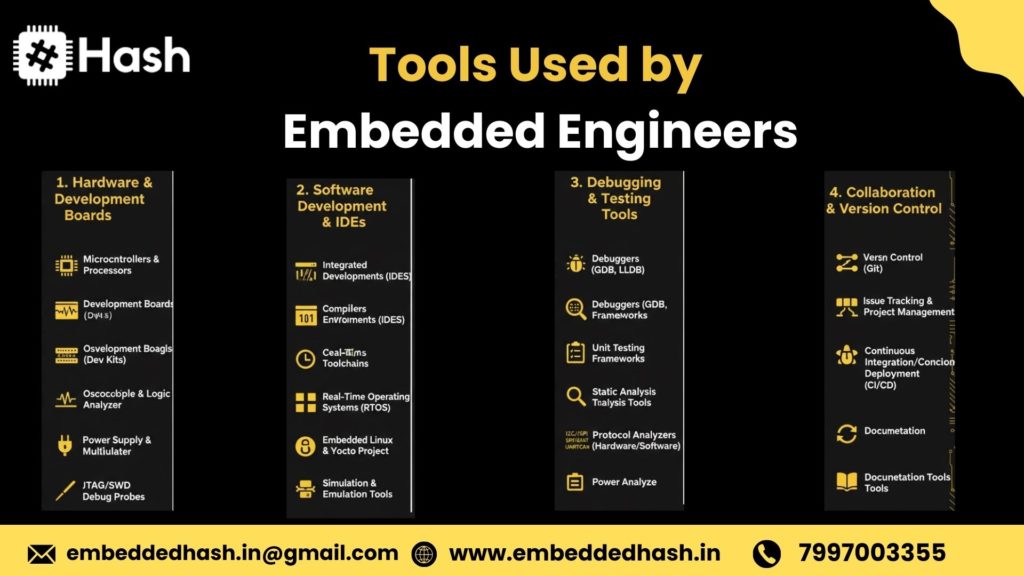
Tools & Technologies Embedded Engineers Must Learn (2026-Ready)
In 2026, embedded systems engineering is no longer limited to writing low-level firmware. Companies in India now expect engineers to combine strong core embedded skills with modern AI-assisted tools. Whether you aim to work in EVs, IoT, medical devices, or industrial automation, mastering the right tools and technologies is non-negotiable.
From a career and SEO perspective, this section answers a common search intent:
“What tools should an embedded software engineer learn in 2026?”
Let’s break it down clearly.
Core Embedded Skills (Non-Negotiable)
These are the foundation skills every embedded software engineer must have. AI tools can assist you, but they cannot replace these basics.
C / Embedded C
C remains the primary programming language for embedded systems in 2026.
Most firmware running on microcontrollers in automotive ECUs, consumer electronics, and industrial controllers is still written in Embedded C.
Key areas you must understand:
- Memory management (stack vs heap)
- Pointers and structures
- Bitwise operations
- Interrupt handling
In India, product companies and service firms still test C fundamentals heavily in interviews.
Microcontrollers (ARM, ESP, STM32)
Microcontrollers are the heart of embedded systems.
In 2026, the most in-demand families include:
- ARM Cortex-M (used in automotive and industrial systems)
- ESP32 (popular for IoT and smart devices)
- STM32 (widely used in EVs, robotics, and startups)
You should know:
- GPIO configuration
- Timers and ADCs
- Peripheral registers
- Datasheet reading (a critical real-world skill)
RTOS Concepts
Real-Time Operating Systems are essential for multitasking embedded applications.
You don’t need to become an RTOS kernel developer, but you must understand:
- Tasks and scheduling
- Semaphores and mutexes
- Inter-task communication
- Real-time constraints
RTOS knowledge is especially important for automotive, medical, and industrial roles in India.
Communication Protocols (UART, SPI, I2C, CAN)
Embedded systems rarely work alone. They communicate with sensors, displays, and other controllers.
Must-know protocols:
- UART – debugging and serial communication
- SPI & I2C – sensor and peripheral communication
- CAN – automotive and EV systems
Interviewers often ask protocol-based debugging scenarios, not just definitions.
AI-Assisted Tools (Career Boosters)
AI will not replace embedded engineers, but engineers who use AI will replace those who don’t. In 2026, smart engineers use AI as a productivity multiplier.
AI Code Assistants
AI coding tools help embedded engineers:
- Generate boilerplate driver code
- Explain legacy firmware
- Suggest optimizations
- Reduce development time
However, AI-generated code must always be:
- Reviewed
- Tested on hardware
- Optimized for memory and timing
Strong fundamentals are still required to validate AI output.
Embedded ML Frameworks (TinyML Basics)
Embedded AI is growing fast, especially in:
- Smart sensors
- Predictive maintenance
- Wearable and medical devices
TinyML allows machine-learning models to run on low-power microcontrollers.
As a beginner, focus on:
- Understanding model size constraints
- Sensor data preprocessing
- Inference vs training
- Power and memory limitations
TinyML is a career differentiator, not a replacement for core embedded skills.
Simulation & Testing Automation Tools
Testing is a major bottleneck in embedded projects.
In 2026, companies value engineers who can:
- Use simulators before hardware arrives
- Automate unit testing
- Validate firmware using logs and test cases
Simulation tools reduce bugs, save cost, and improve product quality.
Career Scope for Embedded Software Engineers in India (2026)
The career scope for embedded software engineers in India is strong, stable, and future-proof in 2026. While many software roles are being automated or AI-assisted, embedded engineering continues to grow because it works at the intersection of hardware, real-time systems, and safety-critical applications.
India’s push toward EV adoption, smart factories, defense indigenization, and medical device manufacturing has created sustained demand for skilled embedded professionals.
Demand Outlook (2026)
The demand outlook for embedded software engineers in India remains very high in 2026, especially for engineers who understand both software and hardware behavior.
Automotive & EV Growth
India’s EV ecosystem is expanding rapidly with electric cars, two-wheelers, and charging infrastructure. Embedded engineers are needed for BMS, motor control, ADAS, infotainment, and AUTOSAR-based ECUs. OEMs and Tier-1 suppliers are aggressively hiring embedded talent with automotive domain knowledge.
Smart Manufacturing
Factories are becoming smarter using Industry 4.0 concepts. Embedded engineers build firmware for PLCs, industrial controllers, sensors, and robotics, enabling automation, predictive maintenance, and real-time monitoring.
Defense & Aerospace
With organizations like DRDO and private defense startups, embedded engineers are crucial for avionics, radar systems, missile guidance, and secure communication devices. These roles are highly stable and long-term.
Medical Electronics
Medical devices such as patient monitors, infusion pumps, imaging systems, and wearable health devices require highly reliable embedded software. This sector values precision, safety standards, and real-time performance.
Overall, AI will assist embedded engineers—not replace them. Engineers who understand firmware logic, timing constraints, and hardware behavior remain irreplaceable.
Salary Range in India (2026 Estimate)
The salary range for embedded software engineers in India in 2026 reflects strong industry demand and skill scarcity.
Freshers (0–2 years): ₹4–7 LPA
Entry-level engineers with good fundamentals in C/C++, microcontrollers, RTOS basics, and debugging can expect solid starting packages. Product-based companies often offer higher salaries than service firms.
Mid-Level (2–5 years): ₹8–15 LPA
Engineers with hands-on experience in Linux device drivers, communication protocols (CAN, SPI, I2C), and domain knowledge see rapid salary growth. Automotive and industrial roles dominate this bracket.
Senior Engineers (6+ years): ₹18–30+ LPA
Senior embedded engineers who design architectures, lead teams, or specialize in EVs, aerospace, medical compliance, or real-time Linux command premium salaries.
Should Students Be Worried About AI?
Many engineering students in India worry that AI will replace embedded software engineers. This fear is understandable, especially when headlines talk about automation, AI-generated code, and smart systems. However, in reality, AI is changing embedded careers, not killing them.
Embedded systems work closely with real-world hardware—sensors, microcontrollers, motors, power electronics, and safety-critical devices. AI tools can assist with coding or testing, but they cannot fully understand physical systems, hardware constraints, or real-time failures.
In India, industries like EVs, medical devices, industrial automation, aerospace, and defense still depend heavily on human engineers who understand both software and hardware. Companies hiring in Bangalore, Hyderabad, Pune, and Chennai are not looking for “AI-only engineers.” They want engineers who can use AI as a tool, not be replaced by it.
Skills That Make You AI-Proof
Hardware Understanding
AI can write code, but it cannot wire a circuit, analyze noise, or debug hardware faults. Strong knowledge of microcontrollers, sensors, communication protocols, power management, and schematics makes an engineer irreplaceable. In India’s core sectors, hardware understanding is a must-have skill.
Debugging Expertise
Real embedded systems fail in unpredictable ways. Issues like timing glitches, memory corruption, EMI problems, or sensor mismatches require deep debugging skills. Tools like logic analyzers, oscilloscopes, and JTAG debuggers still need human expertise. AI can suggest fixes, but only engineers can diagnose root causes.
System-Level Thinking
Embedded engineers must think beyond code. They consider performance, power consumption, cost, safety, and scalability. AI lacks context about system trade-offs. Engineers who understand how hardware, firmware, and real-world conditions interact are always in demand.
Safety & Compliance Knowledge
Industries such as automotive and medical devices follow strict standards like functional safety and regulatory compliance. AI tools cannot take responsibility for safety-critical decisions. Engineers with safety knowledge remain AI-proof by necessity.
Best Learning Path for Beginners
Start with Fundamentals
Beginners should first master C programming, data structures, microcontrollers, electronics basics, and operating systems concepts. These fundamentals form the backbone of embedded systems and never go out of date.
Add AI Basics Later
Once the basics are strong, students can learn AI concepts relevant to embedded systems, such as edge AI, machine learning fundamentals, and optimization techniques. AI should be an add-on skill, not the foundation.
Focus on Problem-Solving, Not Tools
Tools change every year, but problem-solving skills last a lifetime. Students should practice debugging real projects, building mini systems, and understanding failures. Engineers who solve problems, not just use tools, build long-term careers.
Conclusion — Will AI Replace Embedded Software Engineers?
The biggest takeaway for 2026 is very clear: AI will not eliminate embedded software engineers — it will reward those who adapt.
Unlike pure software roles, embedded systems engineering is deeply connected to real hardware, real-time constraints, and safety-critical environments. These are areas where AI still depends heavily on human expertise. AI can assist with code suggestions, debugging, and documentation, but it cannot replace engineering judgment, hardware understanding, or system-level decision-making.
For students and professionals in India, this is actually good news. Industries such as EVs, automotive electronics, medical devices, industrial automation, and IoT continue to grow rapidly. All of them require skilled embedded engineers who understand both low-level programming and hardware behavior. Engineers who combine strong fundamentals with AI awareness will be more productive, more valuable, and better paid.
So the future is not “AI vs embedded engineers.”
The future is AI + embedded engineers working together.
Frequently Asked Questions
No, AI will not replace embedded engineers in the next 5 years.
AI supports coding, but hardware control, debugging, and safety still need humans.
Yes, embedded systems is a safe and growing career in India.
EVs, IoT, medical devices, and industrial automation ensure long-term demand.
Learn embedded systems first if you like hardware and low-level programming.
You can later add AI skills for embedded AI and edge computing roles.
AI can write basic embedded C code snippets.
However, hardware-specific logic and real-time constraints still need engineers.
Yes, embedded engineering is future-proof in 2026.
Smart devices, EVs, robotics, and automation depend heavily on embedded software.
Basic math and logic are enough for most embedded roles.
Advanced math is only needed for signal processing or control systems.
Embedded systems can feel harder due to hardware interaction.
But with practice, it becomes manageable and highly rewarding.
Yes, freshers can get embedded jobs with strong fundamentals.
Hands-on projects and internships significantly improve chances.
Linux knowledge is very useful but not mandatory for beginners.
It becomes important for embedded Linux and IoT-based roles.
Yes, many AI companies hire embedded engineers.
They work on edge AI, firmware optimization, and hardware integration.
If you want to Learn more About Embedded Systems, join us at Embedded Hash for Demo Enroll Now


 embeddedhash.in@gmail.com