
What Is Embedded Systems Engineering?
Embedded systems engineering is a specialized branch of engineering that focuses on the design, development, and maintenance of embedded systems. These systems are dedicated computing units created to perform specific functions within a larger product. Unlike standard computing devices that handle a wide range of tasks, embedded systems are purpose-built to deliver consistent performance, high dependability, and precise timing for specific applications.
Core Concept of Embedded Systems Engineering
Embedded systems engineering involves the integration of hardware and software. Engineers work with microcontrollers or microprocessors, memory units, sensors, actuators, and communication modules. The primary objective is to build compact systems that can operate with limited resources while delivering precise and predictable performance.
Role of Embedded Systems in Modern Technology
Embedded systems are an essential part of today’s technology-driven world. They are used in:
- Consumer electronics such as smart TVs and washing machines
- Embedded systems manage engine operations and enhance safety functions in modern vehicles.
- Medical equipment like heart monitors and infusion pumps
- Industrial automation and robotics
- Smart devices and Internet of Things (IoT) solutions
These systems work behind the scenes to enable automation, control, and intelligent functionality.
Why Embedded Systems Engineering Is Important
Embedded systems engineering ensures that devices operate accurately, safely, and efficiently. Engineers working in this area handle system stability, efficient power management, and fast real-time response. As products become smarter and more interconnected, embedded systems engineering has become a critical discipline in modern engineering.
Career Scope in Embedded Systems Engineering
Embedded systems engineering offers strong career prospects across multiple industries, including automotive, healthcare, consumer electronics, and IoT. The growing demand for smart and connected devices has created a strong need for skilled embedded engineers, making this a future-proof career path.
Introduction to Embedded Systems Engineering
Embedded systems engineering is a specialized field of engineering that focuses on designing and developing dedicated computer systems built into larger machines or products. Unlike regular computers, these systems are created to perform specific tasks efficiently, such as controlling a washing machine, monitoring a heart rate device, or managing vehicle safety features. For beginners, embedded systems can be understood as the “brain” inside smart devices that makes them function automatically and reliably.
Why Embedded Systems Engineering Is Important Today
In today’s technology-driven world, embedded systems engineering plays a critical role because almost every smart product depends on it. From automation and artificial intelligence to IoT and robotics, embedded systems ensure real-time performance, accuracy, and reliability. As industries move toward smarter and faster solutions, the demand for skilled embedded systems engineers continues to grow rapidly.
How Embedded Systems Impact Daily Life and Industries
Embedded systems are deeply integrated into everyday life and industrial operations. They are used in home appliances, smartphones, medical equipment, automobiles, manufacturing units, aerospace systems, and consumer electronics. In industries, embedded systems help improve productivity, safety, and efficiency by enabling automation, precise control, and real-time data processing.
Who This Field Is For
Embedded systems engineering is ideal for students who enjoy electronics and programming, freshers looking to build a strong technical career, and professionals aiming to upskill in modern technologies. It suits individuals interested in working at the intersection of hardware and software and those who want to contribute to building smart, reliable, and innovative products across various industries.
What Is Embedded Systems Engineering?
Embedded systems engineering is a field of engineering that involves designing, developing, and maintaining embedded systems—special-purpose computer systems built into larger products to perform dedicated functions. In simple terms, it focuses on creating intelligent systems that combine hardware and software to control devices efficiently and reliably. Embedded systems engineering is all about making machines “think” and respond accurately to specific tasks.
Relationship Between Hardware and Software
In embedded systems engineering, hardware and software work closely together. The hardware includes components such as microcontrollers, sensors, memory, and input/output devices, while the software consists of firmware and programs that control how the hardware behaves. Unlike traditional software development, embedded systems engineering requires a deep understanding of how software interacts directly with physical components.
How Embedded Systems Differ From General-Purpose Computing
Embedded systems differ from general-purpose computers because they are designed for a specific function rather than multiple tasks. While a computer can run many applications at once, an embedded system focuses on a single job, such as controlling a motor or monitoring temperature. These systems are optimized for speed, low power consumption, real-time operation, and reliability, making embedded systems engineering essential for critical and performance-driven applications.
How Embedded Systems Engineering Works
Embedded systems engineering focuses on designing systems where hardware and software work together to perform a specific function efficiently and reliably. Unlike general-purpose computers, embedded systems are built for dedicated tasks and often operate under real-time constraints.
Embedded System Architecture
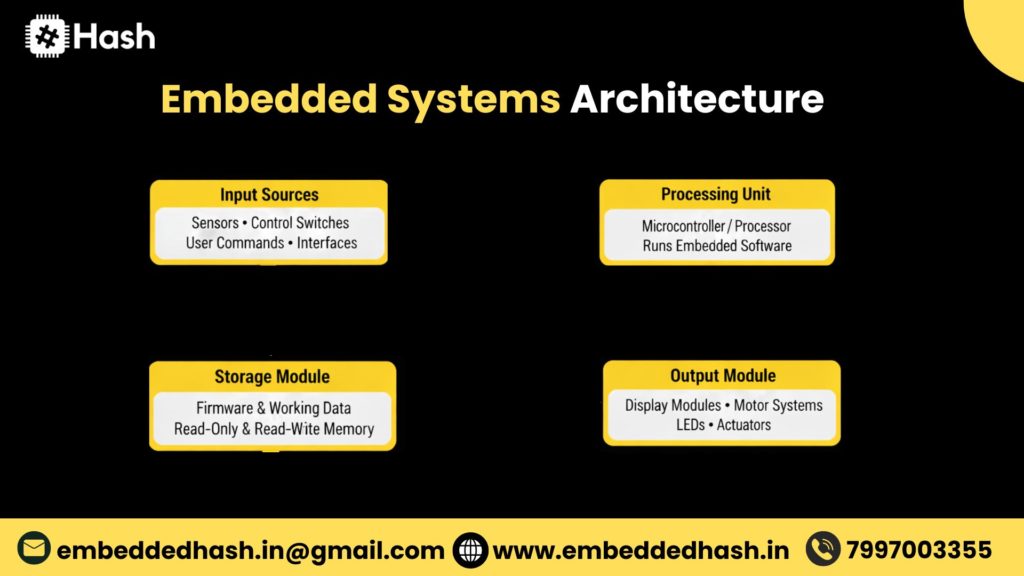
At the core of every embedded system is a simple but powerful architecture that connects inputs, processing, memory, and outputs.
Role of Microcontrollers and Microprocessors
- Microcontrollers (MCUs):
Combine CPU, memory, and peripherals on a single chip. Commonly used in small, cost-effective embedded systems like washing machines, IoT devices, and remote controls. - Microprocessors (MPUs):
Focuses mainly on processing and requires external memory and peripherals. Used in complex systems such as infotainment systems, medical equipment, and industrial controllers.
Interaction Between Processor, Memory, and Peripherals
- The processor executes the embedded software firmware.
- The memory stores program instructions, configuration data, and temporary variables.
- Peripherals (sensors, displays, and communication modules) interact with the external world.
- Data flows from inputs → processor → memory → outputs, enabling intelligent decision-making.
Real-Time System Behavior
Many embedded systems are real-time systems, meaning they must respond within a fixed time limit.
Example:
- An airbag system must deploy instantly during a collision.
- A medical monitor must update readings without delay.
- An airbag system must deploy instantly during a collision.
Missing deadlines can cause system failure, which is why timing, reliability, and efficiency are critical in embedded systems engineering.
Core Components of an Embedded System
An embedded system is built from several essential components that work together to perform a dedicated function reliably and efficiently. Each component has a specific role in ensuring smooth system operation.
Processing Unit (MCU/MPU)
The processing unit acts as the brain of the embedded system. It executes the control logic and software instructions that define how the system behaves.
- Microcontrollers (MCUs) integrate the CPU, memory, and peripherals on a single chip, making them ideal for compact and cost-effective devices.
- Microprocessors (MPUs) focus mainly on computation and rely on external memory and peripherals, making them suitable for more complex applications.
Memory (Flash, RAM, EEPROM)
Memory holds the instructions and information needed for the embedded system to function correctly.
- Flash memory holds the firmware and remains intact even when power is off.
- RAM temporarily stores variables and runtime data while the system is operating.
- EEPROM is used to save configuration settings and small amounts of data that must persist after a power loss.
Input and Output Devices
Input devices allow the system to receive information from the external environment, while output devices enable it to respond or take action.
- Inputs include sensors, switches, and keypads.
- Outputs include displays, LEDs, motors, and actuators.
Together, these devices enable interaction between the embedded system and the real world.
Communication Interfaces
Communication interfaces allow embedded systems to exchange data with other devices or networks. Common interfaces include UART, SPI, I²C, CAN, USB, and Ethernet. These interfaces are essential for connectivity, data transfer, and integration with larger systems or IoT platforms.
Power Supply and Control Logic
The power supply provides the required electrical energy for all system components. It often includes voltage regulation and power management circuits to ensure stable operation. Control logic manages system startup, shutdown, and fault handling, ensuring the embedded system operates safely and efficiently under different conditions.
This combination of components forms the foundation of any embedded system, enabling it to perform specific tasks accurately in both simple and complex applications.
Roles and Responsibilities of an Embedded Systems Engineer
An embedded systems engineer is responsible for building and maintaining systems where hardware and software work together to perform dedicated tasks. Their role spans across design, development, testing, and optimization to ensure reliable system performance.
Designing Embedded Hardware and Firmware
Embedded systems engineers design the overall system architecture, selecting suitable microcontrollers or microprocessors, memory components, and peripherals. They also develop firmware that directly controls the hardware and defines how the system operates at a low level.
Writing and Optimizing Embedded Software
A key responsibility is writing efficient and optimized code, often in languages like C or C++. This software must be lightweight, fast, and reliable, as embedded systems usually operate with limited memory and processing resources.
Interfacing Sensors, Actuators, and Communication Modules
Engineers integrate sensors, actuators, and communication interfaces into the system. This involves configuring hardware connections, writing device drivers, and ensuring smooth data exchange between the embedded system and external devices.
Debugging, Testing, and Validation
Testing and debugging are critical tasks in embedded systems engineering. Engineers use tools such as debuggers, logic analyzers, and simulators to identify errors, verify system behavior, and ensure the system meets functional and performance requirements.
Ensuring Real-Time Performance and Reliability
Many embedded systems operate under strict timing constraints. Engineers must ensure that tasks are executed within defined time limits and that the system remains stable under various operating conditions. Reliability and fault tolerance are especially important in safety-critical applications such as automotive, medical, and industrial systems.
These responsibilities highlight the multidisciplinary nature of embedded systems engineering, requiring strong skills in both hardware and software domains.

Skills Required for Embedded Systems Engineering
To succeed in embedded systems engineering, professionals need a balanced mix of technical expertise and soft skills. Since this field bridges hardware and software, both skill sets are equally important.
Technical Skills
C/C++ Programming
Strong knowledge of C and C++ is essential, as these languages are widely used to develop efficient and low-level embedded software. Engineers must write optimized code that works within limited memory and processing constraints.
Microcontrollers and Microprocessors
Understanding the architecture and operation of microcontrollers (MCUs) and microprocessors (MPUs) is crucial. This includes working with registers, timers, interrupts, and on-chip peripherals.
Embedded Memory and Peripherals
Engineers should be familiar with different memory types such as Flash, RAM, and EEPROM, along with peripheral devices like GPIO, ADC, DAC, and timers. Efficient memory usage and peripheral configuration directly impact system performance.
RTOS Fundamentals
Knowledge of Real-Time Operating Systems (RTOS) helps engineers manage multiple tasks, scheduling, and resource sharing in time-sensitive applications. Concepts like task priority, semaphores, and interrupts are especially important.
Communication Protocols (UART, SPI, I2C, CAN)
Embedded systems often communicate with other devices or modules. Understanding serial communication protocols enables reliable data exchange in applications ranging from simple sensors to complex automotive and industrial systems.
Non-Technical Skills
Problem-Solving and Debugging
Embedded systems engineers must be strong problem-solvers. Debugging both hardware and software issues requires analytical thinking, patience, and attention to detail.
Documentation and Teamwork
Clear documentation helps maintain and scale embedded projects. Engineers also work closely with cross-functional teams, so effective communication and collaboration are essential for successful project delivery.
These skills together form the foundation for building robust, efficient, and reliable embedded systems across various industries.
Tools and Technologies Used
Embedded systems engineering relies on a wide range of tools and technologies to design, develop, test, and maintain reliable systems. These tools help engineers write efficient code, debug hardware-software interactions, and manage complex projects
Embedded IDEs and Compilers
Integrated Development Environments (IDEs) provide a complete workspace for writing, compiling, and deploying embedded code. Popular embedded IDEs support microcontroller-specific libraries and toolchains. Compilers translate high-level code into machine instructions optimized for the target hardware.
Debugging and Testing Tools
Debugging tools help engineers identify and fix issues in both hardware and software. Common tools include in-circuit debuggers, emulators, logic analyzers, and oscilloscopes. Testing tools are used to verify system functionality, timing behavior, and reliability under different conditions.
RTOS Platforms
Real-Time Operating System (RTOS) platforms are used in embedded applications that require precise timing and multitasking. RTOS tools help manage task scheduling, inter-task communication, and resource sharing, ensuring predictable system behavior.
Simulation and Version Control Tools
Simulation tools allow engineers to model and test embedded systems before deploying them on actual hardware, reducing development time and errors. Version control tools help manage source code, track changes, and support collaboration among team members throughout the development lifecycle.
Together, these tools and technologies enable embedded systems engineers to build efficient, scalable, and dependable solutions for real-world applications.
Embedded Systems Engineering vs Other Engineering Fields
Feature | Embedded Systems Engineering | Software Engineering | Electronics Engineering |
Primary Focus | A combination of hardware and software | Software development only | Electronic hardware and circuit design |
Real-Time Operation | Yes, often real-time constrained | Mostly no real-time constraints | Limited real-time involvement |
System Type | Dedicated, task-specific systems | General-purpose systems | Hardware-based systems |
Programming Level | Low-level and system-level programming | High-level application programming | Minimal programming |
Typical Applications | IoT devices, automotive systems, and medical equipment | Web applications, mobile apps, enterprise software | Circuits, power systems, electronic devices |
Hardware Interaction | Direct control of hardware | Minimal hardware interaction | Full hardware design and analysis |
Real-World Applications of Embedded Systems Engineering
Embedded systems engineering plays a vital role in many technologies we use every day. These systems are designed to perform specific functions efficiently and reliably across various industries.
Consumer Electronics
Embedded systems are widely used in consumer electronics such as washing machines, microwave ovens, televisions, and smart home appliances. They control device operations, user interfaces, and energy management, ensuring smooth and automated functionality.
Automotive Systems
Modern vehicles rely heavily on embedded systems for performance, safety, and comfort. Applications include engine control units, braking systems, airbag deployment, infotainment systems, and advanced driver-assistance features.
Healthcare Devices
In healthcare, embedded systems are used in medical equipment such as patient monitoring systems, infusion pumps, pacemakers, and diagnostic devices. These systems require high reliability and accuracy, as they directly impact patient safety.
Industrial Automation
Embedded systems are essential in industrial environments for controlling machinery, robotics, and production processes. They are used in programmable logic controllers (PLCs), sensors, and automated assembly lines to improve efficiency and precision.
IoT and Smart Devices
The Internet of Things (IoT) relies on embedded systems to connect smart devices and enable data collection and communication. Examples include smart thermostats, wearable devices, smart lighting systems, and environmental monitoring sensors.
These real-world applications highlight how embedded systems engineering supports innovation across industries by enabling intelligent, automated, and connected solutions.
Education and Career Path
A career in embedded systems engineering combines strong technical education with hands-on experience. This field offers diverse opportunities across industries that rely on intelligent and real-time systems.
Relevant Degrees and Certifications
Most embedded systems engineers begin with a degree in electronics engineering, electrical engineering, computer engineering, or a related discipline. Specialized certifications in embedded systems, microcontrollers, RTOS, or IoT can strengthen practical skills and improve job prospects. Online courses and hands-on training programs also play a key role in building industry-ready expertise.
Entry-Level Roles and Responsibilities
At the entry level, professionals typically start as embedded software engineers, firmware developers, or junior embedded engineers. Their responsibilities include writing and testing embedded code, working with microcontrollers, debugging hardware-software issues, and assisting in system integration under senior guidance.
Career Growth Opportunities
With experience, embedded systems engineers can advance to roles such as senior embedded engineer, system architect, technical lead, or engineering manager. Some professionals move into specialized domains like automotive systems, robotics, or medical devices, while others transition into research, product development, or entrepreneurship.
Industries Hiring Embedded Systems Engineers
Embedded systems engineers are in demand across many sectors, including automotive, consumer electronics, healthcare, industrial automation, telecommunications, aerospace, and IoT-based industries. The growing adoption of smart and connected devices continues to expand job opportunities in this field.
liability by protecting program code from accidental modification during runtime. It also enhances performance, as each memory type is optimized for its specific task—either code storage or data handling.
Additionally, memory separation supports real-time behavior, making execution more predictable and easier to debug. This structured approach is particularly crucial in safety-critical applications, such as automotive systems, medical devices, and industrial controllers, where stability and accuracy are paramount.
Salary Overview
Salaries for embedded systems engineers vary based on experience, location, and industry. Entry-level roles typically offer competitive starting packages, while experienced professionals with specialized skills can earn significantly higher compensation. Industries such as automotive, medical technology, and industrial automation often provide strong salary growth and long-term career stability.
This career path offers a blend of technical challenge, innovation, and long-term growth for students and professionals interested in embedded systems engineering.
Future Scope of Embedded Systems Engineering
The future of embedded systems engineering is rapidly evolving as technologies become smarter, faster, and more connected. Advancements in computing, communication, and automation are expanding the scope of embedded systems across industries.
Role in IoT and Edge Computing
Embedded systems form the foundation of IoT and edge computing by enabling data collection, processing, and decision-making at the device level. Edge-based embedded systems reduce latency, improve reliability, and minimize dependency on cloud connectivity, making them essential for real-time and mission-critical applications.
AI in Embedded Systems
Artificial intelligence is increasingly being integrated into embedded systems to enable intelligent decision-making. AI-powered embedded devices can perform tasks such as image recognition, predictive maintenance, and voice processing directly on hardware, even with limited resources.
Demand Across Industries
The demand for embedded systems engineers continues to grow across sectors such as automotive, healthcare, industrial automation, consumer electronics, aerospace, and smart infrastructure. The shift toward automation and connected devices ensures long-term career opportunities in this field.
Security and Performance Trends
As embedded systems become more connected, security has become a top priority. Future systems will focus on secure boot mechanisms, encryption, and hardware-level security. At the same time, performance optimization, energy efficiency, and real-time reliability will remain key design considerations.
Overall, embedded systems engineering offers a promising future with strong industry demand and continuous innovation driven by IoT, AI, and smart technologies.
Conclusion
Embedded systems engineering is a multidisciplinary field that combines hardware and software to build reliable, task-specific systems used across modern technology. From consumer electronics and automobiles to healthcare devices and industrial automation, embedded systems play a critical role in shaping how intelligent systems operate in the real world.
Success in this field requires a strong foundation in technical concepts such as microcontrollers, embedded programming, memory, communication protocols, and real-time systems, along with practical hands-on experience. Equally important are problem-solving skills, debugging ability, and the capacity to work collaboratively on complex systems.
Frequently Asked Questions (FAQs)
Embedded systems engineering is the field that focuses on designing and developing systems where hardware and software work together to perform a specific, dedicated function efficiently and reliably.
An embedded systems engineer designs hardware architecture, writes embedded software, integrates peripherals, tests systems, and ensures real-time performance and reliability.
A microcontroller integrates CPU, memory, and peripherals on a single chip, making it suitable for compact systems, while a microprocessor mainly handles processing and requires external components.
A Real-Time Operating System (RTOS) manages tasks, scheduling, and resources to ensure operations are completed within strict timing constraints, which is critical for real-time embedded systems.
Embedded systems are used in consumer electronics, automobiles, healthcare devices, industrial automation, IoT products, and communication systems.
C and C++ are the most commonly used languages, while assembly language is used for low-level hardware control in some applications.
Firmware is specialized software stored in non-volatile memory that controls the hardware functions of an embedded system.
Real-time embedded systems are systems that must respond to inputs within a fixed time limit, such as airbag controllers or medical monitoring devices.
The core components include a processing unit (MCU/MPU), memory, input/output devices, communication interfaces, and a power supply.
Embedded systems are designed for specific tasks with limited resources, while general-purpose computers handle multiple applications with higher flexibility.
EEPROM is used to store small amounts of data, such as configuration settings that must be retained even when power is turned off.
Communication protocols like UART, SPI, I2C, and CAN enable data exchange between embedded systems and external devices or modules.
Yes, embedded systems engineering offers strong career growth due to demand in the automotive, IoT, healthcare, and industrial automation sectors.
Key skills include C/C++ programming, knowledge of microcontrollers, understanding of memory and peripherals, debugging skills, and problem-solving ability.
Yes, a software engineer can transition by learning hardware fundamentals, embedded programming, microcontrollers, and real-time systems concepts.
If you want to Learn more About Embedded Systems, join us at Embedded Hash for Demo Enroll Now


 embeddedhash.in@gmail.com