
Skills Required for Embedded Engineer
Table of Contents
Skills Required for Embedded Engineer
Embedded engineering is one of the fastest-growing career fields in India in 2026 due to increasing demand in IoT, automotive electronics, robotics, and smart devices. To become an embedded engineer, beginners need a combination of C programming, microcontroller knowledge, electronics fundamentals, communication protocols, and problem-solving skills. These skills help engineers develop software that directly works with hardware inside electronic devices like cars, medical equipment, and home appliances. By learning step-by-step through practice and real-world projects, students and early professionals can build strong technical knowledge and start a successful career in embedded systems.
What is an Embedded Engineer?
Definition
An embedded engineer designs and develops software and hardware systems that operate inside electronic devices. These embedded systems perform specific functions within machines. Engineers work with microcontrollers, sensors, and circuits to enable automation and efficiency. Unlike regular software, embedded software directly interacts with hardware in devices like cars, medical equipment, and home appliances.
Real Examples of Embedded Systems:
These devices run using embedded systems designed and developed by embedded engineers. Some common examples include:
Smart TV Remote
The remote control contains a small embedded system that sends signals to the television when buttons are pressed.
Fitness Tracker
Fitness bands and smartwatches monitor health data such as steps, heart rate, sleep patterns, and calories burned using sensors and embedded programming.
Traffic Signal Controller
Traffic lights use embedded systems to manage signal timing automatically based on traffic conditions, helping reduce congestion in cities.
Automotive ECU (Engine Control Unit)
Modern vehicles contain multiple ECUs that control engine performance, fuel injection, braking systems, airbags, and safety features.
Smart Home Automation Devices
Devices like smart lights, smart fans, smart door locks, and voice-controlled assistants use embedded systems to automate home operations.
Why Embedded Engineers Are Important in 2026
1. Growth of IoT Devices
Smart devices such as smartwatches, smart home devices, and smart meters use IoT (Internet of Things) technology. Embedded engineers develop the software that helps these devices function efficiently.
2. Automation in Industries
Industries are increasingly using automation to improve productivity. Machines in factories operate automatically using embedded systems, reducing manual work and improving efficiency.
3. Smart and Electric Vehicles
Modern vehicles use embedded systems for features like sensors, airbags, navigation systems, and battery management. The growth of electric vehicles has increased the demand for embedded engineers.
4. Medical Electronics Development
Medical devices such as ECG machines, patient monitoring systems, insulin pumps, and digital thermometers depend on embedded systems to provide accurate results and improve patient care.
5. Smart Cities and Digital India Projects
Technologies used in traffic control systems, smart surveillance cameras, and smart electricity meters rely on embedded systems. With the growth of smart city initiatives in India, career opportunities for embedded engineers are increasing.
Why Skills Matter to Become an Embedded Engineer
Industry Expectations
In India, companies expect embedded engineers to have strong basics in both software and electronics. Candidates should understand C programming, microcontrollers, circuits, and communication protocols. Having practical knowledge and project experience helps freshers stand out and increases chances of getting hired in embedded system roles.
Career Opportunities
Learning the right skills opens multiple career paths in the embedded domain:
- Embedded Software Engineer
- Firmware Developer
- IoT Engineer
- Automotive Embedded Engineer
- Robotics Engineer
These roles are in demand across industries like automotive, healthcare, consumer electronics, and industrial automation.
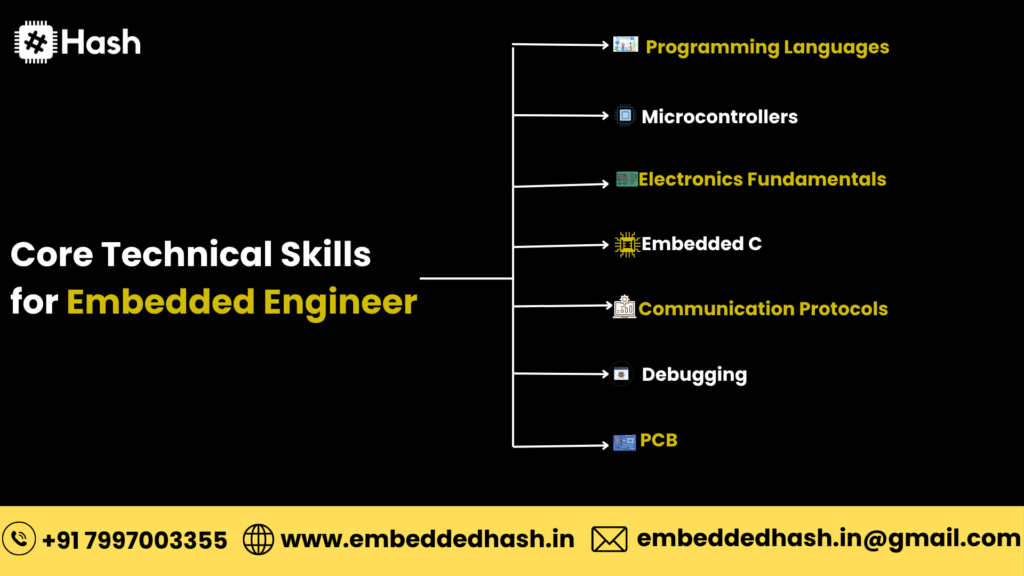
Core Technical Skills Required for Embedded Engineer
1. Programming Languages
C language is the most important programming language for embedded systems because it allows direct interaction with hardware. C++ is used when object-oriented programming is needed for complex applications, while Python is helpful for automation, scripting, and testing tasks.
2. Microcontrollers
Microcontrollers are the main part of embedded systems. Learn architecture basics, GPIO, timers, interrupts, ADC, and PWM concepts. Beginners can start practicing with Arduino, ARM Cortex, or PIC boards to understand how software interacts with hardware components.
3. Electronics Fundamentals
Embedded engineers need basic electronics knowledge to understand how hardware works. Learn resistors, capacitors, diodes, digital electronics basics, and circuit reading. Understanding electronic components helps in building reliable embedded systems and improves hardware troubleshooting skills.
4. Embedded C and Firmware Development
Embedded C helps control hardware at low level using registers, memory handling, and bitwise operations. Beginners can start with simple projects like LED blinking using microcontrollers to understand how firmware communicates directly with hardware devices.
5. RTOS (Real Time Operating Systems)
RTOS helps systems perform multiple tasks with proper timing. Learn task scheduling, multithreading basics, and timing constraints. Tools like FreeRTOS help beginners understand how real-time applications work in automation, robotics, and automotive embedded systems.
6. Communication Protocols
Communication protocols help devices share data with each other. Learn the basics of UART, SPI, I2C, and CAN protocols. Understanding these concepts helps engineers build systems where sensors, controllers, and modules communicate efficiently.
7. Debugging and Problem Solving Skills
Debugging skills help find and fix errors in embedded systems. Tools like debugger, oscilloscope, and multimeter help identify hardware or software issues. Strong problem-solving skills improve system performance and reliability in real-time applications.
8. Basic PCB Design Knowledge
Basic PCB design knowledge helps understand circuit layout and component placement. Tools like KiCad, Altium, and Eagle PCB are used to design circuit boards. Learning PCB basics helps engineers build compact and efficient electronic devices.
Real World Applications of Embedded Engineer Skills
IoT Temperature Monitoring System
This system uses sensors and microcontrollers to measure temperature and send data to cloud or mobile apps. Embedded engineers design the software that collects, processes, and transmits data efficiently in real-time environments.
Fitness Tracker Device
Fitness trackers use embedded programming to monitor steps, heart rate, and sleep patterns. Engineers develop software that works with sensors to collect health data accurately and display useful information to users in real time.
Automotive Airbag System
Automotive airbag systems use real-time embedded software to detect sudden impacts and deploy airbags instantly. Embedded engineers design fast and reliable systems that ensure passenger safety by responding within milliseconds during accidents.
Soft Skills Needed for Embedded Engineers
Technical knowledge alone is not enough to become a successful embedded engineer. Companies also look for soft skills that help engineers communicate, solve problems, and work effectively in teams. These skills improve productivity, project quality, and career growth.
- Problem-Solving Skills
- Analytical Thinking
- Communication Skills
- Teamwork
- Time Management
- Adaptability
- Critical Thinking
- Continuous Learning
Conclusion
To become a successful embedded engineer in 2026, you need a strong combination of programming, electronics knowledge, and problem-solving skills. Beginners can start with C programming and microcontrollers, then gradually learn RTOS, communication protocols, and real-time project development.
With continuous practice, hands-on projects, and consistent learning, you can build strong technical expertise and create a successful career in embedded systems across industries like IoT, automotive, healthcare, and automation.
Frequently Asked Questions
Key skills include C programming, microcontroller knowledge, basic electronics, RTOS concepts, communication protocols, and debugging ability. These skills help engineers develop reliable software that directly works with hardware in embedded devices.
Yes, coding is required. C programming is the most commonly used language in embedded systems because it allows efficient control of hardware and memory in microcontroller-based devices.
Yes, beginners can learn embedded systems by starting with C programming and basic electronics concepts. With regular practice and small projects, anyone can gradually build strong embedded development skills.
C and Embedded C are the most widely used programming languages in embedded systems. Sometimes C++ and Python are also used for specific applications such as testing or high-level development.
Yes, embedded systems is a good career option in India because demand is growing in industries like IoT, automotive, robotics, consumer electronics, and healthcare technology.
Basic embedded system skills can usually be learned within 3 to 6 months with consistent practice. Learning time may vary depending on prior knowledge and project experience.
Yes, understanding electronics basics such as circuits, components, and signals is important because embedded systems involve direct interaction between software and hardware.
RTOS stands for Real Time Operating System. It helps embedded devices perform multiple tasks within specific timing requirements, which is important in applications like automotive systems and robotics.
Common examples include washing machines, smart TVs, fitness trackers, microwave ovens, digital cameras, and cars, where software is built into the device to perform dedicated functions.
Arduino and ARM Cortex based microcontrollers are beginner friendly because they have simple development environments, good documentation, and strong learning community support.
Basic PCB design knowledge is helpful because it allows engineers to understand circuit layout, component placement, and hardware design considerations for embedded products.
Communication protocols such as UART, SPI, I2C, and CAN are used for data exchange between microcontrollers, sensors, and other electronic components in embedded systems.
Embedded systems can feel challenging at the beginning, but with a step-by-step learning approach, regular practice, and project experience, it becomes easier to understand and apply concepts confidently.
C language is mainly used in embedded systems, but Python may be used for testing, automation, and data analysis in some embedded development environments.


 embeddedhash.in@gmail.com