
Embedded Systems Networking
In today’s hyper-connected world, Embedded Systems Networking has become the backbone of everything from smart home devices to advanced industrial automation. Whether it’s a microcontroller inside a wearable or a real-time ECU in an automobile, every embedded device now needs a reliable and secure way to communicate. As industries move toward IoT, Industry 4.0, and AI-powered edge computing, the demand for efficient embedded networking has grown exponentially—especially in tech hubs across India like Bengaluru, Hyderabad, and Pune, where embedded talent and electronics manufacturing are booming.
Introduction —Embedded Systems Networking
In 2026, embedded systems are no longer isolated hardware units. They operate as part of highly connected ecosystems, exchanging data with sensors, gateways, cloud platforms, and other intelligent devices. This shift toward connectivity has transformed networking into the central pillar of modern embedded engineering.
What Embedded Systems Networking Means
Embedded Systems Networking refers to the communication framework that allows microcontrollers, sensors, actuators, and embedded processors to exchange information. These devices rely on a combination of wired protocols (UART, SPI, I²C, CAN, Ethernet) and wireless technologies (Wi-Fi, Bluetooth, Zigbee, LoRa, Thread, 5G) to interact with each other and with cloud services.
Key characteristics of embedded networking include:
- Resource-Constrained Communication: Optimized for low memory, low power, and limited processing capability.
- Real-Time Data Flow: Ensures predictable and deterministic communication for safety-critical applications.
- Protocol Interoperability: Allows devices to talk across heterogeneous networks, from low-power mesh to high-bandwidth Ethernet.
- Secure Connectivity: Authentication, encryption, and firmware integrity are essential in today’s cyber-threat landscape.
In essence, embedded networking enables small devices to behave like smart, aware, interconnected systems rather than standalone electronics.
Role of Networking in IoT, Automation, and Smart Devices
Networking is the core engine driving the global expansion of IoT, automation, and smart technologies. Embedded devices collect, transmit, and act on data — and networking is what makes this continuous data loop possible.
In IoT (Internet of Things)
Every IoT device—from home appliances to industrial sensors—depends on reliable networking to share data with gateways, cloud servers, and mobile apps. Protocols like MQTT, CoAP, BLE, and Wi-Fi enable low-latency communication and remote control.
In Industrial Automation (Industry 4.0)
Smart manufacturing uses embedded controllers and PLCs connected via Ethernet/IP, Modbus, PROFIBUS, CAN, and TSN (Time-Sensitive Networking) to achieve real-time, synchronized operations.
In Smart Consumer Devices
Wearables, smart home gadgets, and connected appliances rely heavily on BLE, Zigbee, Thread, Matter, and Wi-Fi for seamless user experiences.
In Automotive & EV Ecosystems
Modern vehicles use CAN, LIN, FlexRay, Automotive Ethernet, and secure OTA updates for vehicle-to-cloud connectivity.
Without networking, IoT devices wouldn’t be “smart,” automation wouldn’t be “real-time,” and consumer electronics wouldn’t be “connected.”
Why Networking Skills Are Mandatory for Embedded Engineers in 2026
The embedded job market in 2026 demands engineers who can build connected and cloud-ready systems. Companies in India—are increasingly hiring engineers with strong networking expertise.
Why these skills are must-have:
- IoT Is Now the Industry Standard: 70%+ of new embedded products require network connectivity.
- Cloud & Edge Integration: Engineers must understand IP networking, MQTT/HTTP APIs, gateway architectures, and OTA systems.
- Security Requirements: Secure communication protocols, encrypted data flow, and secure boot processes are now mandatory.
- Multi-Protocol Environments: Modern products use a combination of wired and wireless protocols, requiring engineers to manage interoperability.
- Real-Time Communication Skills: TSN, CAN FD, and deterministic networking are crucial in automotive, robotics, and industrial systems.
- High Demand, Low Supply: There is a growing skill shortage, making networking expertise a career accelerator for embedded professionals.
In 2026, an embedded engineer without networking knowledge is like a web developer who doesn’t understand APIs — incomplete and outdated.
Fundamentals of Embedded Systems Networking
Embedded Systems Networking refers to the communication framework that allows microcontrollers, sensors, actuators, and edge devices to exchange data. Unlike traditional computing networks, embedded networks must operate under strict constraints—limited memory, low power budgets, real-time deadlines, and harsh environmental conditions.
Modern embedded products such as smart meters, industrial robots, EV controllers, and home automation hubs rely on network protocols to synchronize performance, push data to the cloud, and enable OTA updates. As India accelerates toward Industry 4.0 and IoT adoption, understanding these networking fundamentals has become essential for developers, students, and hardware engineers.
Embedded networks can be categorized based on three core factors:
- Communication scope — local or cloud-based
- Data rate — low-speed control signals vs high-throughput sensor streams
- Medium — wired or wireless
These fundamentals set the foundation for selecting the right protocol, topology, and architecture for any embedded design.
Device-to-Device vs Device-to-Cloud Communication
Embedded devices typically communicate in two primary ways:
1. Device-to-Device (D2D) Communication
This involves communication between microcontrollers, sensors, or actuators directly.
Examples: UART, I²C, SPI, CAN, Modbus, RS-485
Use cases:
- Motor control systems
- Sensor–MCU communication
- Automotive ECUs
- Industrial PLC networking
Why it matters:
D2D ensures predictable timing, low latency, and highly reliable data exchange in local systems. It is the core of real-time embedded applications.
2. Device-to-Cloud (D2C) Communication
Here, the embedded device sends data to cloud platforms via Ethernet, Wi-Fi, 4G/5G, NB-IoT, LoRaWAN, or MQTT/HTTP/CoAP protocols.
Use cases:
- Smart metering
- Remote monitoring of industrial equipment
- Asset tracking
- Smart agriculture
Why it matters:
D2C enables remote diagnostics, OTA updates, analytics, and business intelligence—critical for modern IoT deployments in India’s rapidly growing smart device market.
Key Performance Concepts: Latency, Bandwidth, Throughput
Understanding network performance metrics is crucial when designing embedded systems:
Latency
The amount of time it takes for data to move from the sender to the receiver. Low latency is critical for:
- Automotive safety systems
- Robotics
- Medical devices
- Real-time control loops
Bandwidth
The maximum amount of data a network can carry per second.
High bandwidth is needed for:
- Camera modules
- Audio/video streaming
- Industrial condition monitoring
Throughput
The actual data transfer rate achieved after considering protocol overhead, errors, and retries.
This reflects real-world performance and depends on both hardware and protocol efficiency.
In embedded networking, the goal is to balance these three metrics while staying within power, cost, and memory limits—a key challenge for engineers building compact IoT products.
Network Topologies: Point-to-Point, Bus, Star, Mesh
The physical or logical arrangement of devices significantly impacts system behavior.
1. Point-to-Point
- Direct connection between two devices
- Simple, secure, and low latency
- Example: UART link between MCU & sensor
2. Bus Topology
- Multiple devices share a common communication line
- Efficient for short distances
- Examples: I²C, CAN, RS-485 (Modbus)
3. Star Topology
- Central hub communicates with all devices
- Common in Wi-Fi and Ethernet networks
- Easy to manage but hub-dependent
4. Mesh Topology
- Each node can relay data for others
- High reliability & redundancy
- Used in Zigbee, Thread, Bluetooth Mesh, LoRaWAN-based networks
Choosing the right topology depends on scalability, coverage, and real-time requirements, especially in large Indian deployments like smart street lighting or manufacturing automation.
Wired vs Wireless Networking — When to Use What
Embedded systems can use either wired or wireless connectivity depending on application needs.
When to Use Wired Networking
Best for:
- Industrial automation
- Automotive systems
- Robotics
- High-noise environments
Advantages:
- High reliability
- Low latency
- Predictable performance
- Better security
Common wired standards: Ethernet, CAN, RS-485, I²C, SPI
When to Use Wireless Networking
Best for:
- IoT smart devices
- Outdoor deployments
- Battery-powered sensors
- Consumer electronics
Advantages:
- Easy installation
- Long-range options
- Supports large-scale deployments
Popular wireless options: Wi-Fi, BLE, Zigbee, LoRaWAN, NB-IoT, 5G
Rule of thumb:
If reliability and timing are critical → Wired
If mobility and scalability matter → Wireless
Low-Level Communication Protocols (Wired)
Wired communication protocols form the backbone of traditional embedded systems. They offer deterministic timing, noise immunity, and high reliability, making them ideal for applications like automotive electronics, industrial automation, sensor modules, and embedded consumer devices. While wireless technologies are rapidly expanding, wired protocols still dominate scenarios where speed, real-time response, and robustness are non-negotiable.
In India’s fast-growing electronics manufacturing and EV ecosystem, engineers continue to rely heavily on these protocols to build stable, production-ready embedded systems.
UART — Simple Serial Communication
UART (Universal Asynchronous Receiver/Transmitter) is one of the most widely used communication methods in microcontroller-based designs. Its simplicity makes it perfect for debugging, bootloader programming, GPS modules, GSM modems, and point-to-point links.
Key Features:
- Asynchronous communication (no clock signal required)
- Full-duplex data transfer
- Ideal for simple command/response protocols
Use Cases in India:
IoT developers, especially in Hyderabad and Bengaluru, commonly use UART for interfacing with modules like ESP8266/ESP32, LoRa transceivers, and debugging data on edge devices.
Best For: Debugging, serial consoles, simple device communication, bootloaders.
SPI — High-Speed Peripheral Communication
SPI (Serial Peripheral Interface) is a synchronous, high-speed protocol used when embedded devices must transfer data quickly and reliably. It supports a master–slave architecture and has dedicated lines for clock, data in/out, and chip selection.
Key Benefits:
- Extremely fast data transfer rates
- Simple hardware design
- Supports multiple slaves via chip select (CS) pins
Typical Uses:
- High-speed sensors (IMUs, ADCs)
- TFT/LCD displays
- Flash memory (NOR/NAND)
Industry Relevance : SPI is heavily adopted in industrial IoT devices, wearables, robotics, and consumer electronics manufactured across India’s electronic clusters.
I²C — Multi-Device Communication with Minimal Pins
I²C (Inter-Integrated Circuit) is designed for scenarios where multiple peripherals must communicate using only two wires: SDA (data) and SCL (clock). Its simplicity and hardware efficiency make it a go-to for sensor-rich embedded systems.
Why Engineers Love I²C:
- Uses only two lines for multiple devices
- Supports multi-master systems
- Ideal for low-speed data transfer
Common Applications:
- Environmental sensors (temperature, humidity, pressure)
- Real-time clocks (RTC)
- EEPROM modules
- Touch controllers
Geo Insight : Popular in Indian embedded training institutes and manufacturing lines because of its low cost and easy integration with MCUs like STM32, PIC, and AVR.
CAN Bus — Automotive & Industrial Networking
CAN (Controller Area Network) is the industry standard for automotive, aerospace, and industrial control systems. It was designed to ensure reliable communication in noisy environments, making it perfect for mission-critical applications.
Why CAN Is Essential in 2026:
- High noise immunity
- Prioritized messaging
- Multi-node communication without a dedicated master
- Fault tolerance and error detection
Where You’ll See It:
- Electric vehicles (EVs)
- Automotive ECUs (ABS, airbag, engine control)
- Industrial automation systems
- Building management systems
India Focus:
With India’s booming EV manufacturing and automotive R&D hubs (Chennai, Pune, Hyderabad), CAN expertise is now a core skill for embedded engineers.
Ethernet — High Reliability & High-Speed Networking
Ethernet is the benchmark for high-speed, high-bandwidth embedded networking, especially when devices need to transmit large data packets or integrate directly with cloud/edge computing platforms.
Advantages:
- High data throughput (10/100/1000 Mbps and beyond)
- Long-distance communication capability
- Robust and mature networking stack (TCP/IP)
Typical Use Cases:
- Industrial controllers (PLC, SCADA systems)
- Smart factories and Industry 4.0 implementations
- Surveillance systems
- Edge AI hardware
Indian Market Trend:
Companies involved in industrial automation, smart manufacturing, and IoT gateways are increasingly adopting Ethernet-enabled microcontrollers like STM32F4/F7, NXP i.MX RT, and Microchip LAN controllers.
Protocol Comparison Table (UART vs SPI vs I²C vs CAN vs Ethernet)
Choosing the right communication protocol is one of the most critical decisions in an embedded design. Each protocol—whether it’s UART for simple serial links or Ethernet for high-bandwidth networking—offers unique benefits depending on speed, complexity, cost, and application. The table below gives you a clear, engineering-level comparison to help you evaluate the best fit for your device or product.
Protocol | Speed | Wiring | Use Case | Advantages | Limitations |
UART | Up to 1 Mbps | 2 wires (TX, RX) | Debug, GPS modules, simple point-to-point communication | Easy to implement, low cost | Only supports two devices, no multi-master, slower than SPI |
SPI | Up to 50+ Mbps | 4+ wires (MOSI, MISO, SCK, SS) | High-speed sensors, displays, ADC/DAC | Very fast, full-duplex, flexible | Requires more pins, not ideal for long distances |
I²C | Up to 3.4 Mbps | 2 wires (SCL, SDA) | Multi-sensor networks, low-speed peripherals | Multi-master, multi-slave support, minimal wiring | Limited speed, susceptible to noise, shorter range |
CAN | Up to 1 Mbps (Classical), 5 Mbps (CAN-FD) | 2 wires (CANH, CANL) | Automotive ECUs, robotics, industrial control | Highly reliable, error detection, long distance | More complex stack, requires transceiver |
Ethernet | 10 Mbps to 1 Gbps+ | 4 twisted pair | Industrial IoT, gateways, high-bandwidth devices | High speed, long range, supports TCP/IP | Higher power usage, increased complexity |
Wireless Networking in Embedded Systems
Wireless networking has become the core of modern embedded systems, enabling devices to connect without physical cables while maintaining reliability, power efficiency, and security. From consumer electronics to industrial IoT deployments, wireless technologies allow embedded devices to communicate over short, medium, or long distances—each optimized for a specific use case.
In 2026, industries in India—especially smart city projects, EV infrastructure, healthcare IoT, and manufacturing automation—are aggressively adopting wireless embedded networking. Choosing the right wireless protocol impacts range, data rate, power usage, latency, and scalability, making it one of the most critical engineering decisions in embedded product design.
Wi-Fi — High Bandwidth Consumer Networking
Wi-Fi is the most widely used wireless technology in embedded systems that require high data throughput. Ideal for consumer electronics and connected appliances, Wi-Fi supports:
- High bandwidth (suitable for video, audio streaming, OTA updates)
- Easy integration thanks to ESP32, ESP32-S3, and other Wi-Fi MCUs
- Strong security with WPA3 and enterprise-grade options
- Direct internet connectivity without gateways
Typical Applications:
- Smart TVs, smart speakers
- Home appliances (ACs, washing machines, refrigerators)
- IoT dev boards (ESP32-based projects)
- Security cameras, Wi-Fi-based sensors
In India’s growing smart home market—driven by brands like Xiaomi, Realme, Samsung, and Indian OEMs—Wi-Fi remains the default choice for consumer-grade connectivity.
Bluetooth & BLE — Low Energy Short-Range Networking
Bluetooth Classic and Bluetooth Low Energy (BLE) are designed for short-range, low-power wireless communication. BLE, in particular, dominates low-energy embedded use cases.
Key Benefits:
- Ultra-low power consumption
- Optimized for battery-operated devices
- Native support on smartphones (iOS + Android)
- Fast pairing and low-latency
Typical Applications:
- Wearables & fitness trackers
- Medical IoT (pulse oximeters, glucose monitors)
- Proximity sensors, beacons
- Wireless keyboards, mice, audio devices
With India becoming a global hub for wearables manufacturing (thanks to Make in India), BLE is the most important wireless protocol for consumer IoT products.
Zigbee — Low-Power Mesh Networking for Smart Homes
Zigbee is a low-power, low-data-rate mesh networking protocol widely used in smart homes and automation systems. Unlike Wi-Fi, Zigbee allows hundreds of devices to form a self-healing mesh network.
Why Zigbee is popular:
- Extremely low power
- Large network support through mesh nodes
- Ideal for sensors and automation
- Cost-effective hardware modules (CC2530, EFR32, etc.)
Typical Use Cases:
- Smart lighting (Philips Hue, Syska)
- Home automation hubs
- PIR sensors, door sensors, climate sensors
- Smart meters in industrial environments
In India, smart lighting and home automation installers heavily rely on Zigbee for its stability and low-power capabilities.
LoRaWAN — Long-Range IoT Connectivity
LoRaWAN provides long-range, low-power, low-bandwidth communication, making it ideal for large-scale IoT deployments that do not require high data speeds.
Core Advantages:
- Range up to 10–15 km in rural areas
- Very low power (battery life of 3–5 years)
- Secure communication (AES-128)
- Highly scalable for thousands of nodes
Typical Applications:
- Agriculture IoT (soil sensors, weather stations)
- Smart city infrastructure (parking, streetlights)
- Utility metering (water, electricity, gas)
- Asset tracking
Many Indian cities—including Hyderabad, Bengaluru, and Pune—use LoRaWAN networks for municipal IoT applications under Smart City initiatives.
Cellular: 4G, 5G, NB-IoT — Wide-Area Connectivity
For applications that require wide-area, always-on connectivity, cellular technologies are the best choice.
4G LTE:
- Reliable and widely available in India
- High data rates for streaming and telemetry
- Good for mobile devices, vehicle trackers, and POS machines
5G (2026 Adoption):
- Ultra-low latency
- High bandwidth for industrial automation
- Edge computing support
- Expected to dominate autonomous systems and industrial IoT
NB-IoT & LTE-M:
- Low-power wide-area (LPWA) cellular technologies
- Inner-city and indoor penetration
- Massive IoT capability
Typical Use Cases:
- EV charging stations
- Vehicle telematics, fleet tracking
- Smart agriculture pumps
- Industrial IoT monitoring
- Remote medical devices
With India’s rapid 5G rollout and telecom support from Jio and Airtel, cellular connectivity is becoming more accessible for embedded products.
Z-Wave, Thread & Matter — The Future of Smart Home Networks (2026)
The smart home landscape is evolving, and three protocols are shaping the next generation of embedded connectivity:
Z-Wave
- Operates on sub-GHz frequencies, reducing Wi-Fi interference
- Highly reliable and used in home automation systems
- Ideal for lighting, locks, sensors, and security devices
Thread
- IPv6-based, low-power mesh networking
- Built for smart home interoperability
- Self-healing, secure, and extremely energy efficient
Matter (2026 Standard)
Matter has become the unified smart home standard, backed by Google, Apple, Amazon, Samsung, and hundreds of manufacturers.
Why Matter matters:
- Seamless interoperability across brands
- Secure onboarding
- Reliable local connectivity
- Works across Wi-Fi and Thread
Applications:
- Smart bulbs and switches
- Smart locks, thermostats
- Home security sensors
- Smart hubs and appliances
In India, Matter-ready devices are growing rapidly in 2026, especially through brands like Philips, Realme, Xiaomi, and Indian OEMs.
Understanding Network Stacks in Embedded Systems
Every connected embedded device—from a tiny ESP32 module to an automotive-grade microcontroller—relies on a well-defined network stack to communicate efficiently. A network stack is a layered architecture that breaks down communication into smaller, manageable functions. For embedded developers, understanding this layered model is essential for optimizing performance, reducing power consumption, and ensuring reliable data transmission over constrained hardware.
Modern embedded systems typically use a lightweight implementation of the TCP/IP stack, often tailored for microcontrollers with limited RAM and flash. Popular stacks include lwIP, uIP, FreeRTOS+TCP, Zephyr Net stack, and vendor-specific networking libraries provided by STM, NXP, TI, and Espressif. These stacks ensure predictable behavior, low latency, and compatibility with IoT platforms like AWS IoT, Azure IoT Hub, and private cloud servers widely used by Indian startups and enterprises.
OSI & TCP/IP for Embedded Developers (Simplified Layer View)
While the OSI model has seven layers and TCP/IP has four, embedded engineers mostly work with a practical, simplified layer approach:
- Physical Layer (PHY)
Deals with electrical signals—Ethernet PHY chips, RF modules (Wi-Fi, BLE, LoRa), GPIO-level signaling like UART. - Data Link Layer (MAC-level Communication)
Handles framing, addressing, and error detection.
Examples: Ethernet MAC, Wi-Fi MAC, CAN bus arbitration, I²C/SPI data framing. - Network Layer (IP Layer)
Here’s where embedded devices get an IP address and understand routing.
Key protocols: IPv4/IPv6, ICMP, ARP. - Transport Layer
Ensures data delivery using TCP or UDP depending on application needs. - Application Layer
Where IoT and user-level protocols live: HTTP, MQTT, CoAP, WebSockets.
For embedded developers, the goal is to pick the right set of layers to match memory constraints, boot time requirements, and power limits—especially important in wearable electronics, sensor nodes, and industrial IoT deployments.
IP Addressing, Subnetting, DHCP, DNS — Embedded Perspective
Embedded devices must intelligently manage their network identity and connectivity. Here’s how these fundamental networking concepts apply in real-world embedded scenarios:
IP Addressing
Each device gets a unique address (static or dynamic).
In India’s IoT deployments—like smart meters and connected agriculture—static IPs are often used for gateway devices, while sensor nodes rely on dynamic allocation.
Subnetting
Used to segment networks for performance and security.
Example: separating machine control networks from IoT monitoring networks in factories.
DHCP (Dynamic Host Configuration Protocol)
Automatically assigns IP addresses.
Most Wi-Fi-enabled embedded platforms (ESP32, STM32 with ESP-AT, TI CC3200) rely on DHCP for plug-and-play connectivity.
DNS (Domain Name System)
Translates domain names into IP addresses.
Embedded systems use lightweight DNS clients to connect to cloud endpoints like:
example.iot.aws.com → IP address lookup done inside the device.
Small optimizations like shorter DNS TTL, caching, and retry logic significantly improve reliability in low-power IoT devices.
TCP vs UDP — Choosing the Right Transport Layer
Embedded systems must carefully choose between TCP and UDP, based on real-time requirements, reliability, bandwidth, and battery constraints.
When to Use TCP
- Cloud communication (MQTT over TCP, HTTPS)
- Firmware update (OTA) downloads
- Applications needing guaranteed delivery
- When order of packets matters
TCP is reliable but heavier, making it less suitable for ultra-low-power sensor nodes.
When to Use UDP
- Real-time control (robotics, motors, industrial field devices)
- Audio/video streaming
- Broadcast/multicast communication
- Lightweight IoT protocols (CoAP, LwM2M)
UDP offers low latency and low overhead, which is ideal for microcontrollers running <128 KB RAM.
In Indian industries—especially automotive and industrial automation—UDP-based protocols remain popular because of their speed and simplicity.
MQTT, CoAP, HTTP — High-Level IoT Application Protocols
This is where embedded systems truly “talk” to applications, cloud services, and mobile apps.
MQTT (Message Queuing Telemetry Transport)
- Lightweight publish–subscribe protocol
- Ideal for low-bandwidth networks and battery-powered nodes
- Widely used in IoT cloud platforms
- Popular in Indian startups deploying home automation and smart energy solutions
MQTT over TLS is the standard for secure IoT.
CoAP (Constrained Application Protocol)
- Designed specifically for constrained embedded devices
- Works over UDP
- Supports request/response like HTTP but with much lower overhead
- Suitable for large sensor networks, smart agriculture, street lighting systems
HTTP/HTTPS
- Easy integration with web services
- Heavier, but essential for REST APIs
- Used in OTA updates, configuration panels, and Wi-Fi-enabled consumer electronics
- Supported by almost all microcontroller IoT SDKs
Choosing the right protocol ensures optimal performance, security, and scalability—especially in large IoT deployments common across smart cities in India.
Designing a Complete Embedded Networking Architecture
A well-structured embedded networking architecture ensures that every component—from tiny sensors to cloud dashboards—communicates efficiently, securely, and with minimal power usage. In 2026, engineers must design systems that not only work reliably in real-time but also scale across diverse environments like smart homes, industrial floors, EV systems, agriculture IoT, and consumer electronics.
A complete architecture typically includes internal communication, gateway-level processing, cloud connectivity, and device management layers. The goal is to enable seamless data flow between MCU-level components and cloud services, regardless of whether the device uses UART, BLE, LoRa, Wi-Fi, or hybrid communication models.
Internal Communication — How MCUs, Sensors & Modules Interact
Internal communication forms the heart of any embedded system, defining how your microcontroller exchanges data with sensors, actuators, modules, and storage peripherals.
Common internal communication examples include:
- I²C: Ideal for environmental sensors, RTCs, small memory modules
- SPI: High-speed data transfers for displays, ADCs/DACs, SD cards
- UART: Debug logs, GPS modules, communication with secondary controllers
- CAN / LIN: Automotive-grade networking for ECUs
- GPIO & Interrupt Lines: Low-level signalling for time-sensitive actions
A strong internal communication design ensures:
- Low latency for real-time tasks
- Noise immunity (critical in industrial/automotive environments)
- Efficient power usage for battery-dependent devices
- Predictable and deterministic behaviour
By optimizing bus speeds, assigning priority to interrupts, and avoiding bottlenecks, engineers build the foundation for reliable end-to-end networking.
Cloud Communication Models
Modern embedded devices often extend beyond local communication to connect with cloud services. Below are the most commonly used models depending on range, bandwidth needs, and power constraints.
Wi-Fi → MQTT Broker
Wi-Fi is a natural choice for high-bandwidth IoT applications such as home automation, industrial monitoring, and connected consumer devices.
A typical flow:
- Device connects to Wi-Fi network
- MCU publishes sensor data to an MQTT broker
- Cloud dashboard consumes and visualizes the data
- Commands (like ON/OFF or thresholds) flow back to the device via MQTT topics
Why it’s popular:
- Seamless cloud integration
- Supports OTA updates
- High throughput for camera/image-based devices
- Works well in homes and enterprise networks
BLE → Smartphone → Cloud
Bluetooth Low Energy is widely used for wearables, smart appliances, medical devices, fitness trackers, and proximity-based solutions.
Communication pattern:
- MCU collects sensor data
- Smartphone app syncs via BLE
- App forwards data to cloud servers (REST, MQTT, WebSockets)
Benefits:
- Ultra-low power consumption
- Ideal when a smartphone can act as a bridge
- Perfect for applications where continuous cloud connectivity is optional
This model is cost-efficient, especially in India where consumers depend heavily on smartphone-driven IoT ecosystems.
LoRa → Gateway → Server
LoRa is preferred for long-range, low-power applications, including smart farming, asset tracking, water-level monitoring, and smart city solutions.
Typical flow:
- Sensor node sends packets over LoR
- LoRa gateway receives dat
- Gateway forwards it via Ethernet/4G/5G to cloud servers
Key advantages:
- 10–15 km coverage in rural Indian regions
- Extremely low battery consumption
- Ideal for remote deployments
LoRaWAN networks are evolving rapidly in India, making this model highly scalable for government/enterprise IoT projects.
Hybrid Architectures (Combining Wired + Wireless)
Many modern embedded products require a hybrid communication approach to balance speed, reliability, and power consumption.
Examples:
- CAN + Wi-Fi in electric vehicles (internal network + cloud telematics)
- SPI Sensors + BLE in smart wearables
- Ethernet Backbone + LoRa Nodes in industrial IoT
- UART Modules + 4G/5G in remote monitoring devices
Hybrid models provide :
- Redundancy (if wireless fails, wired still works)
- Flexibility in deployment
- Efficient partitioning of computation and communication
Better scalability for multi-node networks
These architectures are particularly useful in Indian industrial automation, where devices often operate in noisy environments and need both reliability and remote access.
Power Optimization Techniques for Networked Devices
Since networking consumes significant energy, optimizing power usage is crucial—especially for battery-operated IoT devices.
Here are the top techniques used by embedded engineers:
1. Duty Cycling for Radios
Turn Wi-Fi, BLE, or LoRa radios ON only when necessary.
This can reduce power consumption by 60–80%.
2. Deep Sleep and Ultra-Low Power Modes
Use MCU features like:
- Stop mode
- Standby mode
- Light sleep
- Dynamic frequency scaling
Platforms like ESP32, STM32, Nordic nRF52, and RP2040 support aggressive sleep patterns.
3. Adaptive Data Transmission
Send data only when changes occur (event-driven), not at fixed intervals.
Ideal for environmental sensors and smart meters.
4. Packet Compression & Edge Processing
Compress data before transmitting or process values locally to avoid unnecessary cloud uploads.
5. Use LPWAN Protocols When Possible
LoRa, Sigfox, and NB-IoT are designed for multi-year battery life.
6. Antenna + RF Optimization
A well-tuned antenna reduces retransmissions, improving both reliability and power use.
Security in Embedded Systems Networking
As embedded systems become more connected—to WiFi, BLE, cloud servers, and mobile apps—their attack surface increases dramatically. In 2026, cyber-attacks are shifting from traditional IT systems to edge devices, especially those used in smart homes, EVs, healthcare equipment, and industrial IoT installations across India.
To build reliable and future-proof devices, engineers must treat security as a core design principle, not as a final-stage add-on.
Why Embedded Systems Are Easy Targets
Embedded devices are often resource-constrained and widely deployed in the field, making them ideal entry points for attackers. Key reasons include:
- Limited CPU, RAM, and storage, leaving less room for strong security layers.
- Long product life cycles, meaning devices deployed today may remain active for 10–15 years without proper updates.
- Physical accessibility, especially for devices used in public spaces (POS machines, routers, sensor nodes).
- Poorly secured communication protocols, where default or weak configurations create vulnerabilities
- Infrequent firmware updates, common in low-budget consumer electronics and industrial installations.
This combination makes embedded systems a high-risk yet often overlooked target.
Common Attack Vectors (OTA, WiFi, BLE, Firmware Tampering)
Cyberattacks typically exploit weak communication or update mechanisms. The most frequent vectors include:
Over-the-Air (OTA) Update Exploits
If OTA updates are not encrypted or authenticated, attackers can deliver malicious firmware, gaining full control over the device.
WiFi Attacks
Common threats include:
- Man-in-the-Middle (MitM) attacks
- Rogue access points
- Weak WPA/WPA2 configurations
- Packet sniffing on unsecured networks
IoT devices connected to home routers in India are especially vulnerable.
Bluetooth Low Energy (BLE) Attacks
BLE is convenient but often misconfigured. Attackers can exploit:
- Weak pairing methods
- Replay attacks
- Unauthorized access via sniffed connection keys
Consumer wearables and proximity-based devices frequently suffer from BLE weaknesses.
Firmware Tampering
Attackers physically access a device to alter its firmware via:
- Debug ports (UART/SWD/JTAG)
- Bootloader exploits
- Flash memory extraction
This is common in industrial devices deployed in outdoor or unguarded environments.
Security Best Practices
Building secure embedded systems requires a multi-layered, defense-in-depth strategy. Below are the essentials every modern embedded product must implement:
Encryption
Use strong encryption algorithms like AES-256 for data-at-rest and TLS 1.3 for data-in-transit.
This ensures that intercepted data is unreadable even if communication channels are compromised.
Secure Boot
Secure boot ensures that only trusted, cryptographically signed firmware can run on the device.
If tampered firmware is detected, the device should halt or switch to a safe state.
Authentication
Every device and every user must be authenticated before communication begins.
Examples include:
- Mutual authentication for cloud connections
- Certificate-based authentication instead of passwords
- Token-based or hardware-backed authentication for APIs
Firmware Integrity Validation
Perform runtime integrity checks to ensure firmware has not been altered or corrupted.
This can include:
- Hash validation (SHA-256/512)
- Digital signatures
- Bootloader-level verification
- Watchdog-triggered fallback modes
These measures protect devices from physical tampering and unauthorized code modifications.
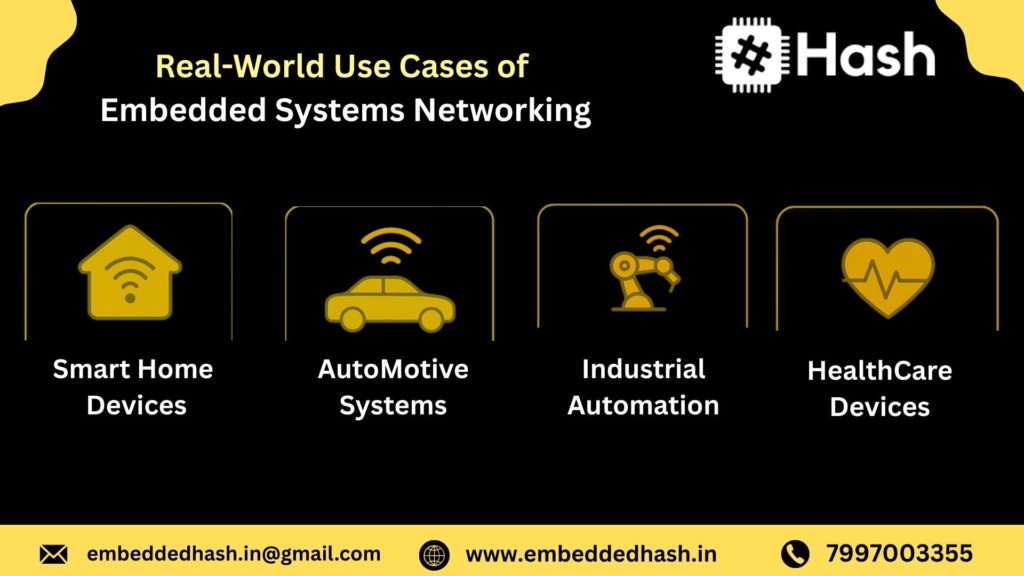
Real-World Use Cases of Embedded Systems Networking
Embedded systems networking powers the invisible connections behind modern smart devices, industrial automation, and real-time decision-making. From EVs on Indian roads to remote agriculture in rural regions, networked embedded devices make data-driven operations possible with speed, accuracy, and reliability. Here’s how this technology shapes high-impact sectors of 2026 and beyond.
Smart Homes & Consumer IoT
Smart home adoption in India is rising rapidly, driven by affordable Wi-Fi/BLE devices and the expansion of 5G networks. Embedded networking enables seamless communication between sensors, appliances, and cloud platforms.
Key Highlights:
- Voice-controlled ecosystems (Alexa, Google Home) use Wi-Fi + BLE chips inside controllers.
- Smart meters and energy monitors communicate via Wi-Fi, Zigbee, and Thread.
- Security cameras, door locks, smart plugs, AC controllers use embedded microcontrollers with wireless stacks built-in.
Why It Matters:
Fast, secure communication enables features like remote control, automation, over-the-air updates (OTA), real-time alerts, and analytics—making smart homes more reliable and energy-efficient.
Automotive & EV Networks (CAN + Automotive Ethernet)
Modern Indian EVs and connected cars (Tata, Mahindra, Hyundai EVs) increasingly depend on robust embedded networks to coordinate dozens of ECUs.
How Networking Powers Automotives:
- CAN bus ensures reliable communication for braking, powertrain, airbags, and BMS systems.
- Automotive Ethernet supports high-speed data for infotainment, ADAS, parking assist, and autonomous features.
- EV battery systems use CAN FD for faster, error-free diagnostics.
Why It Matters:
With India pushing EV adoption and connected vehicle policies, networking ensures safety, real-time response, remote diagnostics, and OTA firmware updates for fleets.
Industrial IoT & SCADA
Manufacturing hubs across India—Hyderabad, Pune, Chennai, Noida—are shifting toward Industry 4.0. Embedded networking plays a central role in enabling automation, predictive maintenance, and machine connectivity.
Key Use Cases:
- PLCs and motor controllers use Modbus, PROFIBUS, and Industrial Ethernet.
- SCADA systems collect live metrics (temperature, vibration, load) from embedded nodes.
- Factories deploy wired Ethernet for deterministic, low-latency control loops.
Why It Matters:
Networked embedded devices improve uptime, reduce manual intervention, and enable advanced analytics—critical for competitive manufacturing and export-oriented industries.
Healthcare & Wearable Devices
From fitness bands to remote patient monitoring systems, embedded networking makes health data continuously available.
Where It’s Used:
- Wearables: Smartwatches, ECG patches, SpO₂ monitors using BLE + low-power MCUs.
- Medical devices: Infusion pumps, ventilators, imaging systems using Ethernet/Wi-Fi.
- Cloud-integrated health dashboards for doctors and caretakers.
Why It Matters:
Post-pandemic, India has seen massive growth in telemedicine and health IoT. Real-time communication between medical devices supports faster diagnoses and efficient patient care.
Agriculture IoT (LoRa + Solar Nodes)
Agriculture in rural India benefits greatly from long-range, low-power connectivity.
How It Works:
- LoRaWAN nodes transmit soil moisture, weather, and crop health data over several kilometers.
- Solar-powered embedded systems ensure year-round operation in remote fields.
- Gateways connect to cloud platforms for analytics and automated irrigation.
Why It Matters:
This transforms traditional farming into precision agriculture—improving yield, reducing water usage, and empowering farmers with data-driven insights.
Step-by-Step Implementation Examples
Real-world examples make embedded networking easier to understand and implement. Below are three practical, industry-level walkthroughs using popular hardware platforms—ESP32, STM32, and LoRaWAN nodes. Each example demonstrates how modern embedded devices connect, communicate, and scale in IoT and industrial environments.
ESP32 Wi-Fi + MQTT Communication Example
This example shows how an ESP32 sends sensor data to an MQTT broker (local or cloud-hosted) using Wi-Fi. It is one of the most commonly used patterns in home automation, industrial monitoring, and consumer IoT projects.
Step-by-Step Implementation:
Set Up the Environment
- Install Arduino IDE or ESP-IDF
- Add ESP32 Board Manager
- Install required libraries: WiFi.h, PubSubClient.h
- Install Arduino IDE or ESP-IDF
Configure Wi-Fi Credentials
const char* ssid = “
const char* password = “YourPass”
Connect to MQTT Broker
- Broker options: Mosquitto (local), HiveMQ, AWS IoT
- Define topic names (e.g., “esp32/temperature”)
Read Sensor - Data (DHT22, BMP180, or internal ADC)
Acquire periodic temperature, humidity, or analog readings.
Publish Data to Broker
Data is sent every few seconds: client.publish(“esp32/temperature”, tempString);
Subscribe to Control Commands (Optional)
The ESP32 can listen to topics like “esp32/ledControl”.
Real-World Use Cases
- Smart home devices
- Environmental monitoring
- Asset tracking dashboards
- Energy meters
- AI-on-edge sensor fusion with lightweight models
STM32 + CAN Bus Networking Example
STM32 microcontrollers are widely used in automotive ECUs, industrial automation, elevators, and robotics. CAN Bus ensures deterministic, fault-tolerant communication.
Step-by-Step Implementation:
- Hardware Setup
- STM32 board with CAN peripheral (e.g., STM32F103/F407)
- MCP2551 or SN65HVD230 CAN transceiver
- 120-ohm termination resistor
- Initialise CAN Peripheral Using STM32CubeMX
- Set CAN bit timing (e.g., 500 kbps commonly used in automotive)
- Enable filters, interrupts, and NVIC configuration
Transmit a CAN Frame
TxHeader.StdId = 0x321;
TxHeader.IDE = CAN_ID_STD;
TxHeader.DLC = 2;
uint8_t data[2] = {0x10, 0x20};
HAL_CAN_AddTxMessage(&hcan, &TxHeader, data, &mailbox);
Receive CAN Messages
- Implement HAL_CAN_RxFifo0MsgPendingCallback() handler
- Parse ID, DLC, and payload
Error Handling- Check for bus-off, error passive, or overload frames
- Reinitialize CAN if needed
Real-World Use Cases
- Automotive ECU communication
- Industrial machinery networks
- Medical device coordination
- Robotics joint controllers
- Distributed sensor networks
LoRaWAN Node → Gateway → Cloud Example
LoRaWAN is ideal for long-range, low-power IoT systems—smart agriculture, energy monitoring, and remote industrial telemetry.
Step-by-Step Implementation:
- Prepare Hardware
- LoRaWAN node (Arduino + RFM95, ESP32 LoRa, or STM32WL)
- LoRaWAN gateway (RAK, Kerlink, Dragino)
- Cloud network server (The Things Network, ChirpStack)
- Register Device on Network Server
- Set Device EUI, App EUI, and App Key
- Choose OTAA (recommended) or ABP activation
- Initialize LoRaWAN Stack
- Use LMIC, LoRaMAC-node, or vendor SDK
- Configure frequency plan (India: IN865 band)
- Send Uplink Data
Example payload: temperature, soil moisture, battery level
Node → Gateway → Network Server → Cloud App Dashboard - Receive Downlinks (Optional)
For configuration updates or actuator control. - Cloud Integration
- Ingest data into MQTT, Node-RED, AWS IoT, or Grafana
- Enable alerts, dashboards, and analytics
Real-World Use Cases
- Smart farming (soil, weather, irrigation control)
- Smart city sensors (waste bins, street lighting)
- Utility metering (water, electricity, gas)
- Remote site monitoring (telecom towers, pipelines)
Battery-powered long-range tracking
Choosing the Right Embedded Networking Protocol
Selecting the right networking protocol is one of the most critical decisions in embedded systems design. The wrong choice can lead to latency issues, excessive power consumption, or integration nightmares. To make an informed decision, engineers must consider device constraints, data throughput requirements, network topology, range, and security needs.
Protocol Selection Decision Table
This table acts as a practical guide for engineers in India’s growing embedded ecosystem— whether you’re in Hyderabad, Bengaluru, Pune, or Chennai, it helps you align protocol choices with local IoT deployment scenarios.
Wired vs Wireless — A Practical Framework
Wired protocols (SPI, I²C, Ethernet, CAN) are stable, high-speed, and low-latency, making them ideal for industrial automation, automotive ECUs, and robotics. Wireless protocols (Wi-Fi, BLE, Zigbee, LoRaWAN, 5G) excel in flexibility and remote monitoring, especially for smart homes, wearables, and IoT networks.
Key considerations:
- Reliability: Wired is less prone to interference; wireless may require redundancy.
- Mobility: Wireless enables remote and mobile devices.
- Installation Cost: Wired networks may have higher upfront cost but lower long-term maintenance.
- Scalability: Wireless networks are easier to expand in large deployments like smart cities.
Short-Range vs Long-Range — Selection Guide
- Short-range (<100m): BLE, Zigbee, I²C, UART – ideal for sensors, wearables, and intra-device communication.
- Medium-range (100m–1km): Wi-Fi, CAN, Ethernet – suitable for industrial IoT, smart building networks.
- Long-range (1km–10+km): LoRaWAN, 5G – perfect for agriculture, smart city infrastructure, and remote monitoring.
Latest Trends in Embedded Systems Networking
Embedded networking is rapidly evolving. Engineers must stay ahead of the curve to deliver efficient, secure, and future-ready devices.
Edge AI + Networked Embedded Systems
Edge AI allows embedded devices to process data locally, reducing latency and bandwidth needs. Networked embedded systems with edge AI are transforming industrial IoT, predictive maintenance, and robotics, enabling real-time decision-making without relying solely on the cloud.
Matter Protocol for Cross-Brand Smart Devices
Matter, formerly known as Project CHIP, is revolutionizing smart home interoperability. It allows devices from different brands to communicate seamlessly over IP-based networks, making it easier for Indian consumers and developers to build cross-brand smart ecosystems.
5G IoT Adoption
5G is no longer futuristic—it’s here in India’s major tech hubs. With ultra-low latency and high bandwidth, 5G enables real-time industrial control, autonomous vehicles, remote health monitoring, and massive IoT networks. Embedded engineers are now designing 5G-ready modules for connected devices.
Zero-Trust Security for Embedded Devices
Security is no longer optional. Zero-trust architecture ensures every device, data packet, and network interaction is authenticated and verified, protecting against cyberattacks in connected environments. This is especially critical for IoT, medical devices, and automotive embedded systems.
Conclusion — Embedded Systems Networking
As embedded devices evolve from standalone modules to intelligent, interconnected systems, the networking layer has become the defining pillar of modern innovation. Whether it’s real-time industrial automation in Hyderabad, connected vehicles on Indian highways, or smart healthcare devices across global markets, the ability of embedded systems to communicate reliably determines their true value.
By selecting the right communication protocols, ensuring robust security, and designing for scalability, engineers can build products that are not only technically strong but also future-proof. In 2026 and beyond, success in embedded engineering will belong to teams that treat networking not as an add-on, but as a core architectural strength—linking hardware, software, cloud, and intelligence into one cohesive ecosystem.
The future of embedded systems is hyper-connected. And the networking layer is what makes it possible.

Frequently Asked Questions
Embedded systems networking refers to the communication layer that connects microcontrollers and embedded devices using wired or wireless protocols to exchange data.
Common protocols include UART, SPI, I²C, CAN, Ethernet, Wi-Fi, BLE, Zigbee, LoRa, and 5G.
Networking enables devices to share real-time data, integrate with IoT platforms, and support remote monitoring, making systems smarter and more efficient.
Wired networking (like SPI, I²C, CAN, Ethernet) is faster and more reliable, while wireless (Wi-Fi, BLE, Zigbee, LoRa) offers flexibility and mobility.
Protocols like BLE and LoRa are designed for low-power operation, which is crucial for battery-powered devices and IoT nodes.
Security risks include unauthorized access, data tampering, and firmware attacks. Using encryption, secure boot, and authentication mitigates these threats.
Yes, embedded devices can connect to cloud platforms like AWS IoT, Azure IoT, or GCP IoT Core for data analytics, OTA updates, and remote monitoring.
CAN (Controller Area Network) is a robust wired protocol widely used in automotive and industrial automation for reliable real-time communication.
It depends on the application. BLE, Zigbee, and LoRa are ideal for low-power, long-range IoT sensor networks.
Consider data rate, power consumption, range, real-time requirements, and scalability when selecting a protocol.
Yes, Ethernet is widely used in industrial automation, robotics, and high-speed IoT devices for reliable wired communication.
If you want to Learn more About Embedded Systems, join us at Embedded Hash for Demo Enroll Now


 embeddedhash.in@gmail.com