
Embedded Systems Mini Project
Embedded Systems mini projects are one of the best ways for students and beginners to learn how real electronic systems work. Whether you’re preparing for a job, building your portfolio, or planning to join an Embedded Systems Course in Hyderabad, mini projects give you the hands-on experience companies now expect.
Definition—What Is an Embedded Systems Mini Project?
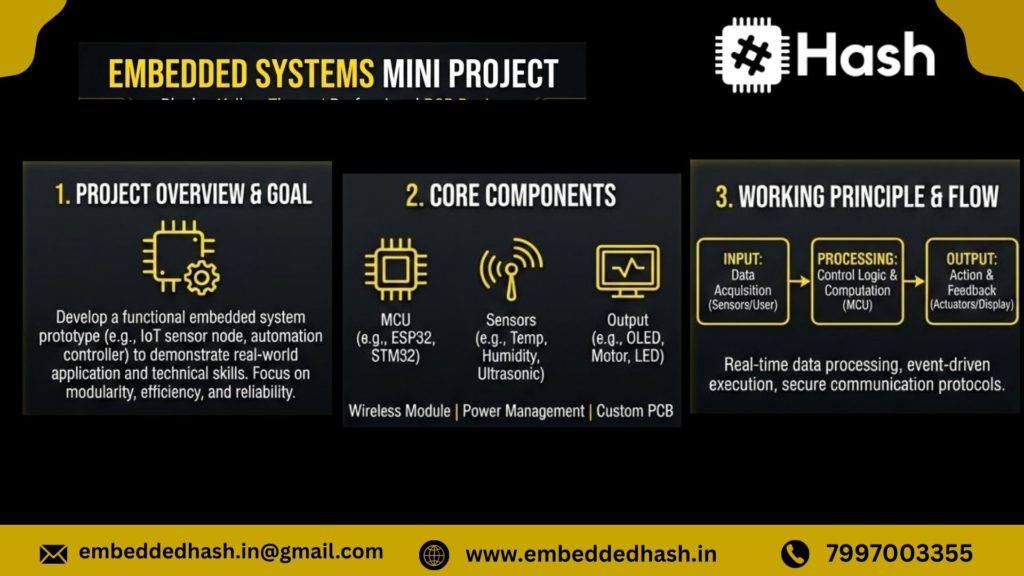
An Embedded Systems Mini Project is a small, hands-on electronics project where a student uses a microcontroller, sensors, and simple code to build a real working system.
Think of it as the “practice version” of what engineers build in companies like Bosch, Qualcomm, NXP, Honeywell, and Tata Elxsi in Hyderabad.
In simple words:
A mini project is a small embedded application that solves one problem using hardware + software.
For example:
- A temperature-controlled fan
- A smart street light
- A home automation switch
- A water level indicator
These projects help you learn how embedded basics actually work — not just in theory, but in real life.
Why Mini Projects Matter for Jobs
Today, companies expect freshers to show practical skills, not just write exams.
This is even more true in Hyderabad’s fast-growing tech areas like Madhapur, Hitech City, Kukatpally, and Gachibowli, where embedded hiring has become highly competitive.
Mini projects help you:
Out in Interviews
HR and technical interviewers often ask:
“What projects have you done on your own?”
Candidates with real microcontroller projects get shortlisted faster.
Build a Job-Ready Portfolio
A good portfolio project shows you understand:
- Inputs (sensors)
- Processing (microcontroller logic in Embedded C)
- Outputs (actuators/displays)
This is exactly what companies look for in Embedded, IoT, and Automotive roles.
Show Hands-On Experience
Even if you’re a beginner, a working mini project proves that you:
- Can write and debug basic Embedded C code
- Understand circuit wiring
- Know how to test and deploy embedded hardware
- Can use platforms like Arduino, ESP32, STM32, PIC, or Raspberry Pi
These skills matter more than memorizing definitions from textbooks.
How Mini Projects Build Real-World Skills
Mini projects prepare you for bigger career paths such as IoT, Robotics, Automotive Embedded Systems, and AI-enabled devices.
Here’s how:
1. C Programming Mastery
You learn how to write logical, optimized code for:
- GPIO control
- Timers
- Interrupts
- Sensor data processing
- Communication protocols
You can also explore advanced learning from our Embedded C
2. Hardware Understanding
You get hands-on practice with:
- Breadboards and PCBs
- Sensors (temperature, motion, humidity, IR)
- Actuators (motors, buzzers, relays)
- Power supply circuits
This builds the confidence you need before joining an Embedded Systems
3. IoT & Connectivity Skills
Modern projects use WiFi, Bluetooth, MQTT, and cloud dashboards.
Building mini IoT systems makes you ready for:
- IoT Course
- Home automation jobs
- Industry 4.0 applications
4. Problem-Solving & Debugging Skills
You learn how to:
- Read datasheets
- Fix wiring errors
- Debug code
- Test hardware
These skills are essential for real embedded jobs.
Who Should Start with Mini Projects?
- Engineering students (ECE / EEE / CSE / IT)
- Diploma electronics students
- Job seekers preparing for embedded roles
- Anyone planning to enter Automotive Embedded Systems or AUTOSAR
Even if you’re a complete beginner, mini projects give you the perfect foundation.
Why Mini Projects Matter for Students & Job Seekers
If you are an engineering or diploma student in Hyderabad, doing Embedded Systems Mini Projects is no longer optional — it’s one of the biggest selection factors for fresher jobs in 2026.
Companies in Hyderabad want candidates who can build, test, and explain real electronic systems, not just memorize theory.
Let’s understand why mini projects have become so important for students and job seekers.
Growing Embedded Job Demand
Hyderabad is now one of India’s fastest-growing embedded and semiconductor hubs.
Major tech zones like Hitech City, Gachibowli, Madhapur, Kukatpally, Financial District, and Uppal are home to:
Top Embedded & Semiconductor Companies
- Qualcomm
- NXP
- AMD
- NVIDIA
- Intel
- Micron
- Broadcom
Automotive & EV Companies Hiring Embedded Engineers
- Tata Elxsi
- Bosch
- Hyundai Mobis
- Motherson
- Ola Electric
- Mahindra Electric
IoT, Automation & AI Startups (Madhapur, Hitech City)
- Smart home startups
- Industrial IoT companies
- Robotics companies
- Health-tech device startups
All these companies need embedded fresher talent — but only those who can show hands-on projects get shortlisted.
This is why building electronics mini projects gives you a huge advantage in Hyderabad’s job market.
What Recruiters Expect From Freshers
During interviews, Hyderabad recruiters repeatedly look for three things:
1. Can You Build Something Real?
Recruiters want to see whether you can connect:
- Sensors
- Microcontrollers
- Displays
- Motors
- Code
A single working mini project proves your practical skills.
2. Can You Code in Embedded C?
Most companies use Embedded C, not Arduino drag-and-drop style coding.
If your mini project includes:
- Timers
- Interrupts
- UART/I2C/SPI
- Task handling…you automatically stand out.
3. Can You Explain Your Project Clearly?
Interviewers ask:
- What problem does your project solve?
- What microcontroller did you choose and why?
- How did you handle errors?
- What improvements can you add?
Mini projects give you strong, confident answers.
Mini Projects That Impress Hiring Managers
Here are project types that Hyderabad recruiters LOVE because they show real-world skills:
IoT-Based Mini Projects
- Smart Home Automation System (ESP32)
- IoT Weather Monitoring Dashboard
- Smart Energy Meter with Cloud Logging
Shows: IoT, APIs, WiFi, MQTT, app integration
Automotive Embedded Mini Projects
- CAN-based speed monitoring system
- Parking assistance with ultrasonic sensors
- Battery Management System simulation
Shows: Strong fundamentals for Automotive Embedded Systems
Embedded C + Hardware Projects
- Temperature-controlled DC fan
- Automatic street lighting
- Water level controller with buzzer
Shows: Real understanding of GPIO, PWM, sensors, interrupts.
AI + Embedded Mini Projects (Modern Trend)
- Face-detection door lock (ESP32-CAM)
- Smart traffic density system
Shows: Combination of AI + Edge devices — very attractive for Hyderabad startups.
Why Mini Projects Matter More
Hyderabad’s tech ecosystem is built around product-based companies and R&D centers, which value:
- Practical implementation
- Debugging skills
- Creativity
- Self-learning ability
Mini projects demonstrate all these qualities, making you a top choice for recruiters
Top 15 Embedded Systems Mini Project Ideas (Beginner + Intermediate)
Looking for simple, practical, and job-oriented Embedded Systems mini projects?
Here are the top project ideas with clear descriptions, required skills, and industry relevance.
These projects cover Arduino, PIC, ESP32, IoT, Automotive, and Embedded Linux — perfect for students in Hyderabad who want to build resume-ready skills.
If you are planning to learn Embedded Systems professionally, explore:
Embedded Systems Course in Hyderabad
Project Ideas Table (Beginner → Job-Ready)
No. | Project Name | Level | Short Description (AEO-Optimized) | Skills Gained | Best For |
1 | LED Blinking System | Beginner | Simple LED blink using Arduino/PIC with variable delays. | GPIO control, timing, basic coding | First-time learners |
2 | Temperature Monitor Using LM35 | Beginner | Reads temperature via LM35 and displays value on LCD/Serial Monitor. | ADC, sensor interfacing, data conversion | IoT and weather-based starter projects |
3 | IR-Based Obstacle Detector | Beginner | IR sensor detects obstacles and activates buzzer/LED. | Digital input, threshold detection | Robotics and automation basics |
4 | Smart Door Lock (Basic Model) | Beginner | Keypad inputs control a servo motor for locking/unlocking. | Keypad scanning, PWM, security logic | Entry point to smart security systems |
5 | IoT Home Automation (ESP32/NodeMCU) | Intermediate | Control appliances using mobile app/cloud dashboard. | WiFi, MQTT/HTTP, relays, cloud setup | IoT-focused Hyderabad startups |
6 | Smart Energy Meter | Intermediate | Measures voltage/current and calculates power consumption; optional IoT logging. | Sensors (ACS712), ADC, data processing | Smart home and EV charging systems |
7 | RFID Attendance System | Intermediate | RFID card authentication with data stored on LCD or cloud. | RFID communication, UART/I2C | Access control and corporate systems |
8 | Gas Leakage Alert (MQ-2 Sensor) | Intermediate | Detects LPG/CO gas and triggers alarm or SMS alert. | Analog sensor reading, alerts, safety design | Home and industrial safety applications |
9 | Bluetooth-Controlled Robotic Car | Intermediate | Mobile-controlled robot car using HC-05 Bluetooth module. | PWM, motor control, serial communication | Robotics competitions and academic demos |
10 | CAN Bus Automotive Model | Job-Ready | Simulates communication between ECUs using CAN protocol. | CAN frames, arbitration, automotive concepts | Automotive Embedded roles in Hyderabad (Tata Elxsi, Bosch, Mobis) |
11 | Embedded Linux Mini Project | Job-Ready | GPIO control and driver basics using Raspberry Pi/BeagleBone. | Linux commands, device trees, applications | R&D and semiconductor companies |
12 | ESP32 Wi-Fi + Cloud Dashboard | Job-Ready | Control devices and monitor sensors on Firebase/AWS dashboard. | Cloud APIs, real-time databases, IoT workflow | IoT engineers and product developers |
13 | Smart Agriculture Monitoring System | Job-Ready | Tracks soil moisture, temperature, humidity; sends data to cloud/app. | Sensor fusion, automation logic, IoT dashboard | AgriTech startups in Telangana |
14 | Real-Time Vehicle Tracking (GPS + GSM) | Job-Ready | GPS module sends live location via GSM/SMS to user. | UART, GPS parsing, communication protocols | Logistics and fleet management |
15 | Home Security with Motion Detection | Job-Ready | PIR detects motion and triggers alarm or mobile notification. | Interrupts, sensors, optional IoT | Home automation portfolios |
Step-by-Step Guide: How to Build an Embedded Systems Mini Project
Building an embedded systems mini project may feel complicated at first, but the process becomes simple once you follow a clear roadmap. This step-by-step guide is designed for beginners, students, and job seekers in Hyderabad who want hands-on experience that strengthens both skills and resumes.
If you are completely new to embedded systems, you can also start with a formal course like the Embedded Systems Course in Hyderabad to build strong fundamentals before doing projects.
Below is the complete workflow used by engineers in real companies, explained in a beginner-friendly way.
Step 1 — Choose Your Microcontroller
The microcontroller is the brain of your project. It controls sensors, processes data, and performs actions. Choosing the right board depends on your project goal and your programming comfort.
Arduino
Arduino is the most beginner-friendly microcontroller.
It uses simple C/C++ and is perfect for students working on basic electronics projects.
Choose Arduino if your project involves:
- LED control
- Basic sensors
- Motor driving
- Simple automation
Why students in Hyderabad prefer it:
Arduino is available at low cost in local markets like Ameerpet and online stores. It is ideal for academic mini projects.
ESP32
ESP32 is a smart controller with built-in Wi-Fi and Bluetooth. It is best for IoT-based mini projects.
Choose ESP32 if your project involves:
- Home automation
- Wireless sensor monitoring
- Cloud-based IoT dashboards
Raspberry Pi
Raspberry Pi is not just a microcontroller; it is a mini-computer. It supports Python and advanced processing.
Choose Raspberry Pi if your project involves:
- AI/ML applications
- Image processing
- High-speed automation
Raspberry Pi is common among engineering students building innovative projects for competitions or internships.
Step 2 — Gather Components
After choosing the microcontroller, the next step is collecting components. Your component list depends on your project type, but some essentials remain the same.
Common components include:
- Sensors (temperature, motion, light, gas, IR)
- Modules (Bluetooth, Wi-Fi, GSM, GPS, relay modules)
- Power supply (battery, adapter, power bank)
- Breadboard and jumper wires
- Actuators (motors, buzzers, servos, relays)
Local availability in Hyderabad:
Most students buy components from Ameerpet, Koti, and online platforms because prices are affordable and delivery is fast.
Tip:
Always buy one spare sensor or jumper wire pack to avoid delays during debugging.
Step 3 — Write and Upload Code
Coding is the core of any embedded project. Your choice of programming language depends on the board you selected.
C/C++ for Arduino and ESP32
Arduino IDE uses a very simple version of C/C++, making it perfect for beginners.
You write logic such as reading sensors, controlling motors, or sending data.
If you want to master embedded programming deeply, check out Embedded C Training in Hyderabad, which covers real company-level coding skills.
Python for Raspberry Pi
Raspberry Pi supports full Python programming.
It is ideal for:
- Data processing
- AI/ML tasks
- Image recognition
- Automation scripts
You can also combine Python with hardware using libraries like GPIO Zero or RPi.GPIO.
For students interested in ML-based embedded projects, AI and ML can strengthen core concepts.
MicroPython for ESP32
MicroPython lets you control hardware using Python instead of C.
It is easy, fast, and ideal for IoT beginners.
Step 4 — Testing and Debugging
Testing ensures your project works safely and correctly. Debugging helps you identify mistakes quickly.
Using Serial Monitor
Every beginner must learn how to use the serial monitor in Arduino IDE or Thonny.
It displays all sensor readings and helps you understand whether the project is working correctly.
Example uses:
- Checking if sensor values are changing
- Identifying faulty wiring
- Debugging Wi-Fi connection issues
Oscilloscope Basics
An oscilloscope helps visualize electrical signals.
You do not need an expensive device; even a basic USB oscilloscope works for student projects.
Use it for:
- Checking signal quality
- Understanding PWM
- Debugging noisy sensor outputs
Students doing Automotive Embedded Systems Training in Hyderabad or AUTOSAR Training in Hyderabad often learn oscilloscope usage because it is widely used in the automotive industry.
Step 5 — Document Your Project
Documentation is one of the most important but underrated steps.
A well-documented mini project increases your chances of getting shortlisted for embedded and IoT job interviews.
Your documentation should include:
- Project title
- Problem statement
- Components list
- Circuit diagram
- Code with comments
- Testing report
- Final output photos or videos
Benefits for your resume and interview portfolio:
- Helps you explain your project clearly
- Shows companies that you can follow engineering practices
- Adds strong weight to your LinkedIn profile
- Becomes a talking point in technical interviews
If you plan to apply for embedded engineering roles in Hyderabad, a well-documented project can make your resume stand out instantly.
Embedded Systems Course Roadmap (Modules + Timeline)
If you want to start a career in embedded systems, following a structured roadmap is the most important step. A clear learning path helps beginners understand what to study first, how long each module takes, and how to progress from basics to job-ready skills.
This roadmap is designed based on industry expectations in Hyderabad, especially roles in embedded development, IoT engineering, and automotive software. Many training institutes in Hyderabad follow a similar structure, including our recommended and Embedded Systems Institute in Hyderabad.
This roadmap covers:
- Core programming skills
- Microcontroller architecture and hands-on peripherals
- RTOS concepts
- IoT and communication protocols
- Final capstone mini project with resume support
Overall timeline: 8 to 12 weeks, depending on learning speed and practice intensity.
If you follow this roadmap completely, you will be ready for internships, entry-level embedded roles, and advanced learning paths like Automotive Embedded Systems Training in Hyderabad, AUTOSAR Training in Hyderabad, and Embedded C Training in Hyderabad.
Module 1 — C Programming Fundamentals
C programming is the foundation of all embedded systems. Almost every microcontroller, automotive ECU, and IoT device uses C because it is fast, memory-efficient, and gives low-level hardware control.
This module focuses on concepts that directly matter when writing firmware.
Key Topics Covered
- Memory Management
Understanding memory layout (stack, heap, text, data) is essential for debugging and optimization. Embedded developers must know how programs store variables, how memory is allocated, and how to avoid memory leaks on resource-limited devices. - Pointers
Pointers allow direct access to memory addresses. In embedded programming, we use pointers to access registers, manage buffers, and interact with hardware peripherals. Without pointers, register-level programming is not possible. - Structures
Structures help group multiple related variables. They are widely used in device drivers, communication frames, and sensor data representation.
Why this module matters
Almost 60 percent of embedded job interviews in Hyderabad begin with C programming fundamentals. Mastering these topics will prepare you for technical rounds and coding tests. Students who are weak in memory and pointers usually struggle later while learning microcontrollers.
If you want a deeper foundation, you can refer to our detailed Embedded C Training in Hyderabad course page.
Module 2 — Microcontrollers and Peripherals
After learning C, the next step is understanding how microcontrollers work. In this module, students learn register-level programming and how embedded devices interact with the external world.
Most institutes use ARM Cortex-M or AVR microcontrollers. In Hyderabad, ESP32 and STM32 have become very popular due to industry demand.
Topics Covered
- GPIO (General Purpose Input Output)
GPIO pins allow the microcontroller to read switches, buttons, sensors, and control LEDs, motors, or relays.
You learn:
- Input/output configuration
- Pull-up and pull-down resistors
- Interrupt handling
- Debouncing techniques
- Timers
Timers generate accurate delays, measure time intervals, and create PWM signals.
Applications include motor control, LED dimming, and communication timing. - UART, SPI, and I2C
These are the most important communication protocols in embedded systems.
- UART is used for debugging, GPS modules, Wi-Fi modules
- SPI for displays, SD cards, high-speed sensors
- I2C for temperature sensors, RTC modules, EEPROM
Understanding protocol configuration, registers, and interrupt-driven communication makes you job-ready for embedded driver development roles.
Why this module matters
Companies in Hyderabad expect freshers to write basic drivers for UART, GPIO, and timers. Completing this module ensures you can work confidently on real hardware in labs or during interviews.
To explore related courses, you can check our IoT Course in Hyderabad or Embedded Systems Course in Hyderabad.
Module 3 — RTOS Basics
Most modern embedded products use an RTOS (Real-Time Operating System) to manage tasks efficiently—especially in automotive, robotics, and IoT applications.
This module introduces you to real-time concepts that companies expect from entry-level engineers.
Topics Covered
- Tasks
A task is a small, independent program running inside the firmware.
You learn how to create, schedule, and manage multiple tasks. - Scheduling
RTOS uses priority-based scheduling to decide which task runs next.
Students learn:
- Preemptive scheduling
- Time slicing
- Task priority design
- Context switching
Why this module matters
Automotive software companies and IoT startups in Hyderabad frequently use FreeRTOS or similar RTOS platforms. Understanding tasks and scheduling makes it easier to transition into advanced fields such as AUTOSAR Training in Hyderabad and Automotive Embedded Systems Training in Hyderabad.
Module 4 — IoT and Wireless Systems
IoT is one of the fastest-growing sectors in Hyderabad, with strong demand from smart device companies, startups, and automation firms. This module introduces wireless networks and cloud integration.
Topics Covered
- ESP32
The ESP32 is a powerful Wi-Fi and Bluetooth-enabled microcontroller used in real-world IoT products.
Students learn how to:
- Program Wi-Fi networks
- Read sensor data
- Send data to cloud platforms
- MQTT Protocol
MQTT is the most widely used IoT communication protocol.
You learn how to:
- Publish sensor data
- Subscribe to cloud commands
- Manage IoT message flow
This module builds the foundation needed for advanced IoT roles and complements the AI and ML Courses in Hyderabad, especially when working on edge-AI applications.
Module 5 — Capstone Mini Project
Timeline: 8 to 12 weeks
Outcome: Job-ready mini project + resume support
This is the final and most important part of the embedded systems learning journey. The capstone project gives students the opportunity to apply everything they learned—C programming, microcontroller drivers, RTOS, and IoT concepts.
What students build
You will develop a complete embedded mini project with:
- Hardware setup
- Sensor integration
- Communication protocols
- Real-time task flow
- Testing and debugging
- Documentation
Examples of projects:
- Smart home automation system
- IoT energy monitoring device
- RTOS-based industrial controller
- Automotive sensor monitoring unit
Outcome
After completing the project, you receive:
- A job-ready mini project
- Resume and GitHub support
- Interview preparation guidance
- Portfolio building support
This project dramatically improves your chances of landing embedded jobs or internships in Hyderabad. Many companies look for candidates who can demonstrate hands-on skills beyond theory.
Tools You Need for Embedded Systems Mini Projects
To build any successful Embedded Systems mini project, you need the right combination of software IDEs and hardware tools. Whether you are a beginner or preparing for job roles in Hyderabad’s fast-growing embedded industry, the following tools will help you design, test, and debug your projects efficiently.
1. Arduino IDE
The Arduino IDE is one of the most beginner-friendly tools for learning embedded programming. It supports C and C++, comes with ready-made libraries, and allows quick prototyping.
If you are building projects like sensors, motor control, home automation, or IoT prototypes, Arduino IDE gives you a smooth starting point.
Key advantages:
- Simple interface for beginners
- Built-in examples and libraries
- Supports almost all Arduino boards
- Great for rapid prototyping and testing ideas
If you are just getting started, consider learning the basics of Embedded C as well.
Check: Embedded C Training in Hyderabad
2. MPLAB X IDE
MPLAB is the official IDE for programming PIC microcontrollers. Many automotive and industrial companies in Hyderabad rely on PIC-based systems, so learning MPLAB gives you an advantage.
Highlights:
- Professional tool used in real industry
- Supports debugging and simulation
- Integrates seamlessly with XC8/XC16 compilers
- Great for embedded control, motor drivers, and industrial automation projects
Recommended for students aiming for core embedded job roles.
3. STM32CubeIDE
If you want to move beyond basic boards and enter the world of ARM Cortex-M microcontrollers, STM32CubeIDE is the best option. Many companies working in firmware, robotics, and automotive embedded systems use STM32.
Why it’s powerful:
- IDE + code generator + debugger in one tool
- Supports HAL and LL drivers
- Ideal for advanced embedded systems mini projects
- Best choice for learning real-time firmware development
For career-focused learners, STM32 knowledge strongly improves job chances in Hyderabad.
4. VS Code + PlatformIO
VS Code is one of the most flexible and modern IDEs for embedded programming. With the PlatformIO extension, you can program multiple boards such as Arduino, ESP32, STM32, and more.
Benefits:
- Clean and powerful coding environment
- Supports linting, auto-completion, Git, and CI/CD
- Easily portable across systems
- Ideal for IoT, robotics, and research-based mini projects
Perfect for students who want a more professional coding workflow.
If you plan to focus on IoT-based mini projects, explore: IoT Course in Hyderabad
5. Essential Hardware Tools
Along with IDEs, the following hardware tools are mandatory for any embedded mini project:
Multimeter
Used for checking voltage, current, continuity, and debugging power issues.
Beginners often struggle due to wrong power supply connections. A multimeter prevents that.
Jumper Wires and Breadboard
These allow quick circuit prototyping without soldering.
If you want to iterate faster and test multiple project ideas, breadboards are extremely useful.
USB-to-UART Converter
Helps in flashing firmware and debugging serial outputs.
Additional Tools
- Soldering iron (for permanent connections)
- Oscilloscope (optional but useful for advanced debugging)
- Power supply module
If you want hands-on access to all required tools, check: Embedded Systems Institute in Hyderabad
Common Mistakes Students Make and How to Avoid Them
Most beginners face similar problems when building embedded mini projects. Understanding these mistakes will help you avoid frustration, save time, and complete your projects more confidently.
1. Poor Documentation
Many students write code and build circuits without maintaining notes or diagrams. Later, when debugging or presenting the project, they get stuck.
How to avoid it:
- Always sketch your circuit diagram
- Maintain a simple project log
- Record pin configurations, sensor connections, and code versions
- Use GitHub for version control if possible
Good documentation also makes your project look more professional, especially during job interviews.
2. Wrong Power Supply
This is the most common beginner error. Supplying incorrect voltage or current to microcontrollers or sensors can damage your components instantly.
Prevention tips:
- Always check datasheets
- Use a regulated power supply
- Verify connections using a multimeter
- Avoid powering motors directly from microcontrollers
3. Code Not Modular
Beginners often write long code inside a single loop or function. This makes debugging extremely difficult.
Better approach:
- Break code into small reusable functions
- Separate hardware initialization and logic
- Use meaningful variable names
- Test each module separately before combining them
Modular code is also a requirement in companies working with AUTOSAR and automotive embedded systems.
4. No Comments in Code
Writing code without comments is one of the biggest embedded project mistakes.
When you revisit the code after a few days, it becomes very difficult to understand.
Fix this by:
- Adding short comments for every important logic
- Explaining formulas or calibration values
- Writing the purpose of each function
- Using structured formatting
Good commenting is an essential skill for real-world firmware development.
Conclusion — Build Mini Projects to Build Your Career
Mini projects are the fastest and most practical way to start your journey into embedded systems. They help you learn microcontrollers, sensors, coding, debugging, and real-time problem solving.
If you are preparing for job roles in Hyderabad’s embedded and automotive industry, completing a few well-structured mini projects will make your resume stronger and increase your confidence.
Whether you choose Arduino, PIC, ESP32, or STM32, the key is to practice consistently, document your work, and follow good development habits. Every project you build takes you one step closer to becoming a skilled embedded engineer.
If you want hands-on guidance, real hardware practice, and industry-level mini project support, you can enrol in our Embedded Systems Course in Hyderabad and start building real-world projects from day one.

Frequently Asked Questions
The easiest mini projects are LED blinking, temperature monitoring using a sensor, and simple motor control. These require very basic coding and low-cost components, making them ideal for first-time learners.
Arduino is the best for beginners because it is easy to program. ESP32 is preferred for IoT and Wi-Fi-based projects. STM32 is suitable for advanced, industry-level mini projects where speed and performance matter.
Mini projects build hands-on skills, show your ability to design real systems, and strengthen your resume. Employers look for practical project experience, so even small projects help demonstrate coding, debugging, and hardware knowledge.
You need a microcontroller board, basic sensors, jumper wires, a power supply, a breadboard, and an IDE like Arduino IDE, STM32CubeIDE, or MPLAB X. Optional tools include a multimeter and USB-to-serial converter
Most basic projects take 3–5 days. Intermediate IoT or sensor-based projects take 7–10 days. Advanced real-time or wireless communication projects may take 2–4 weeks depending on complexity.
Choose a project based on your skill level, the components you already have, and the technologies you want to learn next, such as IoT, sensors, wireless communication, or real-time systems.
Basic programming knowledge in C or Embedded C is helpful, but beginners can start with Arduino because it uses simple syntax and has many examples available online.
Arduino is better for complete beginners due to its simplicity. ESP32 is better if you want to build IoT, Bluetooth, or Wi-Fi enabled projects. Many students start with Arduino and later move to ESP32
IoT-based monitoring systems, sensor automation, home automation, robotics, and real-time control projects are highly preferred by recruiters. These projects reflect industry-relevant skills
Yes. Many beginner projects use low-cost components like LEDs, sensors, Arduino boards, and breadboards. Most starter kits under a small budget are enough to complete multiple mini projects.
Students in Hyderabad can join specialized institutes offering practical training in Embedded Systems, Embedded C, IoT, Automotive Embedded, AUTOSAR, and AI-ML. Hands-on lab sessions help students build strong project portfolios.
If you want to Learn more About Embedded Systems, join us at Embedded Hash for Demo Enroll Now


 embeddedhash.in@gmail.com