
Embedded Systems Examples
Real-Life Applications Explained
Embedded systems examples are everywhere, from smartphones and washing machines to cars, medical devices, and smart home products. These dedicated computing systems are designed to perform specific tasks efficiently by combining hardware and software .This guide explains real-world embedded systems examples, their applications, benefits, and why learning embedded systems can open excellent career opportunities.
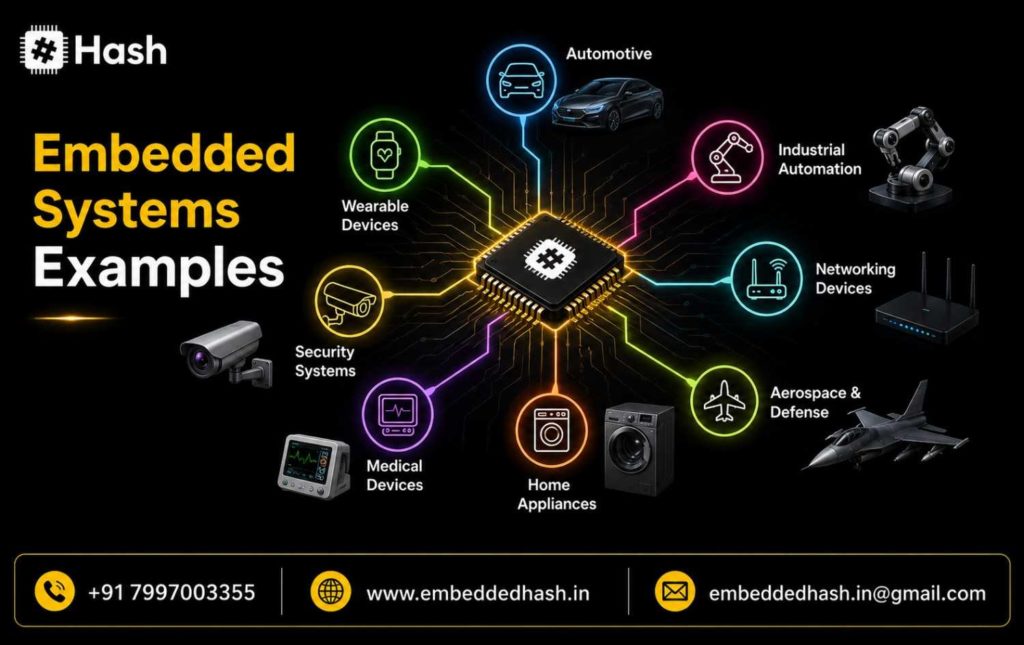
Table of Contents
Introduction to Embedded Systems Examples
- Have you ever wondered how your washing machine automatically selects the right wash cycle? Or how your car reminds you to wear a seatbelt? These everyday features are powered by embedded systems.
- Today, embedded systems are found in almost every electronic product we use. They help devices perform specific tasks quickly, accurately, and with minimal power consumption. From home appliances to medical equipment and industrial machines, embedded systems make modern technology smarter and more reliable.
- If you’re an engineering student, beginner, or someone interested in electronics, learning about embedded systems examples is one of the easiest ways to understand how this technology works in the real world.
- In this guide, you’ll learn what embedded systems are, where they are used, and explore simple, real-life examples across different industries.
What Are Embedded Systems?
An embedded system is a small computer built inside a larger device to perform a specific function. Unlike a desktop or laptop computer that can handle many different tasks, an embedded system is designed for one dedicated purpose.
Most embedded systems combine:
- Embedded hardware such as a microcontroller or microprocessor
- Embedded software and firmware that control the device
- Components like sensors, actuators, and communication modules
- A real-time system that responds quickly when needed
For example, the temperature controller inside an air conditioner continuously reads data from a sensor and adjusts the cooling automatically. The user doesn’t see the embedded system, but it works in the background to keep the room comfortable.
Key Features of Embedded Systems
- Performs a dedicated task
- Fast and reliable operation
- Low power consumption
- Compact design
- Cost-effective
- Can work continuously for years
- Often connected with IoT devices and edge devices
What Are Embedded Systems Examples?
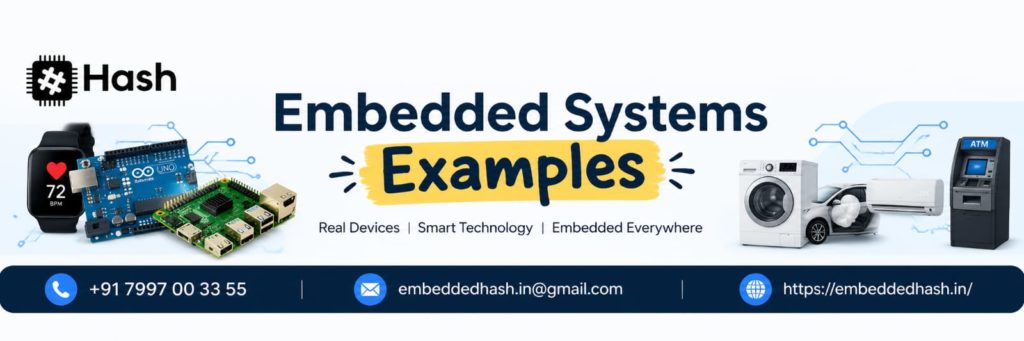
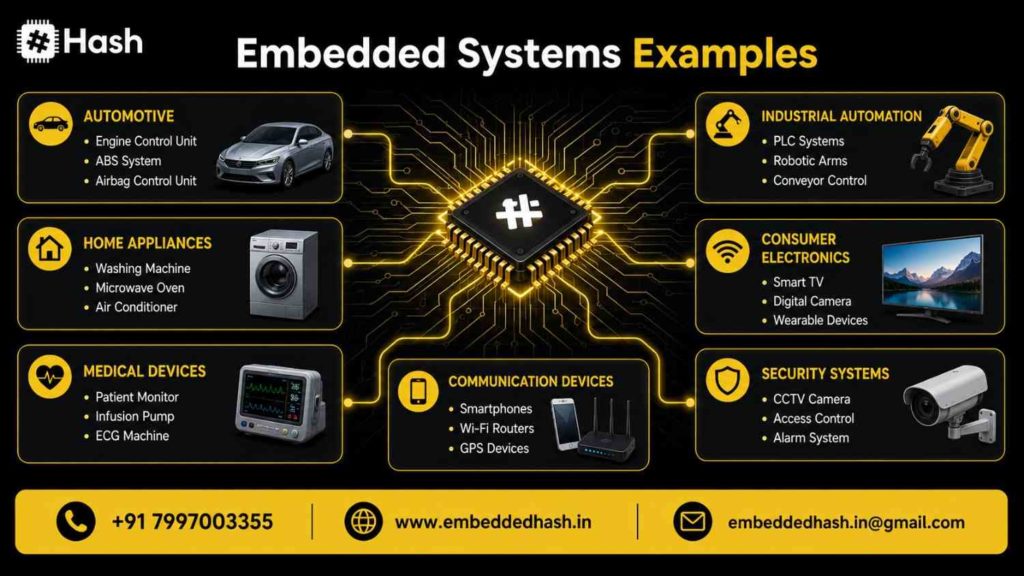
Embedded systems examples are devices that contain a built-in computer to perform a specific job automatically.
Some common examples include:
Device | Embedded System Function |
Washing Machine | Controls washing programs and water levels |
Microwave Oven | Manages cooking time and temperature |
Smart TV | Runs apps, streaming services, and remote functions |
Car ABS | Prevents wheel locking during braking |
Fitness Band | Tracks heart rate and daily activity |
Printer | Controls printing operations |
ATM Machine | Processes secure banking transactions |
Traffic Signal | Controls signal timing automatically |
Smart Door Lock | Provides secure digital access |
Drone | Controls flight stability and navigationSome common examples include: |
These devices use embedded computing to perform one or more dedicated tasks without requiring user intervention for every operation.
Embedded Systems Examples in Daily Life
Many people use embedded systems every day without realizing it. These systems quietly perform important tasks in the background to make life easier, safer, and more convenient.
Some of the most common embedded systems examples in daily life include:
Smartphones:
Although smartphones are powerful computers, they contain several embedded systems that manage:
- Camera functions
- Fingerprint recognition
- Face unlock
- Battery management
- Charging control
Smart Watches:
Smart watches use embedded systems to:
- Monitor heart rate
- Count steps
- Track sleep
- Display notifications
- Measure oxygen levels
Wi-Fi Routers
Your home internet router is another embedded device. It manages:
- Internet connectivity
- Data transmission
- Security
- Network traffic
Digital Cameras:
Embedded systems inside cameras automatically handle:
- Image processing
- Auto focus
- Flash control
- Face detection
Embedded Systems Examples in Home Appliances
Home appliances have become smarter thanks to embedded systems.They combine embedded hardware, firmware, sensors, and actuators to automate everyday tasks while improving energy efficiency.
Washing Machine:
A washing machine relies on an embedded system to control and automate its operations:
- Detect water level
- Control motor speed
- Select wash cycles
- Monitor temperature
- Reduce water consumption
Refrigerator:
Modern refrigerators use embedded systems to:
- Maintain cooling temperature
- Detect when the door is open
- Save energy
- Monitor compressor performance
Microwave Oven:
Embedded systems control:
- Cooking timer
- Heating power
- Touch panel
- Safety lock
Air Conditioner:
Air conditioners use embedded systems to:
- Read room temperature
- Adjust cooling automatically
- Save electricity
- Control fan speed
Smart Vacuum Cleaner:
Robot vacuum cleaners use:
- Distance sensors
- Obstacle detection
- Navigation algorithms
- Automatic charging
Embedded Systems Examples in Automotive
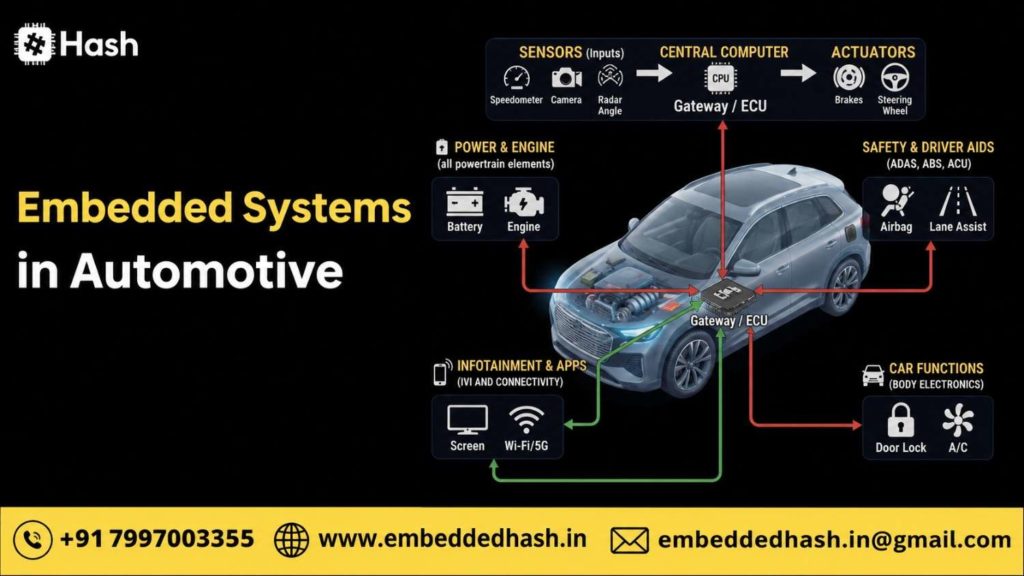
The automotive industry is one of the biggest users of embedded systems. Modern vehicles contain dozens of electronic control units (ECUs) that work together to improve safety, comfort, and performance.
Anti-lock Braking System (ABS)
The embedded system monitors wheel speed and prevents wheels from locking during sudden braking.
Airbag System
Sensors detect a collision and deploy airbags within milliseconds to protect passengers.
Engine Control Unit (ECU)
- Fuel injection
- Ignition timing
- Engine performance
- Emission control
Infotainment System
- Navigation
- Bluetooth connectivity
- Voice commands
- Music and video playback
Parking Assistance
- Using cameras and sensors, embedded systems help drivers park safely by detecting nearby obstacles.
- These technologies make vehicles smarter, safer, and more fuel-efficient.
Embedded Systems Examples in Healthcare
Healthcare depends on reliable embedded systems for accurate monitoring and patient safety. These systems provide real-time data, helping doctors make faster and better decisions.
Patient Monitoring Systems
Hospitals use embedded systems to continuously monitor:
- Heart rate
- Blood pressure
- Oxygen levels
- Body temperature
Glucose Monitoring Devices
These devices help people with diabetes track blood sugar levels quickly and accurately.
Infusion Pumps
Embedded systems control the precise delivery of medication and fluids, reducing the risk of dosage errors.
Digital Thermometers
Embedded sensors measure body temperature and display results within seconds.
Portable ECG Devices
Compact ECG machines record heart activity and allow doctors to monitor patients both in hospitals and remotely.
Healthcare embedded systems improve patient care by delivering accurate measurements, supporting real-time monitoring, and increasing the reliability of medical equipment.
Embedded Systems Examples in Consumer Electronics
Consumer electronics are among the most common embedded systems examples. These devices use embedded hardware and embedded software to perform specific tasks efficiently and provide a better user experience.
Smart TVs
Modern Smart TVs use embedded systems to:
- Stream online content
- Connect to Wi-Fi
- Run apps like YouTube and Netflix
- Accept voice commands
- Display high-quality video
Digital Cameras
Digital cameras use embedded systems to perform functions such as:
- Image processing
- Auto focus
- Face detection
- Flash control
- Video recording
Gaming Consoles
Gaming devices use embedded systems to manage:
- Graphics processing
- Controller communication
- Audio output
- Online connectivity
Wireless Earbuds
Wireless earbuds include embedded systems that:
- Connect through Bluetooth
- Reduce background noise
- Control touch gestures
- Manage battery charging
Smart Speakers
Devices like smart speakers use embedded systems to:
- Recognize voice commands
- Connect to smart home devices
- Play music
- Answer user queries
These products are excellent examples of smart electronics that make daily life more convenient.
Embedded Systems Examples in Industrial Automation
Industries rely on embedded systems to improve productivity, reduce downtime, and increase workplace safety. Most manufacturing plants use industrial automation systems that operate continuously with minimal human intervention.
Programmable Logic Controllers (PLCs)
PLCs control machines in factories by:
- Monitoring sensors
- Controlling motors
- Managing production lines
- Automating repetitive tasks
Industrial Robots
Embedded systems help robots:
- Detect objects
- Control movement
- Perform welding and assembly
- Improve manufacturing accuracy
Conveyor Belt Systems
Factories use embedded controllers to:
- Monitor product movement
- Control belt speed
- Detect faults
- Improve production efficiency
CNC Machines
Computer Numerical Control (CNC) machines use embedded systems for:
- Precision cutting
- Automated machining
- Real-time control
- Consistent product quality
Smart Energy Monitoring
Factories also use embedded systems to:
- Monitor electricity usage
- Reduce energy waste
- Improve equipment efficiency
Industrial embedded systems help companies increase productivity while reducing operational costs.
Embedded Systems Examples in IoT
The Internet of Things (IoT) enables everyday devices to connect and communicate over the internet. Every IoT device contains an embedded system that collects data, processes information, and communicates with other devices.
Smart Home Systems
Examples include:
- Smart lights
- Smart plugs
- Smart door locks
- Smart thermostats
These devices can be managed through a smartphone or a voice assistant.
Smart Agriculture
Embedded systems help farmers by:
- Monitoring soil moisture
- Controlling irrigation systems
- Tracking weather conditions
- Improving crop production
Smart City Solutions
Many cities use embedded systems for:
- Smart traffic lights
- Smart parking systems
- Waste management
- Street lighting
Wearable Devices
Fitness bands and smartwatches collect data using sensors to monitor:
- Heart rate
- Sleep quality
- Daily activity
- Calories burned
Asset Tracking
Businesses use embedded systems with GPS technology to:
- Track vehicles
- Monitor deliveries
- Improve logistics
- Reduce operational delays
As IoT continues to grow, the demand for engineers with embedded systems skills is also increasing.
Why Are Embedded Systems Important?
Embedded systems play a vital role in today’s technology. They make electronic devices faster, smarter, and more reliable while reducing power consumption and operating costs.
Some key benefits include:
- Perform dedicated tasks with high accuracy
- Enable real-time decision making
- Improve device performance
- Reduce power consumption
- Increase product reliability
- Support automation across industries
- Enable communication between connected devices
- Improve user safety and convenience
Without embedded systems, many modern technologies such as smart homes, electric vehicles, medical devices, and industrial automation would not function efficiently.
Embedded Systems Career Opportunities in India
As technologies like IoT, electric vehicles (EVs), robotics, automation, and Edge AI continue to grow, the demand for embedded systems engineers is increasing across India.
Some popular job roles include:
- Embedded Systems Engineer
- Embedded Software Engineer
- Firmware Engineer
- Device Driver Developer
- Embedded Linux Engineer
- IoT Developer
- Automotive Embedded Engineer
- Robotics Engineer
- Hardware Design Engineer
- Validation and Testing Engineer
Industries hiring embedded professionals include:
- Automotive
- Consumer Electronics
- Healthcare
- Aerospace
- Telecommunications
- Semiconductor Companies
- Industrial Automation
- Defense
- Renewable Energy
Embedded Systems Salary in India
Salary depends on your skills, experience, company, and location.
Experience Level | Job Role | Average Annual Salary (India) |
Fresher (0–2 Years) | Embedded Engineer | ₹3 LPA – ₹6 LPA |
Mid-Level (3–5 Years) | Embedded Software Engineer | ₹6 LPA – ₹10 LPA |
Senior (6–10 Years) | Senior Embedded Engineer | ₹10 LPA – ₹18 LPA |
Lead/Architect (10+ Years) | Embedded Architect / Technical Lead | ₹18 LPA – ₹35+ LPA |
Embedded Systems Learning Roadmap
If you want to build a successful career in embedded systems, following a structured learning path is important.
Level | What You Should Learn |
Beginner | C Programming, Digital Electronics, Basic Electronics, Microcontrollers |
Intermediate | Embedded C, ARM, STM32, Communication Protocols (UART, SPI, I2C), Sensors, Actuators |
Advanced | Embedded Linux, RTOS, Device Drivers, IoT, Firmware Development |
Expert | Automotive Embedded Systems, AUTOSAR, Edge AI, TinyML, Robotics, Functional Safety |
Comparison: Embedded Systems vs General-Purpose Computers
Feature | Embedded Systems | General-Purpose Computer |
Purpose | Performs one specific task | Performs multiple tasks |
Size | Compact | Larger |
Power Consumption | Low | Higher |
Performance | Optimized for dedicated functions | Designed for general computing |
Operating System | Firmware, RTOS, Embedded Linux | Windows, Linux, macOS |
Embedded Systems Market Trends in India
The embedded systems industry in India is growing rapidly due to advancements in technology and increasing demand for smart devices.
Some major growth drivers include:
- Expansion of the Electric Vehicle (EV) market
- Rapid adoption of IoT devices
- Growth in industrial automation
- Increased demand for robotics
- Smart healthcare technologies
- Development of smart cities
- Rising investment in semiconductor manufacturing
These trends are creating thousands of new job opportunities for engineers with embedded systems skills. Students who start learning today can build rewarding careers in industries such as automotive, healthcare, consumer electronics, aerospace, and industrial automation.
Key Takeaways
- Embedded systems are specialized computers designed to perform dedicated tasks efficiently.
- Real-life embedded systems examples include washing machines, smart TVs, cars, medical devices, industrial machines, and IoT products.
- Embedded systems combine hardware, firmware, sensors, actuators, and software to deliver reliable and real-time performance.
- The demand for embedded systems engineers is increasing in India due to growth in automotive, IoT, robotics, healthcare, and industrial automation.
- Learning embedded systems through practical projects and industry-relevant technologies can open excellent career opportunities.
Conclusion
- Embedded systems have become an essential part of modern technology. From simple household appliances to advanced automotive systems and smart IoT devices, they power countless products we use every day. Understanding these embedded systems examples helps students and beginners see how embedded technology is applied in real-world scenarios.
- As industries continue to adopt automation, connected devices, Edge AI, and intelligent systems, the demand for skilled embedded systems professionals is expected to grow even further. Building a strong foundation in C programming, microcontrollers, embedded software, firmware, communication protocols, and Embedded Linux can prepare you for a successful career in this field.
- If you’re planning to start your journey, begin with the fundamentals, practice real-world projects, and keep learning the latest technologies. A structured learning path and hands-on experience will help you develop the skills companies are looking for and build a rewarding career in embedded systems.
Frequently Asked Questions
Embedded systems examples include washing machines, microwave ovens, smart TVs, fitness bands, cars, medical devices, printers, ATMs, and smart home devices. These systems are designed to perform specific tasks using embedded hardware and embedded software.
Embedded systems are used in many industries, including automotive, healthcare, consumer electronics, industrial automation, aerospace, telecommunications, and IoT. They help devices perform dedicated tasks efficiently and reliably.
One of the best examples of an embedded system is a washing machine.It combines a microcontroller, sensors, firmware, and actuators to automatically regulate water levels, washing cycles, spin speed, and temperature.
A smartphone is considered a complex computing device that contains multiple embedded systems. Features such as the camera, fingerprint sensor, battery management system, GPS, and face recognition all rely on embedded technology.
A typical embedded system consists of:
- Microcontroller or microprocessor
- Embedded software
- Firmware
- Sensors
- Actuators
- Memory
- Communication interfaces
- Power supply
A microcontroller combines a CPU, memory, and input/output (I/O) peripherals on a single chip, making it well-suited for embedded systems. In contrast, a microprocessor mainly contains a CPU and requires external memory and peripherals to function, making it more suitable for general-purpose computing.
Embedded systems improve the performance, efficiency, and reliability of electronic devices. They enable automation, real-time processing, lower power consumption, and better user experiences in products ranging from home appliances to industrial machines.
Embedded systems engineers are needed in a wide range of industries, including:
- Automotive
- Consumer Electronics
- Healthcare
- Industrial Automation
- Aerospace and Defense
- Semiconductor
- Robotics
- Renewable Energy
- Telecommunications
- Internet of Things (IoT)
Yes. Embedded systems is one of the fastest-growing engineering fields in India. The increasing adoption of electric vehicles, IoT, industrial automation, robotics, and semiconductor manufacturing has created strong demand for skilled embedded systems engineers.
Beginners should start with C programming, basic electronics, and microcontrollers. After that, they can learn Embedded C, ARM, STM32, communication protocols (UART, SPI, I2C), RTOS, Embedded Linux, IoT, and work on practical projects to build industry-ready skills.
No. AI will not replace embedded systems; instead, it enhances them by adding intelligent decision-making to devices. Learning both embedded systems and AI provides better career opportunities in industries like automotive, IoT, robotics, etc..

Shaharuk
Embedded Systems & IoT Training Experts | Practical Learning for Future Engineers
Shaharuk is a Technical Content Writer at Embedded Hash, where he creates educational content focused on Embedded Systems, Embedded C, Microcontrollers, Embedded Linux, RTOS, IoT, and firmware development. His goal is to simplify complex technical concepts, provide career-focused guidance, and help engineering students and professionals gain the practical knowledge required to succeed in the embedded systems industry.


 embeddedhash.in@gmail.com