
Embedded Systems Advantages and Disadvantages
Embedded systems advantages and disadvantages become clear when understanding their role as specialized computers designed to perform specific tasks efficiently within larger systems. Their advantages include high performance, low power consumption, and strong reliability, while their disadvantages involve limited flexibility, restricted processing power, and difficulty in upgrading compared to general-purpose computers.
Introduction to Embedded Systems: Advantages and Disadvantages
Embedded systems advantages and disadvantages are important to understand because embedded systems are an essential part of modern technology, even though many people use them daily without realizing it. From household appliances to advanced industrial machines, these systems help devices operate efficiently, accurately, and automatically.
What Are Embedded Systems?
An embedded system is a small computer system designed to perform one specific task within a larger device or system. Unlike general-purpose computers, such as laptops or desktops, embedded systems are designed for specific functions and operate with limited resources.
They consist of:
- A microcontroller or microprocessor
- Embedded software (firmware)
- Input and output components such as sensors, buttons, or displays
These systems are optimized for speed, reliability, and real-time performance, making them ideal for specialized applications.
Why Embedded Systems Matter in Modern Technology
Embedded systems play a crucial role in today’s digital world. They enable automation, smart functionality, and real-time decision-making across various technologies.
Key reasons why embedded systems are important:
- They improve efficiency and accuracy in devices
- They enable automation in industries
- They support IoT, AI-powered devices, and smart systems
- They reduce human intervention and operational errors
Without embedded systems, many modern innovations such as smart homes, self-driving cars, and medical monitoring devices would not be possible.
Where Embedded Systems Are Used in Daily Life and Industries
Embedded systems are widely used across both consumer electronics and industrial applications.
Daily Life Examples
- Washing machines and microwave ovens
- Smartphones and smart TVs
- Air conditioners and refrigerators
- Smartwatches and fitness trackers
Industrial and Professional Applications
- Automotive systems (engine control units, ABS)
- Medical devices (ECG machines, infusion pumps)
- Industrial automation and robotics
- Aerospace and defense systems
These systems ensure consistent performance, safety, and reliability in critical environments.
What Is an Embedded System?
An embedded system is a special-purpose computing system designed to perform a specific task or set of tasks within a larger device or system. Unlike general-purpose computers, embedded systems are task-oriented, resource-efficient, and often operate in real time.
These systems are commonly embedded into hardware products such as automobiles, medical equipment, consumer electronics, industrial machines, and smart devices, where they control operations automatically with minimal or no user interaction.
How Embedded Systems Work (Hardware + Software)
Embedded systems function through a tight integration of hardware and software, working together to execute predefined operations efficiently.
- Hardware forms the physical structure of the system, including processors, memory, and input/output interfaces.
- Software firmware is written specifically for the hardware and controls how the system behaves, processes data, and responds to inputs.
When an input is received (such as a sensor reading or a user command), the embedded processor analyzes the data, executes programmed instructions, and produces an output—often within strict time constraints. This real-time responsiveness is critical in applications like automotive braking systems or medical monitoring devices.
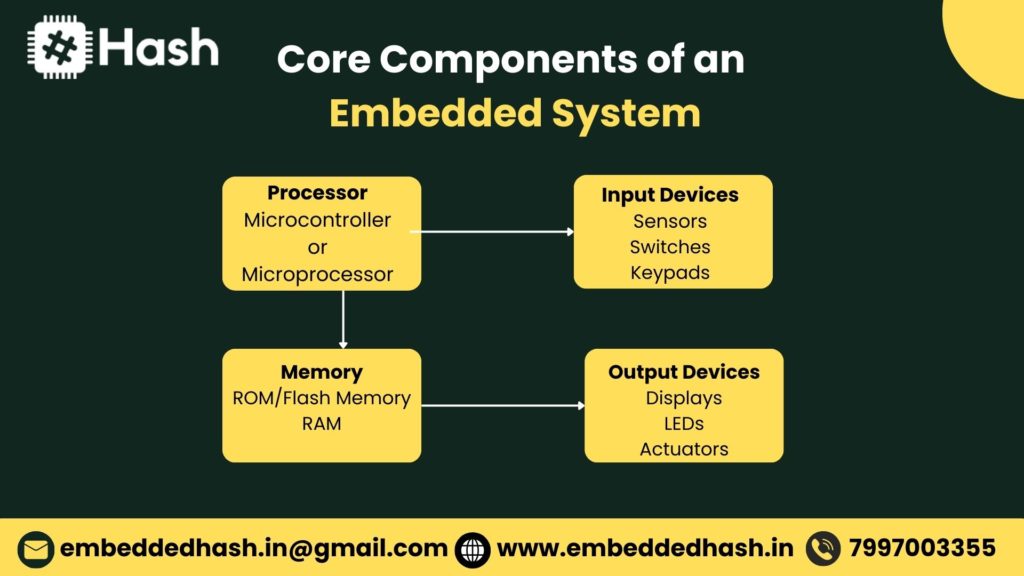
Core Components of an Embedded System
Every embedded system is built around a few essential components:
1. Processor (Microcontroller or Microprocessor)
The processor is the brain of the embedded system. It executes instructions, processes data, and controls system operations. Most embedded systems use microcontrollers due to their low power consumption and integrated features.
2. Memory
Memory stores the program code and data required for system operation.
- ROM/Flash Memory stores the firmware
- RAM holds temporary data during execution
3. Input and Output (I/O) Devices
I/O components allow the system to interact with the external environment.
- Inputs: Sensors, switches, keypads
- Outputs: Displays, motors, LEDs, actuators
Together, these components enable embedded systems to perform dedicated, reliable, and efficient operations across a wide range of real-world applications.
Key Characteristics of Embedded Systems
Embedded systems are designed with specific characteristics that differentiate them from general-purpose computing systems. These features allow embedded systems to operate efficiently, reliably, and within strict constraints, making them ideal for real-world applications such as consumer electronics, automotive systems, medical devices, and industrial automation.
Dedicated/Task-Specific Design
Embedded systems are built to perform a single, well-defined function or a limited set of tasks. Unlike computers that run multiple applications, an embedded system is optimized for one specific purpose, such as controlling a motor, monitoring temperature, or processing sensor data.
This task-specific design improves performance, efficiency, and reliability, as the hardware and software are tightly integrated to meet the exact requirements of the application.
Real-Time Operation
Many embedded systems operate in real-time environments, where tasks must be completed within strict time constraints. A delayed response can lead to system failure or unsafe conditions.
Real-time embedded systems are commonly used in:
- Automotive braking systems
- Medical monitoring equipment
- Industrial control systems
- Aerospace and defense applications
These systems prioritize timely and predictable responses over high computational power.
Low Power Consumption
One of the most important characteristics of embedded systems is their low power consumption. Many embedded devices run on batteries or energy-limited sources, making power efficiency critical.
To minimize energy usage, embedded systems often:
- Use low-power microcontrollers
- Operate at optimized clock speeds
- Enter sleep or idle modes when inactive
This makes them ideal for IoT devices, wearable technology, and remote sensors.
Compact Size
Embedded systems are typically designed to be small and lightweight, allowing them to fit into space-constrained environments. Their compact size enables seamless integration into larger products without increasing bulk or cost.
This characteristic is especially important in:
- Smartphones and smart appliances
- Medical implants and portable devices
- Automotive electronics
High Reliability
Embedded systems are expected to operate continuously and accurately for long periods, often without user intervention. High reliability is achieved through:
- Minimal software complexity
- Stable hardware configurations
- Rigorous testing and validation
In safety-critical applications, such as healthcare and aviation, system reliability is non-negotiable.
Limited Hardware Resources
Unlike general-purpose computers, embedded systems operate with limited hardware resources, including constrained memory, storage, and processing power. This limitation requires developers to write highly optimized and efficient code.
While limited resources reduce cost and power consumption, they also:
- Increase development complexity
- Restrict system flexibility and scalability
Understanding these constraints is crucial when designing and deploying embedded solutions.
Why These Characteristics Matter (AEO Boost)
Understanding the key characteristics of embedded systems helps learners and professionals:
- Choose the right hardware for specific applications
- Design efficient and reliable systems
- Optimise performance within resource constraints
These characteristics define how embedded systems function and explain why they are widely used across modern technology.
Advantages of Embedded Systems
Embedded systems advantages and disadvantages become evident through their task-specific design, high efficiency, and strong reliability. These advantages make embedded systems a preferred choice across industries such as automotive, healthcare, consumer electronics, industrial automation, and IoT applications.
High Efficiency and Performance
Embedded systems are optimized to perform a single, dedicated task, which allows them to operate with maximum efficiency.
Since they do not need to handle multiple applications simultaneously, they deliver faster execution speeds compared to general-purpose computers. This focused processing ensures minimal latency, predictable behavior, and consistent performance, especially in time-critical applications.
Low Power Consumption
One of the most significant advantages of embedded systems is their low power consumption.
They are specifically designed to operate with limited energy resources, making them ideal for IoT devices, medical equipment, wearable technology, and battery-powered systems. Low power usage not only extends battery life but also reduces heat generation and energy costs.
Compact Size
Embedded systems are typically small in size and lightweight, allowing them to fit easily into compact electronic products.
Their minimal hardware requirements make them suitable for space-constrained applications such as smartphones, smart appliances, sensors, and portable medical devices, without compromising performance.
Cost-Effective
Embedded systems are cost-effective, especially when produced in large quantities.
Mass production significantly reduces the per-unit cost of hardware components. Additionally, their low maintenance requirements and reduced operational expenses make them an economical solution for long-term deployment in both consumer and industrial environments.
High Reliability and Stability
Because embedded systems are designed for specific and repetitive tasks, they experience fewer crashes, software failures, and unexpected errors.
Their stable architecture and controlled operating environment contribute to a long operational life, making them highly reliable for continuous operation in critical systems such as medical devices, automotive controls, and industrial machinery.
Real-Time Capabilities
Embedded systems often operate in real-time environments, where immediate response to input is essential.
They can process data and produce output within strict time constraints, which is critical for safety-based and mission-critical systems such as airbags, pacemakers, flight control systems, and industrial automation controls.
Customization for Specific Applications
Embedded systems offer a high level of customization, as both hardware and software can be tailored to meet specific application requirements.
This customization enables optimized performance, efficient resource usage, and better integration with the target system. As a result, embedded systems can be precisely designed for unique functional, environmental, and performance needs.
Disadvantages of Embedded Systems
While embedded systems offer efficiency and reliability, they also come with certain limitations that must be carefully considered during system design and implementation.
Limited Processing Power and Memory
Embedded systems are designed for specific tasks, which means they usually operate with limited CPU power and memory resources. Due to these constraints, they cannot handle heavy multitasking or complex computational operations like general-purpose computers. This makes them unsuitable for applications requiring high data processing, advanced graphics, or extensive parallel execution.
Limited Flexibility and Upgradeability
One major drawback of embedded systems is their restricted flexibility. Once deployed, it is often difficult to modify or upgrade the system, especially if the hardware is tightly integrated with the software. Changes may require hardware replacement or firmware reprogramming, increasing maintenance effort and cost.
Complex Development Process
The development of embedded systems involves a complex and specialized process. Engineers must work closely with both hardware and software components, requiring expertise in microcontrollers, real-time operating systems (RTOS), and low-level programming languages. Additionally, specialized development tools and simulators are often required, increasing development complexity.
Debugging and Testing Challenges
Debugging embedded systems can be particularly challenging because it is hardware-dependent. Unlike traditional software applications, embedded systems may not support standard debugging interfaces. Testing often requires external hardware tools, in-circuit debuggers, or logic analyzers, making the process time-consuming and technically demanding.
High Initial Development Cost
Although embedded systems can be cost-effective in large-scale production, the initial development cost is relatively high. Expenses related to system design, prototyping, testing, and industry certifications significantly increase the upfront investment. This can be a limitation for small-scale projects or startups.
Security Vulnerabilities
Embedded systems, especially those connected to the internet or operating within IoT environments, are vulnerable to security threats. Limited computing resources often restrict the implementation of advanced security mechanisms, making these systems susceptible to malware attacks, data breaches, and unauthorized access.
Embedded Systems vs General-Purpose Systems
The main difference between embedded systems and general-purpose systems lies in their functionality, power usage, and flexibility. Embedded systems are designed to perform one specific task, while general-purpose systems can handle multiple applications and workloads.
Key Differences Between Embedded Systems and General-Purpose Systems
Feature | Embedded Systems | General-Purpose Systems |
Purpose | Designed for a specific, dedicated task | Designed to perform multiple tasks |
Power Consumption | Low, optimized for energy efficiency | High, due to multitasking and heavy processing |
Flexibility | Limited, task-specific functionality | High, supports various applications |
Cost | Lower, especially in mass production | Higher, due to advanced hardware and software |
Examples | Washing machine, ECU, medical devices | Laptop, desktop computer |
Which Is Better: Embedded Systems or General-Purpose Systems? (AEO)
Neither system is universally better—it depends on the use case:
- Choose embedded systems for efficiency, reliability, and real-time performance.
- Choose general-purpose systems for versatility and multitasking needs.
This clear distinction helps engineers and businesses select the right system architecture based on performance, cost, and application requirements.
Real-World Applications of Embedded Systems
Embedded systems play a critical role in modern technology by delivering reliable, task-specific performance across various industries. From everyday household appliances to advanced industrial and medical equipment, embedded systems ensure automation, accuracy, and efficiency in real-world operations.
Consumer Electronics
Embedded systems are widely used in consumer electronics to automate functions and enhance user convenience. These systems are designed to perform specific tasks with minimal power consumption and high reliability.
Common examples include:
- Washing machines—Control wash cycles, water levels, and temperature automatically
- Televisions—Manage display settings, audio processing, and smart features
- Microwave ovens – Regulate cooking time, power levels, and safety mechanisms
These devices rely on embedded controllers to deliver consistent performance and user-friendly operation.
Automotive Industry
The automotive sector heavily depends on embedded systems to improve vehicle safety, performance, and fuel efficiency. Modern vehicles contain multiple embedded controllers working together in real time.
Key applications include:
- Engine Control Units (ECUs)—Optimize fuel injection, ignition timing, and engine performance
- Anti-lock Braking Systems (ABS)—help maintain vehicle control by stopping the wheels from locking during hard braking.
- Airbag systems detect collisions and deploy airbags instantly for passenger safety.
Embedded systems enable vehicles to meet strict safety and emission standards while enhancing driving comfort.
Healthcare Devices
In the healthcare industry, embedded systems are crucial for delivering accurate, real-time monitoring and life-saving functions. These systems must meet high standards of reliability and precision.
Examples include:
- Pacemakers—Regulate heartbeats by delivering electrical impulses
- Patient monitoring systems – Track vital signs such as heart rate, blood pressure, and oxygen levels
Their ability to operate continuously and accurately makes embedded systems essential in medical technology.
Industrial Automation
Embedded systems are the backbone of industrial automation, enabling efficient control and monitoring of manufacturing processes. They help improve productivity, safety, and operational efficiency.
Major applications include:
- Programmable Logic Controllers (PLCs)—Control machinery and production lines
- Robotics – Perform repetitive and precision-based tasks
- Control systems—Monitor temperature, pressure, and speed in industrial environments
These systems ensure real-time decision-making and reduce human intervention in critical processes.
IoT and Smart Devices
With the rise of the Internet of Things (IoT), embedded systems have become central to smart and connected technologies. They enable devices to collect data, communicate, and respond intelligently.
Popular use cases include:
- Smart homes automatically manage lighting, security features, and temperature settings.
- Wearables—fitness bands and smartwatches—track physical activity and health-related data.
- Sensors—Environmental and industrial sensors for data collection and analysis
Embedded systems in IoT devices support connectivity, automation, and data-driven decision-making.
When Should You Use Embedded Systems?
Embedded systems are best suited for applications where specific functionality, efficiency, and reliability are more important than general-purpose computing. However, they are not the right fit for every use case. Understanding when to use—and when not to use—embedded systems helps developers and businesses avoid costly design mistakes.
Ideal Use Cases for Embedded Systems
Embedded systems should be used when an application requires dedicated performance with minimal resources.
Use embedded systems when:
- The system performs a single or a limited set of predefined tasks
- Real-time response is critical (e.g., automotive braking systems, medical monitors)
- Low power consumption is required for long-term operation
- The device must operate continuously without user intervention
- Space and hardware resources are limited
- High reliability and stability are essential
Common real-world examples include:
- Automotive control units (ABS, airbag systems)
- Medical devices (ECG machines, infusion pumps)
- Consumer electronics (microwaves, washing machines)
- Industrial automation systems
- Smart home and IoT devices
These environments benefit from the efficiency, speed, and predictability of embedded systems.
Situations Where Embedded Systems Are NOT Suitable
Despite their advantages, embedded systems are not ideal for all applications.
Avoid using embedded systems when:
- The application requires frequent feature changes or upgrades
- High computational power or multitasking is needed
- User interaction is complex or dynamic
- The system must run multiple unrelated applications
- Rapid prototyping and scalability are priorities
Examples where embedded systems may not be suitable:
- Desktop or laptop computing
- Data analytics platforms
- Cloud-based applications
- Large-scale software systems requiring regular updates
In such cases, general-purpose computing systems offer greater flexibility and long-term scalability.
For businesses, embedded systems are ideal when the goal is to optimize cost, improve efficiency, and deliver consistent performance. For developers, they offer precise control over hardware and software, making them suitable for performance-critical applications.
Future of Embedded Systems
The future of embedded systems is closely tied to the rapid advancement of smart technologies, automation, and connected devices. As industries continue to move toward digital transformation, embedded systems are evolving to become more intelligent, secure, and performance-driven. Their role is expanding beyond basic control functions to enable real-time decision-making and advanced data processing.
Role in IoT, AI, and Edge Computing
Embedded systems play a central role in IoT, artificial intelligence, and edge computing ecosystems. In IoT environments, they act as the core processing units that collect sensor data, process information, and communicate with cloud platforms.
With the integration of AI and machine learning, modern embedded systems can now perform predictive analysis, image recognition, and voice processing directly on devices. Edge computing further enhances this capability by allowing data to be processed locally, reducing latency, bandwidth usage, and dependency on centralized cloud systems. This is especially critical for applications like autonomous vehicles, smart healthcare devices, and industrial automation.
Growing Demand Across Industries
The demand for embedded systems is growing rapidly across multiple industries. Sectors such as automotive, healthcare, consumer electronics, manufacturing, telecommunications, and aerospace increasingly rely on embedded solutions to improve efficiency and innovation.
Technologies like electric vehicles, smart factories, wearable devices, and smart cities are driving large-scale adoption. As businesses focus on automation, real-time monitoring, and energy-efficient systems, embedded systems are becoming essential for staying competitive in global markets.
Security and Performance Improvements
As embedded systems become more connected, security and performance enhancements are a top priority. Future embedded systems are being designed with built-in security features, including secure boot, hardware-level encryption, and real-time threat detection.
At the same time, improvements in processor architectures, real-time operating systems (RTOS), and low-power computing are significantly boosting performance. These advancements enable faster response times, improved reliability, and better energy efficiency—making embedded systems suitable for mission-critical and safety-sensitive applications.
Conclusion
Embedded systems play a vital role in modern technology by delivering efficient, reliable, and task-specific performance across industries such as healthcare, automotive, consumer electronics, and industrial automation. Their advantages—including low power consumption, compact size, real-time operation, and high reliability—make them an ideal solution for systems that require consistent and dedicated functionality.
However, embedded systems also come with certain limitations. Restricted processing power, limited flexibility, higher development complexity, and upgrade challenges can make them less suitable for applications that require frequent changes or extensive user interaction. These disadvantages highlight the importance of careful planning and system design before implementation.
Frequently Asked Questions (FAQs)
Embedded systems offer high efficiency, low power consumption, compact size, real-time performance, reliability, and cost-effectiveness. They are designed for specific tasks, which allows them to perform faster and more accurately than general-purpose systems.
The main disadvantages include limited processing power, restricted memory, lack of flexibility, difficult upgrades, and complex development. Once deployed, modifying embedded systems can be challenging.
Embedded systems are used instead of computers because they are task-specific, energy-efficient, faster for dedicated functions, and more reliable. They also require less space and are more cost-effective for single-purpose applications.
Yes, embedded systems can be expensive to develop initially due to specialized hardware, custom software, testing, and real-time constraints. However, they are usually cost-effective in mass production.
Embedded systems are used in daily-life devices like kitchen appliances, home automation systems, vehicles, and medical equipment to perform specific control and monitoring tasks efficiently.
Household devices such as washing machines, microwave ovens, air conditioners, refrigerators, and smart TVs use embedded systems to automate functions and improve performance.
Some embedded systems use real-time operating systems (RTOS), while others run without any OS. It depends on the complexity and real-time requirements of the application.
Embedded systems are widely used in automotive, healthcare, consumer electronics, industrial automation, telecommunications, aerospace, and IoT applications.
Common programming languages include C, C++, Python (for high-level systems), Assembly, and Embedded Java. C is the most widely used due to its efficiency and hardware control.
Yes, embedded systems form the core of IoT devices. They collect data, process information, and communicate with other systems over networks.
No, embedded systems are not easy to upgrade. Hardware limitations and tightly coupled software make updates complex compared to general-purpose computers.
Yes, embedded systems are designed to be highly reliable and stable, especially in critical applications like medical devices, automotive safety systems, and industrial controls.
A real-time embedded system responds to inputs within strict time constraints. Examples include airbag control systems, pacemakers, and industrial robots.
Not all embedded systems require internet access. However, modern embedded systems often include connectivity for monitoring, updates, and remote control.
Embedded systems are widely used in real life across consumer electronics, automobiles, healthcare devices, and industrial equipment to perform dedicated control and monitoring functions efficiently.
If you want to Learn more About Embedded Systems, join us at Embedded Hash for Demo Enroll Now


 embeddedhash.in@gmail.com