
Embedded Systems Roadmap
Complete Beginner to Expert Guide(2026)
If you want to build a successful career in embedded systems, following a well-structured Embedded Systems Roadmap is one of the best ways to get started. This guide walks you through each stage of the learning journey, from C programming and microcontrollers to Embedded Linux, RTOS, IoT, Automotive Embedded Systems, and Edge AI. It also covers salary insights, career opportunities, and the latest industry trends in India to help you plan your career with confidence.
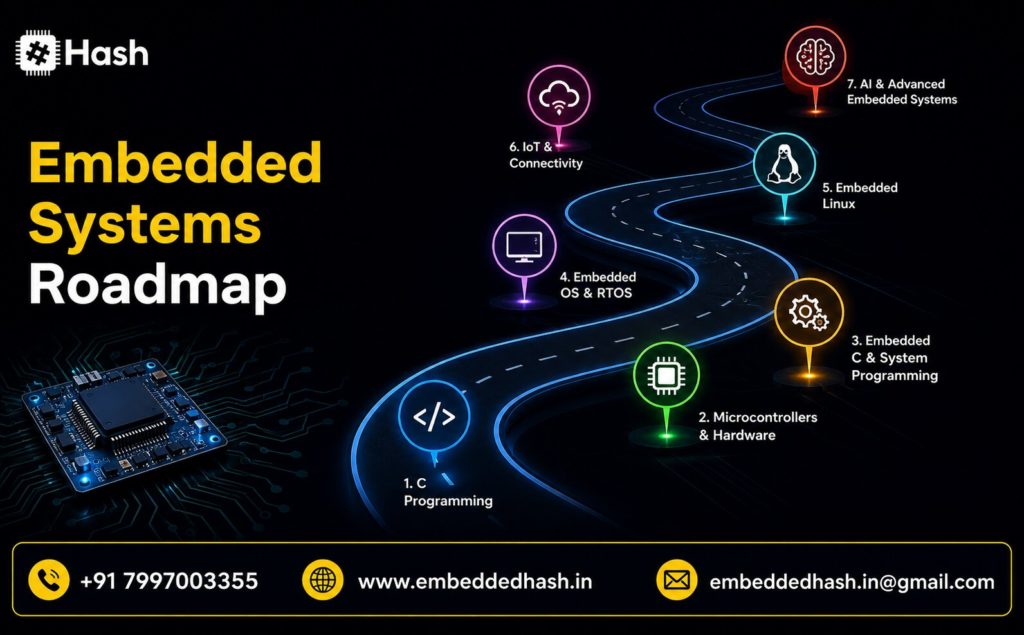
Table of Contents
Introduction To Embedded Systems Roadmap
- Choosing the right learning path can be confusing, especially if you’re a beginner. The embedded systems roadmap helps you understand what to learn, in what order, and which skills employers expect in 2026.
- Whether you’re an engineering student, recent graduate, career switcher, or working professional, this guide provides a practical roadmap to become an industry-ready embedded systems engineer.
- Instead of randomly learning technologies, you’ll follow a structured path that builds your knowledge step by step, helping you gain confidence and improve your chances of landing high-paying embedded systems jobs.
Why Follow an Embedded Systems Roadmap?
Many students learn programming, electronics, or IoT separately without understanding how everything connects in real-world embedded product development.
A roadmap helps you:
- Learn technologies in the correct sequence
- Avoid unnecessary topics
- Build practical knowledge
- Prepare for technical interviews
- Create industry-level projects
- Become job-ready faster
- Understand current industry requirements
- Stay updated with future technologies
Following a roadmap also prevents information overload because every new topic builds upon the previous one.
Key Features of Embedded Systems
- Performs a dedicated task
- Fast and reliable operation
- Low power consumption
- Compact design
- Cost-effective
- Can work continuously for years
- Often connected with IoT devices and edge devices
What is an Embedded Systems Roadmap?
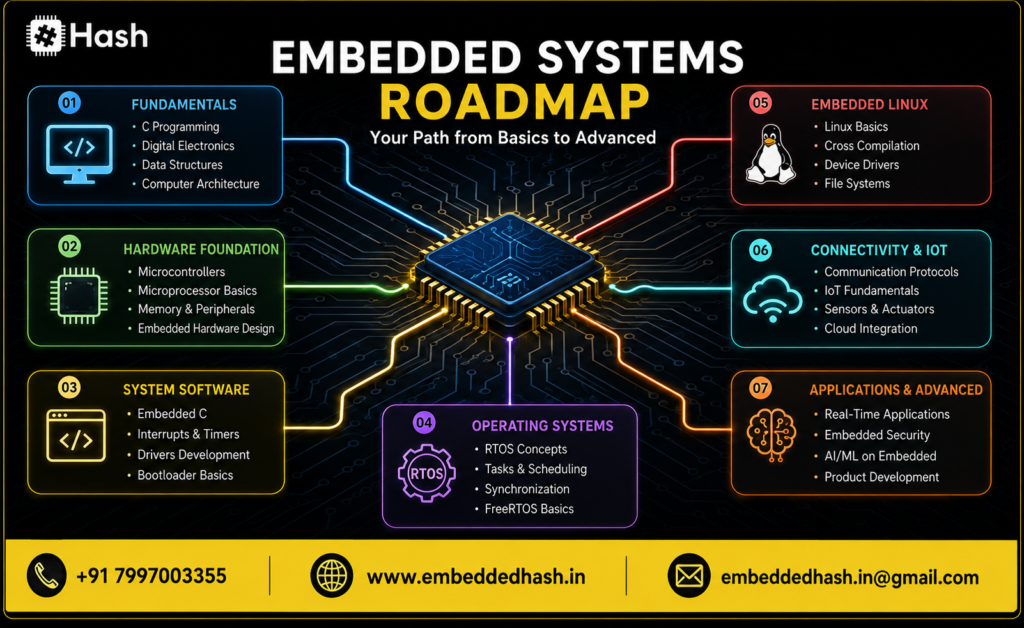
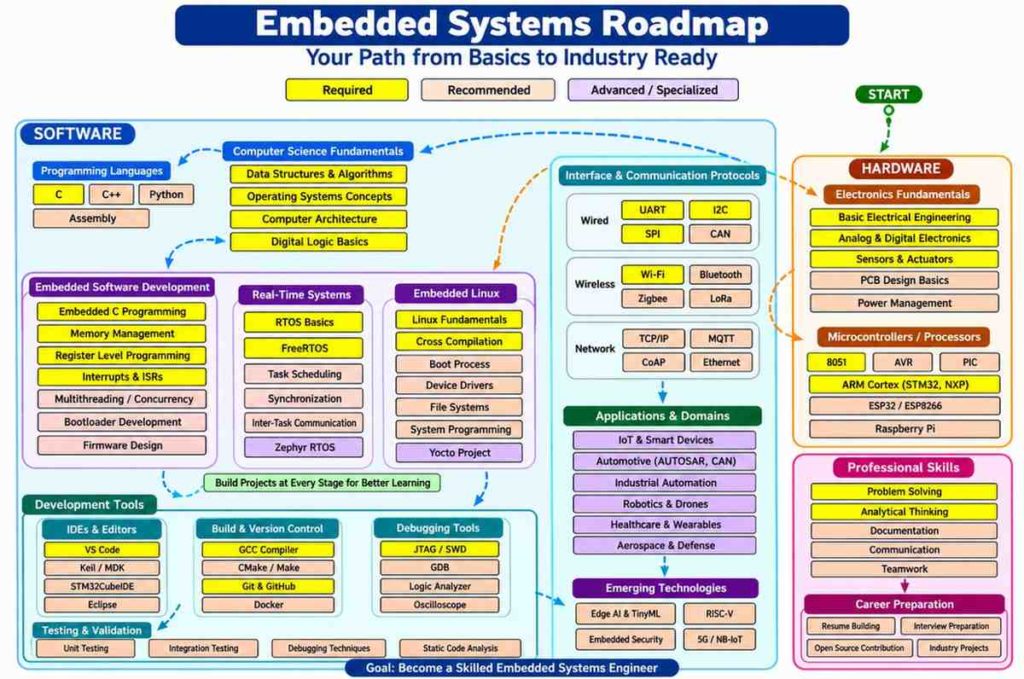
An embedded systems roadmap is a structured learning path that guides aspiring engineers from the fundamentals of programming and electronics to advanced topics such as Embedded Linux, RTOS, Automotive Embedded Systems, IoT, and AI-powered embedded applications.
Instead of learning randomly, the roadmap focuses on acquiring skills that are directly relevant to real-world product development.
A complete roadmap generally includes:
- Programming fundamentals
- Electronics basics
- Digital electronics
- Microcontrollers
- Embedded C Programming
- Communication Protocols
- ARM Architecture
- RTOS
- Embedded Linux
- Device Driver Development
- Debugging Techniques
- Git & Version Control
- IoT
- Automotive Embedded Systems
- Edge AI & TinyML
- Real-time Projects
- Interview Preparation
Why Embedded Systems is a Great Career Choice in 2026?
The demand for embedded engineers continues to rise because almost every smart device contains an embedded system.
Industries hiring embedded engineers include:
- Automotive
- Consumer Electronics
- Industrial Automation
- Medical Devices
- Aerospace
- Robotics
- IoT
- Telecommunications
- Smart Home Devices
- Electric Vehicles (EV)
- Wearable Technology
- Defense Systems
Major reasons for growing demand
- Growth of IoT devices
- Expansion of Electric Vehicles
- Industry 4.0 adoption
- Smart manufacturing
- AI-powered edge devices
- Robotics automation
- Medical electronics innovation
- 5G-enabled embedded applications
According to industry reports, India continues to experience increasing demand for embedded software engineers as automotive electronics, semiconductor manufacturing, and IoT development expand rapidly across the country.
What Skills Do You Need Before Starting the Embedded Systems Roadmap?
Before diving into advanced technologies, focus on building a strong foundation.
Basic Technical Skills
Learn:
- Computer fundamentals
- Problem-solving
- Logical thinking
- Basic mathematics
- Binary number system
- Number conversions
- Boolean algebra
These concepts make programming and hardware development much easier later.
Step 1: Learn C Programming
- C remains the most important programming language for embedded systems.
- Almost every firmware application is written using Embedded C because it provides direct access to hardware resources while remaining highly efficient.
Topics to Learn
- Variables
- Data Types
- Operators
- Loops
- Functions
- Arrays
- Strings
- Pointers
- Structures
- Unions
- Enums
- Bit Manipulation
- Dynamic Memory
- File Handling
- Preprocessor Directives
Why C Programming Matters
It helps you:
- Control hardware efficiently
- Write optimized firmware
- Access memory directly
- Develop drivers
- Understand RTOS concepts
- Build scalable embedded applications
Practice Projects
- Calculator
- LED Blink Logic
- Digital Clock
- Number Converter
- Password System
- Temperature Converter
Step 2: Understand Electronics Fundamentals
- Programming alone is not enough.
Embedded engineers also need to understand how hardware works.
Learn Basic Electronics
- Voltage
- Current
- Resistance
- Power
- Ohm’s Law
- Kirchhoff’s Laws
- Capacitors
- Inductors
- Diodes
- Transistors
- MOSFET
- Relays
Why Electronics is Important
Understanding electronics helps you:
- Read circuit diagrams
- Design hardware interfaces
- Troubleshoot hardware issues
- Work with sensors
- Develop embedded products
Step 3: Master Digital Electronics
- Embedded systems operate using digital logic.
- Every microcontroller is built using digital electronic concepts.
Topics to Cover
- Logic Gates
- Boolean Expressions
- Truth Tables
- Flip-Flops
- Multiplexers
- Demultiplexers
- Counters
- Registers
- Encoders
- Decoders
- Finite State Machines
Benefits
Digital electronics helps you understand:
- Processor design
- Memory organization
- Communication logic
- Timing diagrams
- Embedded hardware architecture
Step 4: Learn Microcontrollers
- Microcontrollers are the main source of every embedded system.
A microcontroller combines the processor, memory, timers, communication peripherals, and GPIO pins into a single chip.
Popular Microcontrollers
- 8051
- AVR
- PIC
- ARM Cortex-M
- STM32
- ESP32
- MSP430
- Arduino Boards
- NXP LPC Series
Topics to Learn
- GPIO
- Timers
- PWM
- Interrupts
- ADC
- DAC
- UART
- SPI
- I2C
- CAN
- Watchdog Timer
- Clock Configuration
Step 5: Learn Communication Protocols
- Devices communicate using communication protocols.
Understanding these protocols is essential for embedded product development
Serial Communication
- UART
- USART
- Debugging
- GPS Modules
- Bluetooth Modules
- PC Communication
SPI
Used for connecting:
- Flash Memory
- Displays
- Sensors
- ADC
- DAC
I2C
Used in:
- Temperature Sensors
- EEPROM
- RTC Modules
- OLED Displays
- Environmental Sensors
CAN Protocol
Commonly used in:
- Automotive Electronics
- Electric Vehicles
- Industrial Automation
- Medical Equipment
Step 6: Learn ARM Architecture
- Most modern embedded products use ARM-based processors because they offer excellent performance, low power consumption, and scalability.
- Learning ARM architecture is a major milestone in the embedded systems roadmap.
Topics to Learn
- ARM Cortex-M Family
- ARM Registers
- Memory Map
- Stack
- Heap
- Exception Handling
- Interrupt Vector Table
- Startup Code
- Boot Process
- Low Power Modes
Common Mistakes Beginners Make
- Many beginners delay their progress by focusing on the wrong topics or learning without a structured plan.
Avoid these mistakes:
- Learning multiple programming languages at once
- Skipping C programming fundamentals
- Ignoring electronics concepts
- Memorizing code instead of understanding logic
- Avoiding hands-on projects
- Not practicing debugging
- Depending only on online videos
- Ignoring version control tools
- Building a weak portfolio
- Not preparing for technical interviews early
By avoiding these mistakes, you can build a stronger foundation and progress more efficiently through the embedded systems roadmap.
Step 7: Learn Embedded Linux
- Many modern embedded devices run Linux because it is open-source, stable, scalable, and highly customizable. Industries such as automotive, networking, medical devices, and industrial automation rely heavily on Embedded Linux.
Why Learn Embedded Linux?
- Embedded Linux enables developers to create feature-rich applications that run on powerful embedded hardware.
Skills You Should Learn
- Linux File System
- Linux Boot Process
- Shell Scripting
- Process Management
- Memory Management
- File Permissions
- Kernel Basics
- Buildroot
- Yocto Project
- Cross Compilation
- BusyBox
- Bash Commands
Essential Linux Commands
- ls
- pwd
- cd
- cp
- mv
- mkdir
- rm
- chmod
- grep
- find
- ps
- top
- kill
- cat
- echo
Step 8: Learn Device Driver Development
- Device drivers act as a bridge between the operating system and hardware, allowing them to communicate and function together effectively.
- If you’re interested in Linux kernel programming or embedded software development, learning driver development is an excellent skill.
Topics to Learn
- Linux Kernel Basics
- Character Drivers
- Block Drivers
- Platform Drivers
- GPIO Drivers
- Interrupt Handling
- Kernel Modules
- Device Tree
- Sysfs
- Procfs
- Kernel Logging
Step 9: Learn RTOS (Real-Time Operating System)
- Many embedded products perform multiple tasks simultaneously. An RTOS helps manage these tasks efficiently while meeting strict timing requirements.
Popular RTOS Platforms
- FreeRTOS
- Zephyr RTOS
- ThreadX
- VxWorks
- RTEMS
Core Concepts
- Tasks
- Threads
- Scheduling
- Context Switching
- Semaphores
- Mutexes
- Queues
- Event Groups
- Timers
- Memory Allocation
Step 10: Learn Debugging Techniques
- Debugging is one of the most valuable skills for an embedded engineer. Efficient debugging reduces development time and improves product quality.
Common Debugging Tools
- GDB
- JTAG
- ST-Link
- OpenOCD
- Logic Analyzer
- Oscilloscope
- Serial Terminal
- Multimeter
Best Practices
- Read datasheets carefully
- Verify hardware connections
- Use breakpoints
- Monitor memory usage
- Check communication signals
- Analyze logs systematically
Step 11: Learn Git and Version Control
- Modern software development requires collaboration. Git helps developers track changes, manage versions, and work effectively in teams.
Git Commands to Learn
- git init
- git clone
- git add
- git commit
- git push
- git pull
- git branch
- git merge
- git checkout
- git status
Benefits
- Track code history
- Collaborate with teams
- Roll back changes
- Manage project versions
- Improve development workflow
Step 12: Explore IoT Development
- The Internet of Things (IoT) connects embedded devices to the internet, enabling smart communication and automation.
Topics to Learn
- MQTT
- HTTP
- Wi-Fi Communication
- BLE (Bluetooth Low Energy)
- Cloud Platforms
- ESP32 Programming
- NodeMCU
- Sensor Integration
- Edge Computing
Real-World Applications
- Smart Homes
- Smart Agriculture
- Wearable Devices
- Industrial IoT
- Smart Cities
- Healthcare Monitoring
- Asset Tracking
Step 13: Learn Automotive Embedded Systems
The automotive industry is one of the largest employers of embedded engineers.
- Modern vehicles use embedded systems in almost every function.
Automotive Domains
- ADAS
- Infotainment
- Engine Control Unit (ECU)
- Body Control Module (BCM)
- Battery Management System (BMS)
- Electric Vehicles (EV)
- Autonomous Driving
Automotive Standards to Learn
- AUTOSAR
- ISO 26262
- CAN
- LIN
- FlexRay
- Automotive Ethernet
Step 14: Learn Edge AI and TinyML
Embedded systems are increasingly integrating Artificial Intelligence to enable intelligent decision-making directly on devices.
Topics
- TinyML
- TensorFlow Lite
- Edge AI
- AI Model Optimization
- Image Recognition
- Voice Recognition
- Predictive Maintenance
Applications
- Smart Cameras
- AI Surveillance
- Medical Diagnostics
- Smart Factories
- Predictive Maintenance
- Voice Assistants
Build Real-Time Embedded Projects
Projects demonstrate practical skills and strengthen your portfolio.
Beginner Projects
- LED Blinking
- Digital Stopwatch
- Calculator
- Temperature Monitor
- LCD Interface
Intermediate Projects
- Home Automation
- RFID Attendance System
- Smart Irrigation
- Digital Weather Station
- Bluetooth Robot
Advanced Projects
- Autonomous Robot
- Industrial Monitoring System
- EV Battery Monitoring
- Smart Traffic Control
- AI-based Object Detection
- CAN Bus Communication System
Essential Tools Every Embedded Engineer Should Know
Category | Popular Tools |
IDEs | Keil, STM32CubeIDE, MPLAB X, Arduino IDE |
Debugging | GDB, OpenOCD, ST-Link |
Simulation | Proteus, MATLAB Simulink |
PCB Design | KiCad, Altium Designer, Eagle |
Version Control | Git, GitHub |
Embedded Linux | Buildroot, Yocto |
RTOS | FreeRTOS, Zephyr |
Embedded Systems Career Roadmap
Level | Skills to Learn | Goal |
Beginner | C Programming, Electronics, Digital Logic | Build Foundation |
Intermediate | Microcontrollers, ARM, Communication Protocols | Firmware Development |
Advanced | Embedded Linux, RTOS, Device Drivers, Git | Industry-Ready Engineer |
Expert | Automotive, Edge AI, IoT, Linux Kernel, System Design | Senior Embedded Engineer |
Embedded Systems Salary in India (2026)
Experience | Average Annual Salary |
Fresher (0–2 Years) | ₹3.5 – ₹6.5 LPA |
Mid-Level (3–5 Years) | ₹7 – ₹12 LPA |
Senior (6–10 Years) | ₹12 – ₹22 LPA |
Lead / Architect (10+ Years) | ₹22 – ₹40+ LPA |
Embedded Systems Career Paths Comparison
Career Role | Primary Focus | Key Skills |
Embedded Software Engineer | Firmware Development | Embedded C, ARM, RTOS |
Embedded Linux Engineer | Linux-Based Devices | Linux, Kernel, Drivers |
IoT Engineer | Connected Devices | ESP32, MQTT, Cloud |
Automotive Embedded Engineer | Vehicle Electronics | AUTOSAR, CAN, ISO 26262 |
Firmware Engineer | Device-Level Software | C, Microcontrollers |
Edge AI Engineer | Intelligent Embedded Systems | TinyML, TensorFlow Lite |
Industry Trends and Market Demand in India
Embedded systems continue to play a critical role in India’s technology ecosystem.
Key Growth Drivers
- Expansion of Electric Vehicles (EVs)
- Growth in semiconductor manufacturing
- Rising demand for IoT devices
- Increased investment in Industry 4.0
- Adoption of AI-powered edge devices
- Growth in robotics and automation
- Government initiatives supporting electronics manufacturing
Industries Hiring Embedded Engineers
- Automotive
- Semiconductor
- Consumer Electronics
- Medical Devices
- Aerospace
- Telecommunications
- Industrial Automation
- Defense
- Smart Manufacturing
Top Skills Recruiters Look For
Recruiters value engineers who combine technical knowledge with practical implementation.
Must-Have Skills
- Embedded C
- ARM Cortex
- RTOS
- Embedded Linux
- Communication Protocols
- Device Drivers
- Git
- Debugging
- Problem Solving
- Real-Time Projects
Certifications to Strengthen Your Profile
While projects carry the most weight, certifications can reinforce your expertise.
Recommended certifications:
- Embedded Systems Programming
- Embedded Linux Development
- ARM Cortex Programming
- FreeRTOS
- IoT Development
- Automotive Embedded Systems
- PCB Design Fundamentals
What It Takes to Get Your First Embedded Systems Job?
A strong learning path should be supported by a practical job strategy.
Tips
- Build 5–10 real-time projects
- Maintain a GitHub portfolio
- Practice coding daily
- Understand datasheets
- Learn debugging thoroughly
- Prepare for technical interviews
- Solve embedded programming problems
- Attend workshops and hackathons
- Network with professionals on LinkedIn
Future Scope of Embedded Systems
Embedded systems will continue to grow with advancements in AI, autonomous vehicles, healthcare, and smart infrastructure.
Future opportunities include:
- AI Edge Computing
- Smart Manufacturing
- Robotics
- Autonomous Vehicles
- Medical Electronics
- Space Technology
- Drone Systems
- Industrial IoT
- Wearable Technology
Continuous learning and hands-on experience will remain the key to long-term success.
Key Takeaways
- Follow a structured roadmap instead of learning topics randomly.
- Build strong foundations in C programming, electronics, and microcontrollers.
- Gain practical experience through real-time projects and debugging.
- Learn advanced technologies such as Embedded Linux, RTOS, IoT, Automotive Systems, and Edge AI to stay competitive.
- Continuously update your skills to match evolving industry requirements and improve your career prospects
Conclusion
Following a structured embedded systems roadmap is one of the most effective ways to build a successful career in embedded engineering. Start with the fundamentals, strengthen your programming and hardware knowledge, and gradually move toward advanced technologies like Embedded Linux, RTOS, Automotive Embedded Systems, IoT, and Edge AI.
The industry values engineers who can solve real-world problems through practical implementation. Focus on building projects, understanding system design, and continuously improving your technical skills.
If you’re ready to begin your embedded systems journey, Embedded Hash provides industry-focused learning with hands-on projects, expert mentorship, and practical training designed to help students and aspiring engineers become job-ready in today’s competitive technology landscape.
Frequently Asked Questions
An embedded systems roadmap is a structured learning path that starts with C programming and electronics, then progresses through microcontrollers, communication protocols, Embedded Linux, RTOS, IoT, and advanced domains like automotive systems and Edge AI.
With consistent practice, beginners can build a solid foundation in 6–12 months. Becoming industry-ready often takes additional project experience and hands-on development.
Yes. Embedded systems remain in high demand due to growth in electric vehicles, IoT, robotics, healthcare devices, industrial automation, and semiconductor industries.
C is the most commonly used language for embedded systems. Learning C++ and Python later can also be beneficial, depending on your career goals.
Yes. Embedded systems is open to students from various engineering branches, including CSE, IT, EEE, and Mechanical, provided they have a good foundation in programming and electronics.
Beginners often start with Arduino or STM32 because they have strong community support, extensive documentation, and are widely used for learning and prototyping.
Yes. Embedded Linux is widely used in networking equipment, medical devices, automotive systems, and industrial automation, making it a valuable skill for advanced roles.
Many companies expect familiarity with RTOS concepts, especially for applications requiring multitasking, scheduling, and deterministic performance.
Include projects such as smart home automation, IoT sensor networks, CAN communication, embedded Linux applications, and RTOS-based systems to demonstrate practical skills.
Focus on mastering core concepts, completing real-time projects, using Git for version control, practicing debugging, preparing for interviews, and showcasing your work through a professional portfolio.
No. AI will not replace embedded systems; instead, it enhances them by adding intelligent decision-making to devices. Learning both embedded systems and AI provides better career opportunities in industries like automotive, IoT, robotics, etc..
An embedded engineer in India typically earns ₹3 LPA–₹6 LPA as a fresher, while experienced professionals can earn ₹8 LPA–₹20+ LPA, depending on their skills, location, industry, and expertise in Embedded C, Linux, RTOS, and automotive systems.
Embedded Systems Roadmap
Complete Beginner to Expert Guide (2026)
If you want to build a successful career in embedded systems, following a well-structured Embedded Systems Roadmap is one of the best ways to get started. This guide walks you through each stage of the learning journey, from C programming and microcontrollers to Embedded Linux, RTOS, IoT, Automotive Embedded Systems, and Edge AI. It also covers salary insights, career opportunities, and the latest industry trends in India to help you plan your career with confidence.
Table of Contents
Introduction to Embedded Systems Roadmap
- Choosing the right learning path can be confusing, especially if you’re a beginner. The embedded systems roadmap helps you understand what to learn, in what order, and which skills employers expect in 2026.
- Whether you’re an engineering student, recent graduate, career switcher, or working professional, this guide provides a practical roadmap to become an industry-ready embedded systems engineer.
- Instead of randomly learning technologies, you’ll follow a structured path that builds your knowledge step by step, helping you gain confidence and improve your chances of landing high-paying embedded systems jobs.
Why Follow an Embedded Systems Roadmap?
Many students learn programming, electronics, or IoT separately without understanding how everything connects in real-world embedded product development.
A roadmap helps you:
- Learn technologies in the correct sequence
- Avoid unnecessary topics
- Build practical knowledge
- Prepare for technical interviews
- Create industry-level projects
- Become job-ready faster
- Understand current industry requirements
- Stay updated with future technologies
- Following a roadmap also prevents information overload because every new topic builds upon the previous one.
What is an Embedded Systems Roadmap?
An embedded systems roadmap is a structured learning path that guides aspiring engineers from the fundamentals of programming and electronics to advanced topics such as Embedded Linux, RTOS, Automotive Embedded Systems, IoT, and AI-powered embedded applications.
Instead of learning randomly, the roadmap focuses on acquiring skills that are directly relevant to real-world product development.
A complete roadmap generally includes:
- Programming fundamentals
- Electronics basics
- Digital electronics
- Microcontrollers
- Embedded C Programming
- Communication Protocols
- ARM Architecture
- RTOS
- Embedded Linux
- Device Driver Development
- Debugging Techniques
- Git & Version Control
- IoT
- Automotive Embedded Systems
- Edge AI & TinyML
- Real-time Projects
- Interview Preparation
Why Embedded Systems is a Great Career Choice in 2026?
The demand for embedded engineers continues to rise because almost every smart device contains an embedded system.
Industries hiring embedded engineers include:
- Automotive
- Consumer Electronics
- Industrial Automation
- Medical Devices
- Aerospace
- Robotics
- IoT
- Telecommunications
- Smart Home Devices
- Electric Vehicles (EV)
- Wearable Technology
- Defense Systems
Major reasons for the growing demand
- Growth of IoT devices
- Expansion of Electric Vehicles
- Industry 4.0 adoption
- Smart manufacturing
- AI-powered edge devices
- Robotics automation
- Medical electronics innovation
- 5G-enabled embedded applications
According to industry reports, India continues to experience increasing demand for embedded software engineers as automotive electronics, semiconductor manufacturing, and IoT development expand rapidly across the country.
What Skills Do You Need Before Starting the Embedded Systems Roadmap?
Before diving into advanced technologies, focus on building a strong foundation.
Basic Technical Skills
Learn:
- Computer fundamentals
- Problem-solving
- Logical thinking
- Basic mathematics
- Binary number system
- Number conversions
- Boolean algebra
These concepts make programming and hardware development much easier later.
Step 1: Learn C Programming
- C remains the most important programming language for embedded systems.
- Almost every firmware application is written using Embedded C because it provides direct access to hardware resources while remaining highly efficient.
Topics to Learn
- Variables
- Data Types
- Operators
- Loops
- Functions
- Arrays
- Strings
- Pointers
- Structures
- Unions
- Enums
- Bit Manipulation
- Dynamic Memory
- File Handling
- Preprocessor Directives
Why C Programming Matters
It helps you:
- Control hardware efficiently
- Write optimized firmware
- Access memory directly
- Develop drivers
- Understand RTOS concepts
- Build scalable embedded applications
Practice Projects
- Calculator
- LED Blink Logic
- Digital Clock
- Number Converter
- Password System
- Temperature Converter
Step 2: Understand Electronics Fundamentals
- Programming alone is not enough.
Embedded engineers also need to understand how hardware works.
Learn Basic Electronics
- Voltage
- Current
- Resistance
- Power
- Ohm’s Law
- Kirchhoff’s Laws
- Capacitors
- Inductors
- Diodes
- Transistors
- MOSFET
- Relays
Why Electronics is Important
Understanding electronics helps you:
- Read circuit diagrams
- Design hardware interfaces
- Troubleshoot hardware issues
- Work with sensors
- Develop embedded products
Step 3: Master Digital Electronics
- Embedded systems operate using digital logic.
- Every microcontroller is built using digital electronic concepts.
Topics to Cover
- Logic Gates
- Boolean Expressions
- Truth Tables
- Flip-Flops
- Multiplexers
- Demultiplexers
- Counters
- Registers
- Encoders
- Decoders
- Finite State Machines
Benefits
Digital electronics helps you understand:
- Processor design
- Memory organization
- Communication logic
- Timing diagrams
- Embedded hardware architecture
Step 4: Learn Microcontrollers
- Microcontrollers are the main source of every embedded system.
A microcontroller combines the processor, memory, timers, communication peripherals, and GPIO pins into a single chip.
Popular Microcontrollers
- 8051
- AVR
- PIC
- ARM Cortex-M
- STM32
- ESP32
- MSP430
- Arduino Boards
- NXP LPC Series
Topics to Learn
- GPIO
- Timers
- PWM
- Interrupts
- ADC
- DAC
- UART
- SPI
- I2C
- CAN
- Watchdog Timer
- Clock Configuration
Step 5: Learn Communication Protocols
- Devices communicate using communication protocols.
Understanding these protocols is essential for embedded product development
Serial Communication
- UART
- USART
- Debugging
- GPS Modules
- Bluetooth Modules
- PC Communication
SPI
Used for connecting:
- Flash Memory
- Displays
- Sensors
- ADC
- DAC
I2C
Used in:
- Temperature Sensors
- EEPROM
- RTC Modules
- OLED Displays
- Environmental Sensors
CAN Protocol
Commonly used in:
- Automotive Electronics
- Electric Vehicles
- Industrial Automation
- Medical Equipment
Step 6: Learn ARM Architecture
- Most modern embedded products use ARM-based processors because they offer excellent performance, low power consumption, and scalability.
- Learning ARM architecture is a major milestone in the embedded systems roadmap.
Topics to Learn
- ARM Cortex-M Family
- ARM Registers
- Memory Map
- Stack
- Heap
- Exception Handling
- Interrupt Vector Table
- Startup Code
- Boot Process
- Low Power Modes
Common Mistakes Beginners Make
- Many beginners delay their progress by focusing on the wrong topics or learning without a structured plan.
Avoid these mistakes:
- Learning multiple programming languages at once
- Skipping C programming fundamentals
- Ignoring electronics concepts
- Memorizing code instead of understanding logic
- Avoiding hands-on projects
- Not practicing debugging
- Depending only on online videos
- Ignoring version control tools
- Building a weak portfolio
- Not preparing for technical interviews early
By avoiding these mistakes, you can build a stronger foundation and progress more efficiently through the embedded systems roadmap.
Step 7: Learn Embedded Linux
- Many modern embedded devices run Linux because it is open-source, stable, scalable, and highly customizable. Industries such as automotive, networking, medical devices, and industrial automation rely heavily on Embedded Linux.
Why Learn Embedded Linux?
- Embedded Linux enables developers to create feature-rich applications that run on powerful embedded hardware.
Skills You Should Learn
- Linux File System
- Linux Boot Process
- Shell Scripting
- Process Management
- Memory Management
- File Permissions
- Kernel Basics
- Buildroot
- Yocto Project
- Cross Compilation
- BusyBox
- Bash Commands
Essential Linux Commands
- ls
- pwd
- cd
- cp
- mv
- mkdir
- rm
- chmod
- grep
- find
- ps
- top
- kill
- cat
- echo
Step 8: Learn Device Driver Development
- Device drivers act as a bridge between the operating system and hardware, allowing them to communicate and function together effectively.
- If you’re interested in Linux kernel programming or embedded software development, learning driver development is an excellent skill.
Topics to Learn
- Linux Kernel Basics
- Character Drivers
- Block Drivers
- Platform Drivers
- GPIO Drivers
- Interrupt Handling
- Kernel Modules
- Device Tree
- Sysfs
- Procfs
- Kernel Logging
Step 9: Learn RTOS (Real-Time Operating System)
- Many embedded products perform multiple tasks simultaneously. An RTOS helps manage these tasks efficiently while meeting strict timing requirements.
Popular RTOS Platforms
- FreeRTOS
- Zephyr RTOS
- ThreadX
- VxWorks
- RTEMS
Core Concepts
- Tasks
- Threads
- Scheduling
- Context Switching
- Semaphores
- Mutexes
- Queues
- Event Groups
- Timers
- Memory Allocation
Step 10: Learn Debugging Techniques
- Debugging is one of the most valuable skills for an embedded engineer. Efficient debugging reduces development time and improves product quality.
Common Debugging Tools
- GDB
- JTAG
- ST-Link
- OpenOCD
- Logic Analyzer
- Oscilloscope
- Serial Terminal
- Multimeter
Best Practices
- Read datasheets carefully
- Verify hardware connections
- Use breakpoints
- Monitor memory usage
- Check communication signals
- Analyze logs systematically
Step 11: Learn Git and Version Control
- Modern software development requires collaboration. Git helps developers track changes, manage versions, and work effectively in teams.
Git Commands to Learn
- git init
- git clone
- git add
- git commit
- git push
- git pull
- git branch
- git merge
- git checkout
- git status
Benefits
- Track code history
- Collaborate with teams
- Roll back changes
- Manage project versions
- Improve development workflow
Step 12: Explore IoT Development
- The Internet of Things (IoT) connects embedded devices to the internet, enabling smart communication and automation.
Topics to Learn
- MQTT
- HTTP
- Wi-Fi Communication
- BLE (Bluetooth Low Energy)
- Cloud Platforms
- ESP32 Programming
- NodeMCU
- Sensor Integration
- Edge Computing
Real-World Applications
- Smart Homes
- Smart Agriculture
- Wearable Devices
- Industrial IoT
- Smart Cities
- Healthcare Monitoring
- Asset Tracking
Step 13: Learn Automotive Embedded Systems
The automotive industry is one of the largest employers of embedded engineers.
- Modern vehicles use embedded systems in almost every function.
Automotive Domains
- ADAS
- Infotainment
- Engine Control Unit (ECU)
- Body Control Module (BCM)
- Battery Management System (BMS)
- Electric Vehicles (EV)
- Autonomous Driving
Automotive Standards to Learn
- AUTOSAR
- ISO 26262
- CAN
- LIN
- FlexRay
- Automotive Ethernet
Step 14: Learn Edge AI and TinyML
Embedded systems are increasingly integrating Artificial Intelligence to enable intelligent decision-making directly on devices.
Topics
- TinyML
- TensorFlow Lite
- Edge AI
- AI Model Optimization
- Image Recognition
- Voice Recognition
- Predictive Maintenance
Applications
- Smart Cameras
- AI Surveillance
- Medical Diagnostics
- Smart Factories
- Predictive Maintenance
- Voice Assistants
Build Real-Time Embedded Projects
Projects demonstrate practical skills and strengthen your portfolio.
Beginner Projects
- LED Blinking
- Digital Stopwatch
- Calculator
- Temperature Monitor
- LCD Interface
Intermediate Projects
- Home Automation
- RFID Attendance System
- Smart Irrigation
- Digital Weather Station
- Bluetooth Robot
Advanced Projects
- Autonomous Robot
- Industrial Monitoring System
- EV Battery Monitoring
- Smart Traffic Control
- AI-based Object Detection
- CAN Bus Communication System
Essential Tools Every Embedded Engineer Should Know
Category | Popular Tools |
IDEs | Keil, STM32CubeIDE, MPLAB X, Arduino IDE |
Debugging | GDB, OpenOCD, ST-Link |
Simulation | Proteus, MATLAB Simulink |
PCB Design | KiCad, Altium Designer, Eagle |
Version Control | Git, GitHub |
Embedded Linux | Buildroot, Yocto |
RTOS | FreeRTOS, Zephyr |
Embedded Systems Career Roadmap
Level | Skills to Learn | Goal |
Beginner | C Programming, Electronics, Digital Logic | Build Foundation |
Intermediate | Microcontrollers, ARM, Communication Protocols | Firmware Development |
Advanced | Embedded Linux, RTOS, Device Drivers, Git | Industry-Ready Engineer |
Expert | Automotive, Edge AI, IoT, Linux Kernel, System Design | Senior Embedded Engineer |
Embedded Systems Salary in India (2026)
Experience | Average Annual Salary |
Fresher (0–2 Years) | ₹3.5 – ₹6.5 LPA |
Mid-Level (3–5 Years) | ₹7 – ₹12 LPA |
Senior (6–10 Years) | ₹12 – ₹22 LPA |
Lead / Architect (10+ Years) | ₹22 – ₹40+ LPA |
Embedded Systems Career Paths Comparison
Career Role | Primary Focus | Key Skills |
Embedded Software Engineer | Firmware Development | Embedded C, ARM, RTOS |
Embedded Linux Engineer | Linux-Based Devices | Linux, Kernel, Drivers |
IoT Engineer | Connected Devices | ESP32, MQTT, Cloud |
Automotive Embedded Engineer | Vehicle Electronics | AUTOSAR, CAN, ISO 26262 |
Firmware Engineer | Device-Level Software | C, Microcontrollers |
Edge AI Engineer | Intelligent Embedded Systems | TinyML, TensorFlow Lite |
Industry Trends and Market Demand in India
Embedded systems continue to play a critical role in India’s technology ecosystem.
Key Growth Drivers
- Expansion of Electric Vehicles (EVs)
- Growth in semiconductor manufacturing
- Rising demand for IoT devices
- Increased investment in Industry 4.0
- Adoption of AI-powered edge devices
- Growth in robotics and automation
- Government initiatives supporting electronics manufacturing
Industries Hiring Embedded Engineers
- Automotive
- Semiconductor
- Consumer Electronics
- Medical Devices
- Aerospace
- Telecommunications
- Industrial Automation
- Defense
- Smart Manufacturing
Top Skills Recruiters Look For
Recruiters value engineers who combine technical knowledge with practical implementation.
Must-Have Skills
- Embedded C
- ARM Cortex
- RTOS
- Embedded Linux
- Communication Protocols
- Device Drivers
- Git
- Debugging
- Problem Solving
- Real-Time Projects
Certifications to Strengthen Your Profile
While projects carry the most weight, certifications can reinforce your expertise.
Recommended certifications:
- Embedded Systems Programming
- Embedded Linux Development
- ARM Cortex Programming
- FreeRTOS
- IoT Development
- Automotive Embedded Systems
- PCB Design Fundamentals
What It Takes to Get Your First Embedded Systems Job?
A strong learning path should be supported by a practical job strategy.
Tips
- Build 5–10 real-time projects
- Maintain a GitHub portfolio
- Practice coding daily
- Understand datasheets
- Learn debugging thoroughly
- Prepare for technical interviews
- Solve embedded programming problems
- Attend workshops and hackathons
- Network with professionals on LinkedIn
Future Scope of Embedded Systems
Embedded systems will continue to grow with advancements in AI, autonomous vehicles, healthcare, and smart infrastructure.
Future opportunities include:
- AI Edge Computing
- Smart Manufacturing
- Robotics
- Autonomous Vehicles
- Medical Electronics
- Space Technology
- Drone Systems
- Industrial IoT
- Wearable Technology
Continuous learning and hands-on experience will remain the key to long-term success.
Key Takeaways
- Follow a structured roadmap instead of learning topics randomly.
- Build strong foundations in C programming, electronics, and microcontrollers.
- Gain practical experience through real-time projects and debugging.
- Learn advanced technologies such as Embedded Linux, RTOS, IoT, Automotive Systems, and Edge AI to stay competitive.
- Continuously update your skills to match evolving industry requirements and improve your career prospects
Conclusion
Following a structured embedded systems roadmap is one of the most effective ways to build a successful career in embedded engineering. Start with the fundamentals, strengthen your programming and hardware knowledge, and gradually move toward advanced technologies like Embedded Linux, RTOS, Automotive Embedded Systems, IoT, and Edge AI.
The industry values engineers who can solve real-world problems through practical implementation. Focus on building projects, understanding system design, and continuously improving your technical skills.
If you’re ready to begin your embedded systems journey, Embedded Hash provides industry-focused learning with hands-on projects, expert mentorship, and practical training designed to help students and aspiring engineers become job-ready in today’s competitive technology landscape.
Frequently Asked Questions
An embedded systems roadmap is a structured learning path that starts with C programming and electronics, then progresses through microcontrollers, communication protocols, Embedded Linux, RTOS, IoT, and advanced domains like automotive systems and Edge AI.
With consistent practice, beginners can build a solid foundation in 6–12 months. Becoming industry-ready often takes additional project experience and hands-on development.
Yes. Embedded systems remain in high demand due to growth in electric vehicles, IoT, robotics, healthcare devices, industrial automation, and semiconductor industries.
C is the most commonly used language for embedded systems. Learning C++ and Python later can also be beneficial, depending on your career goals.
Yes. Embedded systems is open to students from various engineering branches, including CSE, IT, EEE, and Mechanical, provided they have a good foundation in programming and electronics.
Beginners often start with Arduino or STM32 because they have strong community support, extensive documentation, and are widely used for learning and prototyping.
Yes. Embedded Linux is widely used in networking equipment, medical devices, automotive systems, and industrial automation, making it a valuable skill for advanced roles.
Many companies expect familiarity with RTOS concepts, especially for applications requiring multitasking, scheduling, and deterministic performance.
Include projects such as smart home automation, IoT sensor networks, CAN communication, embedded Linux applications, and RTOS-based systems to demonstrate practical skills.
Focus on mastering core concepts, completing real-time projects, using Git for version control, practicing debugging, preparing for interviews, and showcasing your work through a professional portfolio.
No. AI will not replace embedded systems; instead, it enhances them by adding intelligent decision-making to devices. Learning both embedded systems and AI provides better career opportunities in industries like automotive, IoT, robotics, etc..
An embedded engineer in India typically earns ₹3 LPA–₹6 LPA as a fresher, while experienced professionals can earn ₹8 LPA–₹20+ LPA, depending on their skills, location, industry, and expertise in Embedded C, Linux, RTOS, and automotive systems.
Embedded Systems Roadmap
Complete Beginner to Expert Guide (2026)
If you want to build a successful career in embedded systems, following a well-structured Embedded Systems Roadmap is one of the best ways to get started. This guide walks you through each stage of the learning journey, from C programming and microcontrollers to Embedded Linux, RTOS, IoT, Automotive Embedded Systems, and Edge AI. It also covers salary insights, career opportunities, and the latest industry trends in India to help you plan your career with confidence.
Table of Contents
Introduction to Embedded Systems Roadmap
- Choosing the right learning path can be confusing, especially if you’re a beginner. The embedded systems roadmap helps you understand what to learn, in what order, and which skills employers expect in 2026.
- Whether you’re an engineering student, recent graduate, career switcher, or working professional, this guide provides a practical roadmap to become an industry-ready embedded systems engineer.
- Instead of randomly learning technologies, you’ll follow a structured path that builds your knowledge step by step, helping you gain confidence and improve your chances of landing high-paying embedded systems jobs.
Why Follow an Embedded Systems Roadmap?
Many students learn programming, electronics, or IoT separately without understanding how everything connects in real-world embedded product development.
A roadmap helps you:
- Learn technologies in the correct sequence
- Avoid unnecessary topics
- Build practical knowledge
- Prepare for technical interviews
- Create industry-level projects
- Become job-ready faster
- Understand current industry requirements
- Stay updated with future technologies
- Following a roadmap also prevents information overload because every new topic builds upon the previous one.
What is an Embedded Systems Roadmap?
An embedded systems roadmap is a structured learning path that guides aspiring engineers from the fundamentals of programming and electronics to advanced topics such as Embedded Linux, RTOS, Automotive Embedded Systems, IoT, and AI-powered embedded applications.
Instead of learning randomly, the roadmap focuses on acquiring skills that are directly relevant to real-world product development.
A complete roadmap generally includes:
- Programming fundamentals
- Electronics basics
- Digital electronics
- Microcontrollers
- Embedded C Programming
- Communication Protocols
- ARM Architecture
- RTOS
- Embedded Linux
- Device Driver Development
- Debugging Techniques
- Git & Version Control
- IoT
- Automotive Embedded Systems
- Edge AI & TinyML
- Real-time Projects
- Interview Preparation
Why Embedded Systems is a Great Career Choice in 2026?
The demand for embedded engineers continues to rise because almost every smart device contains an embedded system.
Industries hiring embedded engineers include:
- Automotive
- Consumer Electronics
- Industrial Automation
- Medical Devices
- Aerospace
- Robotics
- IoT
- Telecommunications
- Smart Home Devices
- Electric Vehicles (EV)
- Wearable Technology
- Defense Systems
Major reasons for the growing demand
- Growth of IoT devices
- Expansion of Electric Vehicles
- Industry 4.0 adoption
- Smart manufacturing
- AI-powered edge devices
- Robotics automation
- Medical electronics innovation
- 5G-enabled embedded applications
According to industry reports, India continues to experience increasing demand for embedded software engineers as automotive electronics, semiconductor manufacturing, and IoT development expand rapidly across the country.
What Skills Do You Need Before Starting the Embedded Systems Roadmap?
Before diving into advanced technologies, focus on building a strong foundation.
Basic Technical Skills
Learn:
- Computer fundamentals
- Problem-solving
- Logical thinking
- Basic mathematics
- Binary number system
- Number conversions
- Boolean algebra
These concepts make programming and hardware development much easier later.
Step 1: Learn C Programming
- C remains the most important programming language for embedded systems.
- Almost every firmware application is written using Embedded C because it provides direct access to hardware resources while remaining highly efficient.
Topics to Learn
- Variables
- Data Types
- Operators
- Loops
- Functions
- Arrays
- Strings
- Pointers
- Structures
- Unions
- Enums
- Bit Manipulation
- Dynamic Memory
- File Handling
- Preprocessor Directives
Why C Programming Matters
It helps you:
- Control hardware efficiently
- Write optimized firmware
- Access memory directly
- Develop drivers
- Understand RTOS concepts
- Build scalable embedded applications
Practice Projects
- Calculator
- LED Blink Logic
- Digital Clock
- Number Converter
- Password System
- Temperature Converter
Step 2: Understand Electronics Fundamentals
- Programming alone is not enough.
Embedded engineers also need to understand how hardware works.
Learn Basic Electronics
- Voltage
- Current
- Resistance
- Power
- Ohm’s Law
- Kirchhoff’s Laws
- Capacitors
- Inductors
- Diodes
- Transistors
- MOSFET
- Relays
Why Electronics is Important
Understanding electronics helps you:
- Read circuit diagrams
- Design hardware interfaces
- Troubleshoot hardware issues
- Work with sensors
- Develop embedded products
Step 3: Master Digital Electronics
- Embedded systems operate using digital logic.
- Every microcontroller is built using digital electronic concepts.
Topics to Cover
- Logic Gates
- Boolean Expressions
- Truth Tables
- Flip-Flops
- Multiplexers
- Demultiplexers
- Counters
- Registers
- Encoders
- Decoders
- Finite State Machines
Benefits
Digital electronics helps you understand:
- Processor design
- Memory organization
- Communication logic
- Timing diagrams
- Embedded hardware architecture
Step 4: Learn Microcontrollers
- Microcontrollers are the main source of every embedded system.
A microcontroller combines the processor, memory, timers, communication peripherals, and GPIO pins into a single chip.
Popular Microcontrollers
- 8051
- AVR
- PIC
- ARM Cortex-M
- STM32
- ESP32
- MSP430
- Arduino Boards
- NXP LPC Series
Topics to Learn
- GPIO
- Timers
- PWM
- Interrupts
- ADC
- DAC
- UART
- SPI
- I2C
- CAN
- Watchdog Timer
- Clock Configuration
Step 5: Learn Communication Protocols
- Devices communicate using communication protocols.
Understanding these protocols is essential for embedded product development
Serial Communication
- UART
- USART
- Debugging
- GPS Modules
- Bluetooth Modules
- PC Communication
SPI
Used for connecting:
- Flash Memory
- Displays
- Sensors
- ADC
- DAC
I2C
Used in:
- Temperature Sensors
- EEPROM
- RTC Modules
- OLED Displays
- Environmental Sensors
CAN Protocol
Commonly used in:
- Automotive Electronics
- Electric Vehicles
- Industrial Automation
- Medical Equipment
Step 6: Learn ARM Architecture
- Most modern embedded products use ARM-based processors because they offer excellent performance, low power consumption, and scalability.
- Learning ARM architecture is a major milestone in the embedded systems roadmap.
Topics to Learn
- ARM Cortex-M Family
- ARM Registers
- Memory Map
- Stack
- Heap
- Exception Handling
- Interrupt Vector Table
- Startup Code
- Boot Process
- Low Power Modes
Common Mistakes Beginners Make
- Many beginners delay their progress by focusing on the wrong topics or learning without a structured plan.
Avoid these mistakes:
- Learning multiple programming languages at once
- Skipping C programming fundamentals
- Ignoring electronics concepts
- Memorizing code instead of understanding logic
- Avoiding hands-on projects
- Not practicing debugging
- Depending only on online videos
- Ignoring version control tools
- Building a weak portfolio
- Not preparing for technical interviews early
By avoiding these mistakes, you can build a stronger foundation and progress more efficiently through the embedded systems roadmap.
Step 7: Learn Embedded Linux
- Many modern embedded devices run Linux because it is open-source, stable, scalable, and highly customizable. Industries such as automotive, networking, medical devices, and industrial automation rely heavily on Embedded Linux.
Why Learn Embedded Linux?
- Embedded Linux enables developers to create feature-rich applications that run on powerful embedded hardware.
Skills You Should Learn
- Linux File System
- Linux Boot Process
- Shell Scripting
- Process Management
- Memory Management
- File Permissions
- Kernel Basics
- Buildroot
- Yocto Project
- Cross Compilation
- BusyBox
- Bash Commands
Essential Linux Commands
- ls
- pwd
- cd
- cp
- mv
- mkdir
- rm
- chmod
- grep
- find
- ps
- top
- kill
- cat
- echo
Step 8: Learn Device Driver Development
- Device drivers act as a bridge between the operating system and hardware, allowing them to communicate and function together effectively.
- If you’re interested in Linux kernel programming or embedded software development, learning driver development is an excellent skill.
Topics to Learn
- Linux Kernel Basics
- Character Drivers
- Block Drivers
- Platform Drivers
- GPIO Drivers
- Interrupt Handling
- Kernel Modules
- Device Tree
- Sysfs
- Procfs
- Kernel Logging
Step 9: Learn RTOS (Real-Time Operating System)
- Many embedded products perform multiple tasks simultaneously. An RTOS helps manage these tasks efficiently while meeting strict timing requirements.
Popular RTOS Platforms
- FreeRTOS
- Zephyr RTOS
- ThreadX
- VxWorks
- RTEMS
Core Concepts
- Tasks
- Threads
- Scheduling
- Context Switching
- Semaphores
- Mutexes
- Queues
- Event Groups
- Timers
- Memory Allocation
Step 10: Learn Debugging Techniques
- Debugging is one of the most valuable skills for an embedded engineer. Efficient debugging reduces development time and improves product quality.
Common Debugging Tools
- GDB
- JTAG
- ST-Link
- OpenOCD
- Logic Analyzer
- Oscilloscope
- Serial Terminal
- Multimeter
Best Practices
- Read datasheets carefully
- Verify hardware connections
- Use breakpoints
- Monitor memory usage
- Check communication signals
- Analyze logs systematically
Step 11: Learn Git and Version Control
- Modern software development requires collaboration. Git helps developers track changes, manage versions, and work effectively in teams.
Git Commands to Learn
- git init
- git clone
- git add
- git commit
- git push
- git pull
- git branch
- git merge
- git checkout
- git status
Benefits
- Track code history
- Collaborate with teams
- Roll back changes
- Manage project versions
- Improve development workflow
Step 12: Explore IoT Development
- The Internet of Things (IoT) connects embedded devices to the internet, enabling smart communication and automation.
Topics to Learn
- MQTT
- HTTP
- Wi-Fi Communication
- BLE (Bluetooth Low Energy)
- Cloud Platforms
- ESP32 Programming
- NodeMCU
- Sensor Integration
- Edge Computing
Real-World Applications
- Smart Homes
- Smart Agriculture
- Wearable Devices
- Industrial IoT
- Smart Cities
- Healthcare Monitoring
- Asset Tracking
Step 13: Learn Automotive Embedded Systems
The automotive industry is one of the largest employers of embedded engineers.
- Modern vehicles use embedded systems in almost every function.
Automotive Domains
- ADAS
- Infotainment
- Engine Control Unit (ECU)
- Body Control Module (BCM)
- Battery Management System (BMS)
- Electric Vehicles (EV)
- Autonomous Driving
Automotive Standards to Learn
- AUTOSAR
- ISO 26262
- CAN
- LIN
- FlexRay
- Automotive Ethernet
Step 14: Learn Edge AI and TinyML
Embedded systems are increasingly integrating Artificial Intelligence to enable intelligent decision-making directly on devices.
Topics
- TinyML
- TensorFlow Lite
- Edge AI
- AI Model Optimization
- Image Recognition
- Voice Recognition
- Predictive Maintenance
Applications
- Smart Cameras
- AI Surveillance
- Medical Diagnostics
- Smart Factories
- Predictive Maintenance
- Voice Assistants
Build Real-Time Embedded Projects
Projects demonstrate practical skills and strengthen your portfolio.
Beginner Projects
- LED Blinking
- Digital Stopwatch
- Calculator
- Temperature Monitor
- LCD Interface
Intermediate Projects
- Home Automation
- RFID Attendance System
- Smart Irrigation
- Digital Weather Station
- Bluetooth Robot
Advanced Projects
- Autonomous Robot
- Industrial Monitoring System
- EV Battery Monitoring
- Smart Traffic Control
- AI-based Object Detection
- CAN Bus Communication System
Essential Tools Every Embedded Engineer Should Know
Category | Popular Tools |
IDEs | Keil, STM32CubeIDE, MPLAB X, Arduino IDE |
Debugging | GDB, OpenOCD, ST-Link |
Simulation | Proteus, MATLAB Simulink |
PCB Design | KiCad, Altium Designer, Eagle |
Version Control | Git, GitHub |
Embedded Linux | Buildroot, Yocto |
RTOS | FreeRTOS, Zephyr |
Embedded Systems Career Roadmap
Level | Skills to Learn | Goal |
Beginner | C Programming, Electronics, Digital Logic | Build Foundation |
Intermediate | Microcontrollers, ARM, Communication Protocols | Firmware Development |
Advanced | Embedded Linux, RTOS, Device Drivers, Git | Industry-Ready Engineer |
Expert | Automotive, Edge AI, IoT, Linux Kernel, System Design | Senior Embedded Engineer |
Embedded Systems Salary in India (2026)
Experience | Average Annual Salary |
Fresher (0–2 Years) | ₹3.5 – ₹6.5 LPA |
Mid-Level (3–5 Years) | ₹7 – ₹12 LPA |
Senior (6–10 Years) | ₹12 – ₹22 LPA |
Lead / Architect (10+ Years) | ₹22 – ₹40+ LPA |
Embedded Systems Career Paths Comparison
Career Role | Primary Focus | Key Skills |
Embedded Software Engineer | Firmware Development | Embedded C, ARM, RTOS |
Embedded Linux Engineer | Linux-Based Devices | Linux, Kernel, Drivers |
IoT Engineer | Connected Devices | ESP32, MQTT, Cloud |
Automotive Embedded Engineer | Vehicle Electronics | AUTOSAR, CAN, ISO 26262 |
Firmware Engineer | Device-Level Software | C, Microcontrollers |
Edge AI Engineer | Intelligent Embedded Systems | TinyML, TensorFlow Lite |
Industry Trends and Market Demand in India
Embedded systems continue to play a critical role in India’s technology ecosystem.
Key Growth Drivers
- Expansion of Electric Vehicles (EVs)
- Growth in semiconductor manufacturing
- Rising demand for IoT devices
- Increased investment in Industry 4.0
- Adoption of AI-powered edge devices
- Growth in robotics and automation
- Government initiatives supporting electronics manufacturing
Industries Hiring Embedded Engineers
- Automotive
- Semiconductor
- Consumer Electronics
- Medical Devices
- Aerospace
- Telecommunications
- Industrial Automation
- Defense
- Smart Manufacturing
Top Skills Recruiters Look For
Recruiters value engineers who combine technical knowledge with practical implementation.
Must-Have Skills
- Embedded C
- ARM Cortex
- RTOS
- Embedded Linux
- Communication Protocols
- Device Drivers
- Git
- Debugging
- Problem Solving
- Real-Time Projects
Certifications to Strengthen Your Profile
While projects carry the most weight, certifications can reinforce your expertise.
Recommended certifications:
- Embedded Systems Programming
- Embedded Linux Development
- ARM Cortex Programming
- FreeRTOS
- IoT Development
- Automotive Embedded Systems
- PCB Design Fundamentals
What It Takes to Get Your First Embedded Systems Job?
A strong learning path should be supported by a practical job strategy.
Tips
- Build 5–10 real-time projects
- Maintain a GitHub portfolio
- Practice coding daily
- Understand datasheets
- Learn debugging thoroughly
- Prepare for technical interviews
- Solve embedded programming problems
- Attend workshops and hackathons
- Network with professionals on LinkedIn
Future Scope of Embedded Systems
Embedded systems will continue to grow with advancements in AI, autonomous vehicles, healthcare, and smart infrastructure.
Future opportunities include:
- AI Edge Computing
- Smart Manufacturing
- Robotics
- Autonomous Vehicles
- Medical Electronics
- Space Technology
- Drone Systems
- Industrial IoT
- Wearable Technology
Continuous learning and hands-on experience will remain the key to long-term success.
Key Takeaways
- Follow a structured roadmap instead of learning topics randomly.
- Build strong foundations in C programming, electronics, and microcontrollers.
- Gain practical experience through real-time projects and debugging.
- Learn advanced technologies such as Embedded Linux, RTOS, IoT, Automotive Systems, and Edge AI to stay competitive.
- Continuously update your skills to match evolving industry requirements and improve your career prospects
Conclusion
Following a structured embedded systems roadmap is one of the most effective ways to build a successful career in embedded engineering. Start with the fundamentals, strengthen your programming and hardware knowledge, and gradually move toward advanced technologies like Embedded Linux, RTOS, Automotive Embedded Systems, IoT, and Edge AI.
The industry values engineers who can solve real-world problems through practical implementation. Focus on building projects, understanding system design, and continuously improving your technical skills.
If you’re ready to begin your embedded systems journey, Embedded Hash provides industry-focused learning with hands-on projects, expert mentorship, and practical training designed to help students and aspiring engineers become job-ready in today’s competitive technology landscape.
Frequently Asked Questions
An embedded systems roadmap is a structured learning path that starts with C programming and electronics, then progresses through microcontrollers, communication protocols, Embedded Linux, RTOS, IoT, and advanced domains like automotive systems and Edge AI.
With consistent practice, beginners can build a solid foundation in 6–12 months. Becoming industry-ready often takes additional project experience and hands-on development.
Yes. Embedded systems remain in high demand due to growth in electric vehicles, IoT, robotics, healthcare devices, industrial automation, and semiconductor industries.
C is the most commonly used language for embedded systems. Learning C++ and Python later can also be beneficial, depending on your career goals.
Yes. Embedded systems is open to students from various engineering branches, including CSE, IT, EEE, and Mechanical, provided they have a good foundation in programming and electronics.
Beginners often start with Arduino or STM32 because they have strong community support, extensive documentation, and are widely used for learning and prototyping.
Yes. Embedded Linux is widely used in networking equipment, medical devices, automotive systems, and industrial automation, making it a valuable skill for advanced roles.
Many companies expect familiarity with RTOS concepts, especially for applications requiring multitasking, scheduling, and deterministic performance.
Include projects such as smart home automation, IoT sensor networks, CAN communication, embedded Linux applications, and RTOS-based systems to demonstrate practical skills.
Focus on mastering core concepts, completing real-time projects, using Git for version control, practicing debugging, preparing for interviews, and showcasing your work through a professional portfolio.
No. AI will not replace embedded systems; instead, it enhances them by adding intelligent decision-making to devices. Learning both embedded systems and AI provides better career opportunities in industries like automotive, IoT, robotics, etc..
An embedded engineer in India typically earns ₹3 LPA–₹6 LPA as a fresher, while experienced professionals can earn ₹8 LPA–₹20+ LPA, depending on their skills, location, industry, and expertise in Embedded C, Linux, RTOS, and automotive systems.


 embeddedhash.in@gmail.com