
Embedded Systems in Robotics
Embedded systems in robotics are small computing systems inside robots that control sensing, data processing, decision-making, and movement in real time.They enable robots to interact intelligently with the physical world by combining hardware control and software logic with precise timing and reliability.
What Are Embedded Systems in Robotics?
Embedded systems are the core intelligence units that allow robots to sense, think, and act in the real world. They are not optional add-ons — they are fundamental to how robots function.
In robotics, embedded systems handle everything from reading sensor data to controlling motors with millisecond-level accuracy. Without them, robots cannot move, react, or make decisions.
Definition
Embedded systems in robotics are small computers built inside robots that control how the robot senses its surroundings, makes decisions, and moves.
Think of it like this:
- Your brain decides what to do
- Your nerves carry signals
- Your muscles perform actions
In a robot:
- The embedded system is the brain + nerves
- Sensors are the eyes and ears
- Motors and actuators are the muscles
Everyday, Relatable Examples:
- A washing machine deciding when to spin faster
- A microwave adjusting heating time
- A robot vacuum detecting obstacles and changing direction
Now scale this intelligence up — that’s what embedded systems do inside robots, drones, and autonomous machines.
Core Building Blocks of Embedded Systems in Robotics
Every robotic embedded system is built using a few essential components. Understanding these building blocks makes robotics much easier to learn and design.
1️ Microcontroller / Processor (The Brain)
This is the main control unit of the robot.
What it does:
- Runs the robot’s program
- Processes sensor data
- Makes real-time decisions
- Sends control signals to motors and actuators
In simple terms, this chip decides what the robot should do next.
2️ Sensors (The Senses)
Sensors allow robots to understand the physical world.
Common sensor inputs include:
- Distance (obstacle detection)
- Light and vision
- Temperature
- Pressure and force
- Motion and orientation
Sensors convert real-world signals into electrical data that the embedded system can understand..
3️ Actuators (The Muscles)
Actuators convert electrical commands into physical movement.
Examples:
- Motors rotating wheels
- Robotic arms lifting objects
- Grippers opening and closing
The embedded system controls how fast, how far, and how precisely these movements happen.
4️ Communication Modules (The Connectivity)
Robots often need to communicate with:
- Other robots
- Computers
- Cloud platforms
- Mobile apps
Communication modules enable:
- Wi-Fi
- Bluetooth
- CAN
- UART / SPI / I²C
This allows robots to send data, receive commands, and work as part of larger systems.
5️ Embedded Software / Firmware (The Intelligence)
This is the software layer that ties everything together.
It includes:
- Device drivers (for sensors and motors)
- Control algorithms
- Communication logic
- Real-time task scheduling
Embedded software ensures the robot:
- Responds on time
- Behaves predictably
- Operates safely and reliably
In robotics, software quality is just as critical as hardware quality.
How Embedded Systems Control a Robot
At the core of every robot is a continuous control process handled by an embedded system.
This process allows robots to react to the real world instantly, accurately, and safely.
Unlike regular computers, embedded systems in robotics work under real-time constraints.
A delay of even a few milliseconds can cause instability, wrong movement, or failure—especially in drones, medical robots, or industrial automation.
The Control Loop (Sense → Process → Decide → Act)
This is the fundamental operating cycle of every robot, regardless of its size or purpose.
1️.Sense
The robot collects data from its environment using sensors.
Examples:
- Cameras detect objects and paths
- IMU sensors measure orientation and motion
- IR or ultrasonic sensors detect obstacles
Embedded systems constantly read this sensor data in real time.
2️. Process
The embedded processor analyzes the incoming data.
What happens here:
- Filtering noisy sensor signals
- Converting raw data into meaningful values
- Running algorithms (vision, localization, sensor fusion)
This step turns raw signals into usable intelligence.
3️. Decide
Based on processed data, the system makes decisions.
Examples:
- Should the robot move forward or stop?
- Should it turn left to avoid an obstacle?
- Is the system operating safely?
Real-time decision-making is critical here, often handled using RTOS-based scheduling and control algorithms.
4️. Act
Finally, the robot performs physical actions.
Actions include:
- Rotating motors
- Moving robotic arms
- Adjusting speed or direction
Embedded systems generate precise electrical signals to control actuators smoothly and accurately.
Why This Control Loop Is Critical
- Runs hundreds or thousands of times per second
- Ensures stability, safety, and responsiveness
- Separates intelligent robots from simple automated machines
- Without this loop, robots cannot adapt to changing environments.
Embedded Systems Architecture in Robotics (Simplified Table)
Below is a clear, beginner-friendly architecture breakdown used in modern robots:
Layer | Purpose | Examples |
Perception | Gather real-world data | Camera, IR sensors, IMU |
Processing | Analyze & compute sensor data | ARM MCU, Embedded AI boards |
Control | Make real-time decisions | RTOS, PID control algorithms |
Actuation | Perform physical movement | DC motors, Servo motors |
How This Architecture Helps in Real Projects
- Students understand robotics step by step
- Engineers design scalable and modular systems
- Companies build reliable, maintainable robots
- Each layer has a clear responsibility, making robots easier to debug, upgrade, and optimize.
Applications of Embedded Systems in Robotics
Embedded systems are the core enablers that transform robots from simple machines into intelligent, reliable, and autonomous systems. Below are the most important real-world applications, explained clearly with a practical and industry-focused approach.
Industrial Automation
Speed, Precision, Repeatability
Industrial robots are widely used in factories for tasks that demand high accuracy and consistency. Embedded systems make this possible by ensuring real-time control and deterministic behavior.
How embedded systems help:
- Control robotic arms with microsecond-level precision
- Synchronize motors, sensors, and actuators
- Maintain consistent performance over millions of cycles
- Execute safety-critical operations without delays
Common use cases:
- Assembly lines (automotive, electronics)
- Welding and painting robots
- Pick-and-place systems
- CNC and material handling robots
Why it matters:
Embedded systems ensure robots perform the same task perfectly, every single time—something humans cannot match at scale.
Healthcare & Service Robots
Assistance, Monitoring, Rehabilitation
In healthcare, reliability and safety are non-negotiable. Embedded systems allow robots to operate with controlled precision and real-time feedback, which is essential when working around patients.
How embedded systems help:
- Process sensor data for patient monitoring
- Control smooth and safe movements
- Enable assistive functions for elderly or disabled users
- Support rehabilitation and therapy routines
Examples:
- Surgical assistance robots
- Hospital delivery robots
- Patient monitoring robots
- Rehabilitation and physiotherapy robots
Why it matters:
Embedded systems ensure robots respond instantly and safely, improving patient care while reducing workload on medical staff.
Drones & Autonomous Platforms
Navigation, Mapping, Obstacle Avoidance
Drones and autonomous vehicles operate in dynamic environments where real-time decision-making is critical. Embedded systems act as the onboard intelligence that keeps them stable and autonomous.
How embedded systems help:
- Read data from GPS, IMU, cameras, LiDAR, and ultrasonic sensors
- Perform flight stabilization and motion control
- Enable autonomous navigation and path planning
- Detect and avoid obstacles in real time
Applications include:
- Surveillance and security drones
- Agricultural monitoring
- Delivery drones
- Autonomous ground robots (AGVs)
Why it matters:
Without embedded systems, drones would crash within seconds. Stability, autonomy, and safety all depend on embedded control.
Consumer & Educational Robots
Cleaning, Learning, Entertainment
Consumer robots bring embedded systems into everyday life. These robots focus on cost efficiency, power optimization, and ease of use, all driven by embedded design.
How embedded systems help:
- Manage battery life and power consumption
- Control movement and task execution
- Enable basic AI-driven behaviors
- Support user interaction and learning modes
Examples:
- Robotic vacuum cleaners
- Educational coding robots
- Toy robots and companion bots
- Smart home service robots
Why it matters:
Embedded systems make robots affordable, reliable, and user-friendly for mass markets.
Smart Manufacturing / Industry 4.0
Efficiency, Quality, Safety
Industry 4.0 combines robotics, embedded systems, IoT, and data analytics to create smart factories. Embedded systems are the foundation of this transformation.
How embedded systems help:
- Enable machine-to-machine communication
- Monitor production quality in real time
- Predict failures using sensor data
- Improve worker safety through intelligent automation
Applications include:
- Smart robotic assembly lines
- Automated inspection systems
- Collaborative robots (cobots)
- Predictive maintenance robots
Why it matters:
Embedded systems allow factories to become intelligent, adaptive, and data-driven, not just automated.
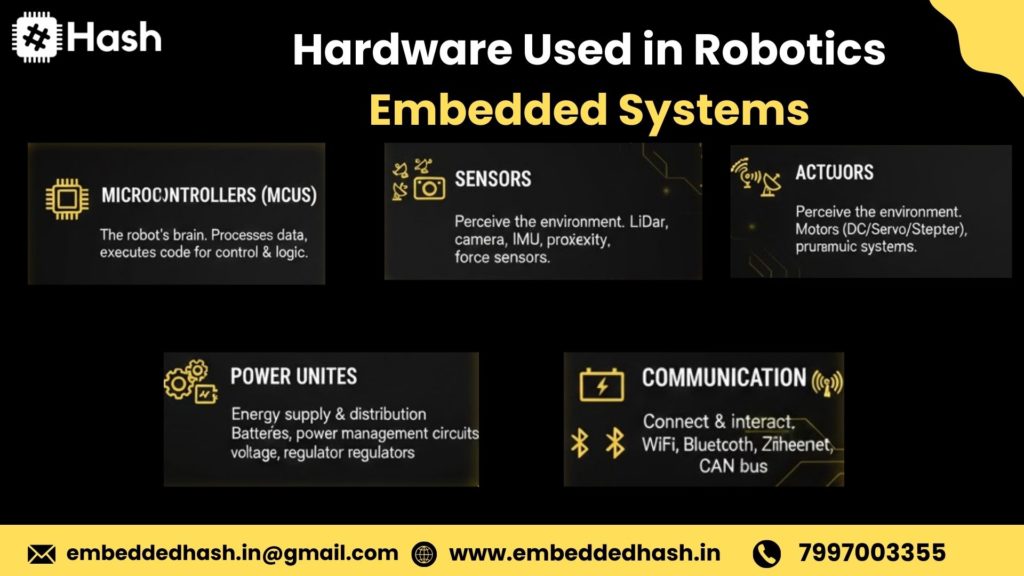
Hardware Used in Robotics Embedded Systems
Hardware is the physical foundation of any robot. It determines how fast the robot reacts, how accurately it moves, and how safely it operates. In robotics, embedded hardware must be compact, power-efficient, reliable, and real-time capable.
Let’s break this down into the three most critical hardware layers used in robotics embedded systems.
Computing Boards (The Robot’s Brain)
Computing boards are responsible for processing sensor data, running control algorithms, and issuing commands to actuators. The choice of board depends on performance needs, power limits, and application complexity.
Arduino
- Best for beginners and rapid prototyping
- Easy programming and large community support
- Ideal for simple robots like line followers, obstacle-avoidance bots, and basic automation
- Limited processing power, but excellent for learning embedded fundamentals
Use case: Educational robots, hobby projects, entry-level robotics learning
STM32
- Industry-grade microcontrollers used in professional robotics
- Real-time performance with high reliability
- Low power consumption with advanced peripherals (timers, ADCs, communication)
- Preferred in automotive, industrial, and medical robotics
Use case: Industrial robots, control-heavy systems, safety-critical applications
Raspberry Pi Pico
- Based on a powerful microcontroller architecture
- Combines simplicity with higher performance than entry-level boards
- Excellent for robotics projects requiring fast I/O and multitasking
- Supports MicroPython and C/C++
Use case: Mid-level robotics projects, academic labs, real-time experiments
Jetson Nano / Raspberry Pi
- Used when AI, computer vision, or high-level processing is required
- Capable of running Linux, ROS, and AI frameworks
- Handles image processing, object detection, and navigation algorithms
Use case: Autonomous robots, delivery robots, drones with vision, AI-powered robots
Sensors (The Robot’s Senses)
Sensors allow robots to understand their environment. Without sensors, robots cannot react intelligently to the real world.
Ultrasonic Sensors
- Measure distance using sound waves
- Simple, low-cost, and reliable for obstacle detection
- Common in beginner and industrial robots
Used for: Collision avoidance, distance measurement, navigation
Gyroscope / IMU (Inertial Measurement Unit)
- Measures orientation, acceleration, and angular velocity
- Helps robots maintain balance and direction
- Essential for drones, mobile robots, and humanoids
Used for: Stability control, motion tracking, navigation accuracy
Camera / Vision Sensors
- Enable robots to “see” the environment
- Used with image processing and AI algorithms
- Critical for object detection, facial recognition, and mapping
Used for: Autonomous navigation, AI robotics, medical and delivery robots
Temperature / Environmental Sensors
- Monitor heat, humidity, gas, or pressure
- Protect components from overheating
- Enable robots to operate safely in harsh environments
Used for: Industrial automation, medical robots, environmental monitoring
Actuators (The Robot’s Muscles)
Actuators convert electrical signals into physical movement. They define how precisely and powerfully a robot can move.
DC Motors
- Simple and cost-effective
- Speed controlled using PWM signals
- Common in wheeled robots
Used for: Robot wheels, conveyor belts, basic motion systems
Servo Motors
- Provide precise position control
- Easy to control with embedded systems
- Widely used in robotic arms and joints
Used for: Grippers, robotic arms, steering mechanisms
Stepper Motors
- Move in fixed steps for high accuracy
- Ideal for controlled, repeatable motion
- Require more power and precise drivers
Used for: CNC robots, 3D printers, precision positioning systems
Software & Programming in Embedded Robotics
embedded C/C++, but works alongside them.
MicroPython – Making Embedded Robotics Easier for Learning and Rapid Prototyping
MicroPython is a compact and efficient implementation of Python specifically built to run on microcontrollers.
Why MicroPython matters:In robotics, software is what turns hardware into intelligence.
Motors, sensors, and controllers are useless unless software tells them when to move, how fast to react, and what decision to take next. Embedded robotics software is different from normal app or web development because it must be:
- Fast (real-time response)
- Reliable (no crashes allowed)
- Hardware-aware (direct control of pins, memory, timers)
- Deterministic (same input → same response time)
Programming Languages Used in Embedded Robotics
Different languages are used at different levels of the robotic system. Each one has a purpose.
C – The Foundation of Embedded Robotics
C is the most widely used language in embedded systems and remains the backbone of robotics firmware.
Why C is critical in robotics:
- Direct access to hardware registers
- Extremely fast execution
- Low memory usage
- Full control over timing and interrupts
Where C is used:
- Sensor drivers
- Motor control logic
- Real-time control loops
- Low-level firmware
If you are working close to the hardware, C is unavoidable.
C++ – Object-Oriented Control & Robotics Logic
C++ builds on C and is heavily used in modern robotics.
Why robotics uses C++:
- Object-oriented design (clean, modular code)
- High performance (almost as fast as C)
- Better abstraction for complex robotic systems
Where C++ is used:
- Robot motion planning
- Control algorithms
- Middleware and communication layers
- Robotics frameworks and libraries
C++ is ideal when robotics systems grow complex and need structure without sacrificing speed.
Python – High-Level Robotics Intelligence
Python is popular in robotics for logic, experimentation, and AI integration.
Why Python is used:
- Easy to learn and read
- Rapid prototyping
- Excellent for AI, vision, and data processing
Where Python fits:
- Robot behavior logic
- Computer vision
- AI decision-making
- Simulation and testing
Python usually does not replace
- Faster learning curve for beginners
- Ideal for prototyping robotics ideas
- Interactive development (REPL)
Common use cases:
- Educational robotics
- Rapid testing of sensors and actuators
- Proof-of-concept projects
MicroPython trades performance for simplicity, so it’s not ideal for high-speed or safety-critical robots, but excellent for learning and innovation.
Real-Time & Middleware in Embedded Robotics
Robots must react within strict time limits. A delayed response can mean failure or danger.
Real-Time Operating Systems (RTOS) – FreeRTOS (Concept Level)
A Real-Time Operating System ensures that tasks run at predictable times.
Why RTOS is essential in robotics:
- Handles multiple tasks (sensor reading, motor control, communication)
- Ensures deadlines are met
- Improves system reliability
Typical RTOS tasks in robots:
- Sensor sampling task
- Motor control task
- Communication task
- Safety monitoring task
RTOS is the backbone of professional-grade embedded robotics systems.
Basics of Robotics Middleware (ROS Concept)
Robotic systems are often too complex for a single program.
Robotics middleware allows:
- Modular software design
- Communication between robot components
- Easier scaling of systems
What middleware enables:
- Sensor data sharing
- Control command distribution
- Hardware abstraction
Middleware acts as the communication nervous system of advanced robots.
Development Environments for Embedded Robotics
Development environments determine how efficiently you write, test, and debug robotics software.
Arduino IDE – Beginner-Friendly Robotics Development
Why it’s popular:
- Simple interface
- Massive community support
- Quick setup
Best for:
- Beginners
- Small robotics projects
- Prototyping ideas
Arduino hides hardware complexity, which is great for learning but limited for large systems.
STM32CubeIDE – Professional Embedded Robotics Development
Key strengths:
- Full control of hardware
- Built-in configuration tools
- Debugging and performance analysis
Best for:
- Industrial robotics
- Real-time motor control
- Professional embedded projects
This is where industry-grade robotics firmware is built.
Keil – High-Reliability Embedded Development
Keil is used in environments where stability and certification matter.
Why it’s used:
- Advanced debugging tools
- Optimized compilers
- Strong hardware support
Best for:
- Safety-critical robotics
- Automotive and industrial systems
PlatformIO – Modern Embedded Development Workflow
PlatformIO brings a modern software-engineering approach to embedded robotics.
Advantages:
- Multi-platform support
- Advanced dependency management
- Works with multiple IDEs
Best for:
- Scalable robotics projects
- Team-based development
- Clean and maintainable codebases
Careers in Embedded Systems & Robotics
Careers in embedded systems and robotics are among the most stable and future-proof tech paths today. Why?
Because robots, smart machines, and automated products cannot function without embedded intelligence.
From startups to global enterprises, companies are actively hiring professionals who can connect hardware with intelligent software.
Let’s break this down clearly.
Job Profiles in Embedded Systems & Robotics
These are the most in-demand roles recruiters look for:
Embedded Systems Engineer
This role focuses on building the core brain of electronic and robotic products.
What you do:
- Program microcontrollers
- Interface sensors and actuators
- Optimize performance and power consumption
- Work close to hardware
Best for:
Students who enjoy low-level programming and hardware interaction.
Robotics Engineer
Robotics engineers design systems that sense, decide, and move.
What you do:
- Integrate embedded controllers with motors and sensors
- Implement control algorithms
- Work on autonomous and semi-autonomous robots
- Combine embedded systems with AI and perceptio
Best for:
Those interested in real-world machines, automation, and innovation.
Firmware Developer
Firmware developers write efficient, reliable code that runs directly on hardware.
What you do:
- Develop low-level software (drivers, bootloaders)
- Handle communication protocols (UART, SPI, I2C, CAN)
- Ensure stability and real-time behavior
- Debug hardware–software issues
Best for:
Engineers who love optimization and system-level coding.
Control Systems Engineer
This role ensures robots move smoothly, accurately, and safely.
What you do:
- Design control logic for motors and actuators
- Work with feedback systems (PID control)
- Improve precision, speed, and stability
- Collaborate closely with embedded and robotics teams
Best for:
Engineers with interest in math, logic, and motion control.
Where You Can Work (Industries Hiring Now)
Embedded systems and robotics skills are not limited to one sector.
Automotive
- ECUs, ADAS, EV systems, autonomous driving
- Real-time embedded software is critical here
Industrial Automation
- Robotic arms, PLC-controlled machines
- Factory automation and Industry 4.0 systems
Healthcare Technology
- Medical robots, monitoring devices, diagnostic machines
- Safety and reliability are top priorities
Consumer Electronics
- Smart devices, wearables, home automation
- Embedded systems power everyday products
Defence & Drones
- UAVs, surveillance robots, autonomous systems
- High-performance embedded and control systems
One skill set, multiple high-paying industries.
Skills Recruiters Expect (Non-Negotiable)
Recruiters don’t just look at degrees — they look for practical embedded skills.
Embedded C / C++
- Core language for embedded and firmware roles
- Memory management and hardware-level control
Microcontrollers
- Hands-on experience with platforms like STM32, ESP32, AVR, PIC
- Understanding registers, timers, interrupts
RTOS Concepts
- Tasks, scheduling, semaphores, queues
- Essential for real-time robotic applications
Debugging Skills
- Using debuggers, logic analyzers, serial logs
- Finding hardware–software integration issues
Basic Electronics
- Reading schematics
- Understanding sensors, motors, power circuits
- Recruiters prefer candidates who can “build and debug”, not just explain theory.
Learning Roadmap — Embedded Systems Course for Robotics
If your goal is to build real robots (not just read theory), you need a structured, step-by-step learning roadmap. Robotics combines electronics, programming, real-time thinking, and system integration — skipping steps leads to confusion and skill gaps.
This roadmap is designed for:
- Students starting from basics
- Job seekers preparing for robotics & embedded roles
- Engineers transitioning into robotics systems
- Training institutes & businesses designing industry-ready curricula
The focus is simple: learn → build → apply → scale.
Step-by-Step Curriculum (Industry-Aligned)
Below is a practical, time-tested curriculum used in professional embedded systems courses for robotics.
Module | Duration | Tools Used | Outcome (What You’ll Actually Learn) |
Electronics Basics | 2 Weeks | Breadboard, Multimeter | Understand voltage, current, resistors, capacitors, power supply, and how real circuits work |
Microcontrollers & C Programming | 3 Weeks | Arduino / STM32 | Write firmware, control I/O pins, timers, interrupts, and build microcontroller logic |
Sensors & Actuators | 2 Weeks | Sensor Kits (IR, Ultrasonic, IMU, Motors) | Interface sensors, read real-world data, and control motors & actuators |
Real-Time Systems | 3 Weeks | FreeRTOS | Build responsive, multitasking robotic systems with deterministic timing |
Robotics Projects | 4 Weeks | ROS, Python | Integrate hardware + software to create working robots |
Why This Roadmap Works
Most beginners fail because they:
- Jump directly to robotics kits
- Ignore electronics fundamentals
- Don’t understand real-time behavior
This roadmap fixes that by ensuring:
- Strong hardware foundation
- Clean embedded firmware skills
- Real-time system thinking
- Hands-on robotics project experience
By the end, learners don’t just “know robotics” — they can build and debug robots independently.
Learning Outcomes (What You’ll Be Able to Do)
“By following this roadmap, you’ll gain the skills and confidence needed to achieve your goal.”
- Design and debug electronic circuits for robots
- Program microcontrollers for real-time control
- Interface sensors and actuators reliably
- Build multitasking embedded systems using RTOS
- Develop end-to-end robotics projects with confidence
These are the exact skills recruiters look for in robotics and embedded systems roles.
Tools & Platforms to Practice Robotics Embedded Systems
Learning embedded systems in robotics is not just about theory. Real skills are built by using the right tools that mirror what the industry uses. Below are the most important platforms every student, job seeker, and engineer should practice with.
Each tool serves a specific purpose in the robotics embedded ecosystem.
Arduino IDE (Best for Beginners & Rapid Prototyping)
The Arduino IDE is the easiest entry point into robotics embedded systems.
It allows you to:
- Program microcontrollers using simple C/C++ syntax
- Interface sensors, motors, displays, and communication modules
- Quickly prototype robotics ideas without complex setup
Why it matters for robotics:
- Ideal for line-following robots, obstacle-avoiding robots, and mini automation projects
- Helps beginners understand how embedded code controls real hardware
- Widely used in academic labs and starter robotics kits
Who should use it:
Students, beginners, and anyone starting with robotics embedded systems.
PlatformIO (Professional Embedded Development Workflow)
PlatformIO is a modern embedded development platform built for scalability and professionalism.
It helps you:
- Work with multiple boards (Arduino, ESP32, STM32, RP2040)
- Manage libraries and dependencies cleanly
- Use advanced debugging and testing tools
Why it matters for robotics:
- Suitable for larger robotics projects with structured code
- Commonly used in startups and professional environments
- Bridges the gap between hobby-level and industry-level development
Who should use it:
Intermediate learners, job seekers, and engineers aiming for clean, production-ready code.
STM32CubeIDE (Industrial-Grade Embedded Control)
STM32CubeIDE, developed by STMicroelectronics, is widely used in professional robotics systems.
It allows you to:
- Configure hardware peripherals visually
- Write high-performance embedded C code
- Debug real-time behavior on STM32 microcontrollers
Why it matters for robotics:
- Used in industrial robots, medical devices, and automotive systems
- Excellent for motor control, real-time constraints, and safety-critical robotics
- Teaches low-level embedded concepts required in core engineering roles
Who should use it:
Advanced students, embedded engineers, and professionals targeting core robotics roles.
MATLAB / Simulink (Model-Based Robotics Development)
MATLAB / Simulink, from MathWorks, is used heavily in robotics research and advanced system design.
It helps you:
- Model robotic systems mathematically
- Simulate sensors, actuators, and control algorithms
- Generate embedded code automatically (model-based design)
Why it matters for robotics:
- Used for control systems, motion planning, and signal processing
- Common in autonomous robots, drones, and research labs
- Helps validate logic before deploying to real hardware
Who should use it:
Students in control systems, robotics researchers, and engineers working on advanced algorithms.
ROS (Basics) – Robot Operating System
ROS (Robot Operating System) is not an operating system but a robotics middleware framework maintained by Open Robotics.
It allows you to:
- Connect sensors, controllers, and algorithms as modular nodes
- Handle communication between different robotic components
- Simulate robots using tools like Gazebo
Why it matters for robotics embedded systems:
- Used in autonomous robots, drones, and research platforms
- Works alongside embedded controllers (Arduino, STM32, ESP32)
- Industry-standard for higher-level robot coordination
Who should use it:
Intermediate to advanced learners building complete robotic systems.
Case Studies — Real Robots Using Embedded Systems
To truly understand the role of embedded systems in robotics, let’s look at real-world robots and break them down in a simple, practical way.
Case Study 1: Warehouse Robot (Logistics & E-commerce)
Problem
Large warehouses face challenges like:
- Slow order picking
- Human errors
- High labor costs
- 24/7 operational demands
Embedded Solution
- Embedded controllers process data from LiDAR, ultrasonic, and vision sensors
- Real-time motor control ensures smooth navigation between shelves
- Embedded firmware handles obstacle avoidance and path planning
- Battery management systems optimize charging cycles
Outcome
- Faster order fulfillment
- Reduced human workload
- High accuracy and uptime
- Scalable automation for growing businesses
Case Study 2: Delivery Robot (Last-Mile Automation)
Problem
Urban deliveries face:
- Traffic congestion
- High delivery costs
- Safety and navigation challenges
Embedded Solution
- Embedded processors fuse data from cameras, GPS, and proximity sensors
- Real-time decision-making for pedestrian detection and route correction
- Secure communication modules for remote monitoring
- Power-efficient embedded design for long operation hours
Outcome
- Contactless, cost-effective deliveries
- Safe navigation in crowded environments
- Reliable autonomous operation with minimal supervision
Case Study 3: Autonomous Drone (Surveillance & Mapping)
Problem
Manual aerial monitoring is:
- Expensive
- Risky
- Time-consuming
Embedded Solution
- Flight controllers run real-time embedded software
- IMU, gyroscope, and GPS data processed within microseconds
- Embedded control algorithms stabilize flight and adjust motor speeds
- Edge processing reduces dependency on cloud connectivity
Outcome
- Stable and precise autonomous flight
- Real-time data capture and analysis
- Used in agriculture, defense, surveying, and disaster response
Future of Embedded Systems in Robotics
The future of robotics is tightly linked to the evolution of embedded systems. Here’s what’s coming next.
AI + Edge Computing
- Embedded systems will run AI models directly on robots
- Less dependence on cloud connectivity
- Faster response times and better privacy
- Ideal for real-time vision, speech, and motion control
Autonomous Decision-Making
- Robots will make complex decisions without human input
- Embedded intelligence enables learning, adaptation, and prediction
- Critical for self-driving robots, drones, and medical systems
Collaborative Robots (Cobots)
- Robots working safely alongside humans
- Embedded safety systems detect force, proximity, and intent
- Used in manufacturing, labs, and healthcare
Smart Factories & Industry 4.0
- Embedded-enabled robots communicating with machines and systems
- Predictive maintenance and real-time optimization
- Fully automated production lines driven by embedded intelligence
Human–Robot Interaction (HRI)
- Robots that understand gestures, voice, and emotions
- Embedded systems handle multimodal sensor data
- Essential for service robots, assistants, and healthcare bots
Conclusion — Embedded Systems in Robotics
Embedded systems are the foundation of modern robotics. They are not optional add-ons or background technology — they are the core intelligence layer that makes robots functional, responsive, and reliable.
From simple line-following robots to advanced autonomous drones and surgical machines, every robot depends on embedded systems to:
- Sense the real world accurately
- Process data in real time
- Make intelligent decisions
- Control movement with precision and safety
In simple terms, robotics without embedded systems does not exist.

Frequently Asked Questions
Yes. Every functional robot needs an embedded system to operate. Without it, a robot cannot sense, process, or act autonomously.
Yes. Every functional robot needs an embedded system to operate. Without it, a robot cannot sense, process, or act autonomously.
C/C++ is preferred for real-time, low-level control in embedded robotics. Python is used mainly for high-level logic, AI, and prototyping on companion computers.
Yes. Many robots use RTOS (Real-Time Operating Systems) for timing-critical tasks, while advanced robots may use Linux-based systems for vision and AI processing.
You need C/C++ programming, microcontrollers, sensors, motor control, basic electronics, and real-time concepts. Debugging and system-level thinking are also crucial.
Absolutely. With growth in automation, robotics, EVs, drones, and AIoT, embedded systems remains a high-demand, future-proof career.
Yes. Embedded systems handle real-time control, while AI models run either on embedded AI chips or companion processors integrated into robotic platforms.
Common tools include Arduino IDE, STM32CubeIDE, PlatformIO, ROS, MATLAB, logic analyzers, debuggers, and simulators.
Robots commonly use ultrasonic sensors, IR sensors, cameras, LiDAR, IMUs, encoders, temperature, and pressure sensors.
Yes. Arduino is ideal for beginners due to its simplicity, strong community support, and wide availability of robotics libraries and tutorials.
If you want to Learn more About Embedded Systems, join us at Embedded Hash for Demo Enroll Now


 embeddedhash.in@gmail.com