
Embedded Systems Memory Types
Embedded systems rely heavily on memory to store programs, data, and intermediate results. Choosing the right memory type directly affects performance, cost, power consumption, and reliability. In this article, we’ll explore embedded systems memory types, their classification, internal architecture, and real-world usage examples in a simple and practical way.
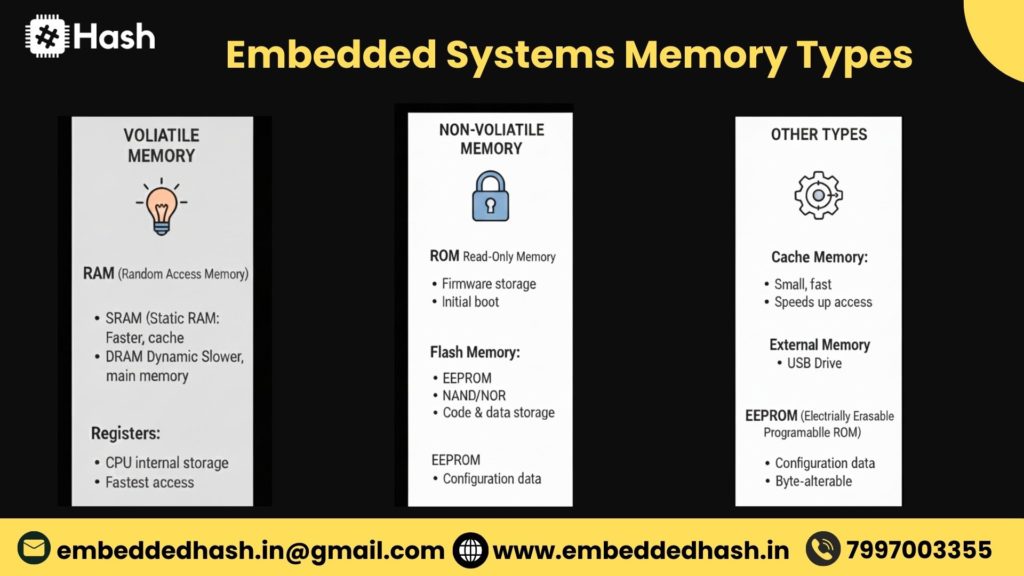
What Is Memory in Embedded Systems?
Memory in embedded systems is used to:
- Store firmware and application code
- Hold temporary data during execution
- Save configuration and user data
- Support real-time processing
Unlike general-purpose computers, embedded systems are resource-constrained, so memory selection is application-specific.
Embedded systems rely heavily on memory to store programs, data, and intermediate results. Choosing the right memory type directly affects performance, cost, power consumption, and reliability. In this article, we’ll explore embedded systems memory types, their classification, internal architecture, and real-world usage examples in a simple and practical way.
Classification of Embedded Systems Memory
Embedded system memory is broadly classified into two main categories:
1. Primary Memory (Internal Memory)
2. Secondary Memory (External Memory)
Let’s understand each in detail.
1. Primary Memory in Embedded Systems
Primary memory is directly accessible by the CPU and is usually on-chip or tightly coupled with the processor.
Types of Primary Memory
a) ROM (Read Only Memory)
ROM stores permanent data and firmware.
Characteristics:
- Non-volatile (retains data without power)
- Used for boot code and firmware
- High reliability
Types of ROM used in embedded systems:
- Mask ROM
- PROM
- EPROM
- EEPROM
- Flash Memory
Example:
Firmware stored in microcontrollers like Arduino, PIC, STM32
Primary Memory Architecture
CPU
├── ROM → Firmware & Program Code
└── RAM → Variables, Stack, Heap
2. Secondary Memory in Embedded Systems
Secondary memory is used for large data storage and is not directly accessed by the CPU.
Types of Secondary Memory
a) Flash Memory
- NAND Flash
- NOR Flash
Used for:
- Data logging
- Firmware updates
- File systems
Example:
SD cards in IoT devices, routers, and cameras
b) EEPROM
- Stores small amounts of non-volatile data
- Used for configuration parameters
Example:
Storing calibration values in industrial controllers
c) External Storage Devices
- SD cards
- eMMC
- USB storage
Example:
Data storage in medical devices and automotive infotainment systems

Comparison of Embedded Systems Memory Types
Memory Type | Volatile | Speed | Cost | Common Use |
ROM | No | Medium | Low | Firmware |
Flash | No | Medium | Medium | Program & Data |
SRAM | Yes | High | High | Fast data access |
DRAM | Yes | Medium | Low | Large data |
EEPROM | No | Low | High | Configuration |
Real-World Examples of Memory Usage in Embedded Systems
2. Automotive ECU
- Flash → Engine control software
- SRAM → Real-time calculations
- EEPROM → Error codes
3. IoT Smart Device
- Flash → Firmware
- RAM → Network buffers
- SD Card → Data logging
Introduction to Embedded System Memory
What Memory Means in Embedded Systems
In embedded systems, memory refers to the hardware components used to store program instructions, operational data, and configuration information required for a device to function. Unlike general-purpose computers, embedded systems are designed for specific tasks, so their memory is carefully optimized for performance, power efficiency, and cost.
Memory in embedded systems enables the processor to:
- Store firmware and control logic
- Temporarily hold sensor data
- Save user settings and system parameters
Without memory, an embedded device cannot execute instructions or respond to real-world inputs.
Why Memory Plays a Critical Role in Embedded Devices
Memory is one of the most critical building blocks of any embedded system because it directly impacts:
- System performance—Faster memory enables quicker data access
- Power consumption—Efficient memory reduces energy usage
- Reliability – Non-volatile memory preserves data during power loss
- Cost optimization – Memory selection affects overall product pricing
Since embedded devices often operate in real-time environments, even a small delay or memory failure can cause system malfunction or safety issues.
Difference Between Embedded System Memory and Computer Memory
Aspect | Embedded System Memory | Computer Memory |
Purpose | Task-specific | General-purpose |
Size | Limited | Large |
Power usage | Very low | High |
Flexibility | Fixed function | Multi-tasking |
Storage type | Mostly on-chip | External + internal |
Where This Knowledge Is Used
Understanding embedded system memory is essential in multiple areas:
1. Academic Exams
- Engineering exams (ECE, EEE)
- Embedded systems coursework
- GATE and university assessments
2. Technical Interviews
- Embedded engineer interviews
- Firmware developer roles
- IoT and automotive positions
3. Real-World Embedded Devices
- Automotive ECUs
- IoT sensors and controllers
- Medical and industrial equipment
- Consumer electronics
This knowledge helps engineers design stable systems, debug memory-related issues, and optimize embedded applications effectively.
What Is Memory in an Embedded System?
In an embedded system, memory is the component that stores the instructions and data needed for the system to operate correctly. It allows the embedded processor microcontroller or microprocessor to read, process, and store information while performing a specific task.
Simply put, memory tells the embedded system what to do and helps it remember important information.
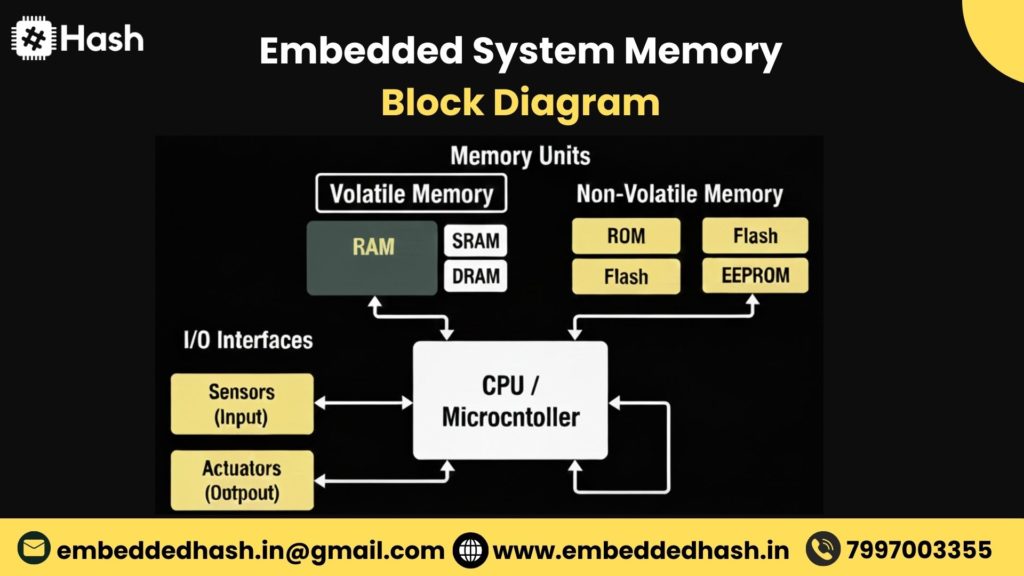
Relationship Between Processor, Memory, and Peripherals
An embedded system works as a coordinated unit where each component has a specific role:
- Processor (CPU): Executes instructions
- Memory: Stores programs and data
- Peripherals: Interact with the external world (sensors, displays, motors)
The processor fetches instructions from memory, processes the data, and then communicates with peripherals to perform real-world actions.
Without memory:
- The processor cannot run programs
- Data cannot be stored or processed
- The system becomes nonfunctional.
Types of Data Stored in Embedded System Memory
Embedded systems store different kinds of data, each serving a specific purpose.
1. Program Code
- Contains the firmware or application logic
- Stored in non-volatile memory (ROM, Flash)
- Remains intact even after power is turned off
Example: Motor control logic in a washing machine
2. Runtime Variables
- Temporary data used during program execution
- Stored in volatile memory (RAM)
- Lost when power is removed
Example: Sensor readings, counters, timers
3. Configuration Data
- System settings and calibration values
- Often stored in EEPROM or Flash
- Retained across power cycles
Example: Device ID, network settings, temperature thresholds
Embedded System Memory Block Diagram
Classification of Memory in Embedded Systems
Memory in embedded systems is broadly categorized based on whether it retains data when power is removed. This classification helps designers choose the right memory type depending on speed, cost, power consumption, and data persistence requirements. The two main categories are volatile memory and non-volatile memory.
Volatile Memory
Volatile memory is a type of memory that stores data only while the system is powered ON. Once the power supply is interrupted, all stored information is immediately lost.
Key Characteristics
- Requires continuous power to retain data
- Offers high-speed read and write operations
- Used for temporary data storage during program execution
- Plays a crucial role in real-time processing
Data Loss on Power Off
When an embedded device is switched off or reset, volatile memory is cleared. This makes it unsuitable for storing permanent information but ideal for handling runtime variables, stack data, and buffers.
Examples
- RAM (Random Access Memory)
- SRAM (Static RAM)
- DRAM (Dynamic RAM)
RAM is commonly used in microcontrollers and embedded processors to store temporary data and intermediate results while the program is running.
Non-Volatile Memory
Non-volatile memory is designed to retain stored data even when power is turned off, making it essential for long-term data storage in embedded systems.
Key Characteristics
- Does not require power to preserve data
- Typically slower than volatile memory
- Commonly used for firmware, boot instructions, and configuration settings
- Ensures system recovery after power loss
Data Retention Without Power
Unlike volatile memory, non-volatile memory maintains its contents during power failures, restarts, or shutdowns. This feature makes it critical for system initialization and persistent settings.
Examples
- ROM (Read-Only Memory)
- Flash Memory
- EEPROM (Electrically Erasable Programmable Read-Only Memory)
These memory types are commonly used to store program instructions, calibration data, and device configurations in embedded products.
Why This Classification Matters
Understanding the difference between volatile and non-volatile memory helps engineers:
- Optimize system performance
- Reduce power consumption
- Improve data reliability
- Design cost-effective embedded solutions
Memory Organization in Embedded Systems
Memory organization in embedded systems refers to how different types of memory are structured and accessed by the processor. Unlike general-purpose computers, embedded systems use a well-defined memory layout to ensure fast execution, reliability, and real-time performance. This organization helps the system efficiently manage program instructions and data while working within limited hardware resources.
Program Memory vs Data Memory
Embedded systems typically divide memory into program memory and data memory, each serving a distinct purpose.
Program Memory
Program memory stores the firmware or application code that the embedded system executes. This memory is usually non-volatile, meaning the data remains intact even when power is turned off. Common examples include Flash memory and ROM. Since program instructions do not change frequently, program memory is optimized for stability and long-term storage.
Data Memory
Data memory is used to store information that changes during system operation, such as variables, sensor readings, stack data, and temporary results. This memory is generally volatile, meaning its contents are lost when power is removed. RAM is the most common form of data memory in embedded systems because it allows fast read and write operations.
How Memory Is Mapped in Embedded Systems
Memory mapping defines how program and data memory are assigned specific address ranges that the processor can access. Each memory block—such as Flash, RAM, or EEPROM—is placed at a fixed address location within the system’s address space.
When the processor executes instructions, it fetches code from program memory addresses and reads or writes data to data memory addresses. This organized addressing ensures that the processor knows exactly where to find instructions and where to store runtime data, improving execution speed and predictability.
Why Memory Separation Is Important in Embedded Design
Separating program memory from data memory is a critical design practice in embedded systems. It improves system reliability by protecting program code from accidental modification during runtime. It also enhances performance, as each memory type is optimized for its specific task—either code storage or data handling.
Additionally, memory separation supports real-time behavior, making execution more predictable and easier to debug. This structured approach is particularly crucial in safety-critical applications, such as automotive systems, medical devices, and industrial controllers, where stability and accuracy are paramount.
Types of Memory Used in Embedded Systems
Embedded systems rely on different types of memory to store instructions, process data, and manage device operations. Among these, RAM (Random Access Memory) plays a crucial role in handling temporary data during execution.
RAM (Random Access Memory)
Purpose of RAM in Embedded Systems
RAM is used as the working memory of an embedded system. It temporarily stores data that the processor actively uses while the system is running, such as
- Runtime variables
- Sensor readings
- Stack and heap data
- Intermediate processing results
Because RAM allows fast read and write operations, it helps the processor execute tasks efficiently and respond quickly to inputs.
Why RAM Is Volatile
RAM is classified as volatile memory, which means it loses all stored data when power is turned off.
This happens because RAM requires a continuous power supply to maintain its stored information. Once the power is removed, the stored electrical charges disappear, and the data is erased.
For this reason, RAM is not suitable for permanent storage and is always paired with non-volatile memory like Flash or EEPROM in embedded systems.
Types of RAM
Embedded systems mainly use two types of RAM based on performance and cost requirements.
SRAM (Static Random Access Memory)
SRAM stores data using flip-flop circuits, which allows it to retain data as long as power is supplied without frequent refreshing.
Key Characteristics:
- Very fast access speed
- Low power consumption
- High reliability
- More expensive per bit
- Lower storage capacity
Usage:
SRAM is commonly used in microcontrollers, cache memory, and real-time embedded applications where speed is critical.
DRAM (Dynamic Random Access Memory)
DRAM stores data as electrical charges in capacitors, which must be refreshed periodically to retain information.
Key Characteristics:
- Higher memory density
- Slower than SRAM
- Requires regular refreshing
- Lower cost per bit
- Higher power consumption
Usage:
DRAM is typically used in embedded systems with complex processing needs, such as embedded Linux devices, multimedia systems, and advanced controllers.
Advantages and Limitations of RAM
Advantages:
- Fast data access improves system performance
- Enables real-time processing
- Supports multitasking operations
- Essential for dynamic data handling
Limitations:
- Data is lost when power is removed
- Limited memory size in small embedded devices
- SRAM is expensive, DRAM is slower
- Requires additional non-volatile memory for permanent storage
ROM (Read-Only Memory)
Read-Only Memory (ROM) is a type of non-volatile storage used in embedded systems to hold permanent instructions that do not change during normal operation. Unlike RAM, ROM retains data even when the power is turned off, making it essential for system startup.
Why ROM Is Used in Embedded Systems
ROM is used because embedded devices need a stable and reliable place to store critical software. The data stored in ROM is protected from accidental modification, ensuring consistent system behavior. This makes ROM ideal for fixed programs that must run every time the device is powered on.
Role of ROM in Firmware and Booting
ROM contains the firmware or bootloader, which is the first code executed when an embedded system starts. This firmware initializes hardware components, checks system status, and loads the main application into working memory. Without ROM, the system would not know how to begin operation.
Types of ROM
PROM (Programmable Read-Only Memory)
PROM allows data to be written only once after manufacturing. Once programmed, the data becomes permanent and cannot be erased or modified. It is used in applications where the firmware does not require updates.
EPROM (Erasable Programmable Read-Only Memory)
EPROM memory can be reset using ultraviolet light, enabling developers to rewrite program code while testing embedded applications.
EEPROM (Electrically Erasable Programmable ROM)
EEPROM can be erased and rewritten electronically, without removing the chip from the circuit. It is suitable for storing small amounts of data that may need occasional updates.
Flash Memory
Flash memory is a modern non-volatile memory used extensively in embedded systems to store both program code and data. It offers faster access times and higher storage capacity compared to traditional ROM types.
What Flash Memory Is
Flash memory stores data in blocks and allows multiple write and erase cycles, making it ideal for systems that require firmware updates.
Difference Between ROM and Flash Memory
Traditional ROM stores fixed data and cannot be easily modified, whereas Flash memory supports reprogramming without special equipment. Flash is faster, more flexible, and better suited for modern embedded applications.
Why Flash Is Widely Used in Modern Embedded Systems
Flash memory is popular because it supports firmware upgrades, bug fixes, and feature enhancements without hardware replacement. Its balance of speed, durability, and cost makes it the preferred choice in IoT devices, consumer electronics, and industrial systems.
EEPROM
EEPROM is a type of non-volatile memory designed for storing small but critical data that must be preserved during power loss.
Purpose of EEPROM
The main purpose of EEPROM is to store configuration settings and system parameters that need to be retained even when the device is powered off.
When EEPROM Is Preferred Over Flash
EEPROM is preferred when frequent, small data updates are required. Unlike Flash memory, EEPROM allows byte-level writing, which reduces wear when only small values change.
Typical Use Cases of EEPROM
Common applications include:
- Device calibration values
- User preferences and settings
- System configuration data
Error logs and counters
Comparison Table of Embedded Systems Memory Types
Choosing the right memory type is critical in embedded system design because each memory serves a specific purpose—from executing programs to storing configuration settings. The table below provides a clear, side-by-side comparison of the most commonly used embedded system memory types, helping beginners, students, and professionals quickly understand their differences.
Embedded Systems Memory Comparison Table
Memory Type | Volatile | Read/Write | Typical Use |
RAM | Yes | Yes | Temporary runtime data and variables |
ROM | No | No | Permanent firmware and boot code |
Flash | No | Yes | Program storage and firmware updates |
EEPROM | No | Yes | Device settings and configuration data |
Explanation of Each Memory Type
RAM (Random Access Memory)
RAM is a temporary working memory used by the processor while the embedded system is running. It stores variables, stack data, and intermediate results. Since RAM loses data when power is removed, it is classified as volatile memory.
ROM (Read-Only Memory)
ROM holds fixed instructions such as bootloaders or core firmware that rarely change. Data stored in ROM remains intact even after power loss, making it ideal for permanent program storage.
Flash Memory
Flash memory is a non-volatile and rewritable memory commonly used to store application programs. It allows firmware updates without replacing hardware, which is especially useful in IoT and consumer devices.
EEPROM (Electrically Erasable Programmable ROM)
EEPROM is designed for storing small but critical data, such as device calibration values or user settings. Unlike Flash, it allows byte-level data updates, making it suitable for configuration storage.
Advantages and Disadvantages of Embedded System Memory
Embedded system memory is designed to support specific applications with high efficiency.
Advantages
Fast Access
Embedded memory provides quick access to program instructions and data, enabling faster execution and real-time responses.
Optimized for Specific Tasks
Memory is tailored to the application’s needs, ensuring efficient storage and processing without unnecessary overhead.
Low Power Usage
Designed for energy efficiency, embedded memory consumes less power, making it ideal for portable and battery-operated devices.
Reliable Storage
Non-volatile memory types ensure data retention even during power loss, improving system stability and reliability.
Disadvantages
Limited Size
Embedded systems have fixed and restricted memory capacity, which limits complex operations and large data handling.
Cost Constraints
High-performance or specialized memory components can increase the overall system cost.
Hardware-Dependent Upgrades
Memory expansion or upgrades are often difficult or impossible without changing the hardware design.
Factors Affecting Memory Selection in Embedded Systems
Choosing the right type of memory is a critical design decision in embedded systems. The selection directly impacts system performance, power efficiency, reliability, and overall cost. Below are the key factors engineers consider when selecting memory for an embedded application.
Performance Requirements
The speed at which data is accessed plays a major role in memory selection. Applications that require fast execution—such as real-time control systems or signal processing—need high-speed memory like SRAM. Slower memory types may cause delays, making them unsuitable for time-critical tasks.
Power Consumption
Many embedded devices operate on batteries or energy-limited sources. Low-power memory is essential for extending device lifespan in applications such as wearables, medical devices, and IoT sensors. Non-volatile memories like Flash and EEPROM are preferred when power efficiency is a priority.
Cost Constraints
Memory cost significantly affects the overall product price, especially in large-scale manufacturing. Designers often balance memory capacity and performance against budget limitations. For cost-sensitive consumer electronics, economical memory solutions are typically chosen without compromising essential functionality.
Data Retention Needs
Different applications require data to be stored for varying durations. Program code and configuration settings must be retained even when power is off, making non-volatile memory necessary. In contrast, temporary data and runtime variables are stored in volatile memory that does not retain data after power loss.
Application Type
The intended use of the embedded system strongly influences memory choice. Industrial automation systems, automotive controllers, and healthcare devices each have unique memory demands based on reliability, speed, and storage requirements. Selecting memory aligned with the application ensures stable and efficient system operation.
Real-World Examples of Memory Usage in Embedded Systems
Consumer Electronics
Common household devices like washing machines, televisions, and microwave ovens rely on embedded memory to store programs and user settings.
- Flash memory stores the main control program that manages device operations
- RAM handles temporary data such as sensor readings, button inputs, and timing tasks
- EEPROM saves user preferences like wash cycles, volume levels, or clock settings even after power loss
These memory components allow consumer electronics to operate smoothly, respond instantly to user input, and retain personalized settings.
Automotive Systems
Modern vehicles use multiple embedded systems, each with dedicated memory for safety and performance.
- Engine Control Units (ECUs) store firmware in Flash memory for fuel injection and engine timing
- RAM processes real-time sensor data such as speed, temperature, and pressure
- EEPROM retains calibration data and fault codes for diagnostics
- ABS and airbag systems rely on fast memory access to meet strict real-time requirements
Reliable memory ensures accurate decision-making and passenger safety in automotive applications.
IoT Devices
IoT devices such as smart sensors, fitness trackers, and wearable technology require efficient memory usage due to limited power and size.
- Flash memory stores device firmware and network protocols
- RAM supports real-time data processing and communication tasks
- Non-volatile memory preserves device configuration and connectivity credentials
Optimized memory design helps IoT devices achieve long battery life, fast response times, and stable wireless communication.
Medical Equipment
In medical electronics, memory reliability is critical because patient safety depends on accurate data handling.
- Patient monitoring systems use RAM for live signal processing and Flash memory for system software
- EEPROM stores calibration values and device settings
- Pacemakers and implantable devices rely on non-volatile memory to maintain essential operation parameters even during power interruptions
Medical embedded systems require memory that is highly stable, secure, and capable of long-term data retention.
Conclusion
Embedded system memory plays a vital role in determining how efficiently a device operates. Different memory types—such as RAM for temporary data, ROM and Flash for program storage, and EEPROM for configuration data—work together to ensure smooth and reliable system performance. Each type is designed for a specific purpose, balancing speed, storage capacity, and data retention.
Choosing the right memory type is critical because it directly affects system speed, power consumption, cost, and long-term reliability. A well-planned memory architecture helps embedded devices perform real-time tasks accurately while maintaining stability and efficiency, especially in resource-constrained environments.
Frequently Asked Questions (FAQs)
Embedded systems mainly use volatile memory (such as RAM) for temporary data and non-volatile memory (such as ROM, Flash, and EEPROM) to store program code and configuration data.
RAM (Random Access Memory) is volatile memory. It temporarily stores data while the system is running and loses all information when power is turned off.
ROM is used to store firmware and boot instructions that must remain available even after power loss, ensuring reliable system startup.
Flash memory supports block-level erasing, which allows faster and more efficient firmware updates compared to EEPROM, which modifies data byte by byte and operates at slower speeds.
Embedded memory is commonly classified into:
- Volatile vs Non-volatile memory
- Program memory vs Data memory
Internal memory vs External memory
Program code is usually stored in Flash memory or ROM, as these retain data even when the device is powered off.
RAM stores runtime variables, stack data, and temporary results, enabling the processor to execute tasks efficiently during operation.
Flash memory stores application firmware and supports reprogramming, making it ideal for updates and long-term data storage.
Yes, EEPROM is still used for small configuration settings that need to be updated without erasing large memory blocks.
SRAM is faster and more reliable but expensive, while DRAM is cheaper and denser but requires periodic refreshing, making SRAM more common in embedded systems.
Most embedded systems require at least a small amount of RAM to execute programs and handle runtime operations.
Limited memory can restrict application complexity, while sufficient memory improves speed, reliability, and multitasking capability.
Key factors include cost, power consumption, speed, endurance, data retention, and application requirements.
Internal memory is integrated into the microcontroller, while external memory is added through interfaces to expand storage capacity.
Embedded memory is task-specific, limited, and power-efficient, whereas computer memory is larger, flexible, and designed for multitasking.
If you want to Learn more About Embedded Systems, join us at Embedded Hash for Demo Enroll Now


 embeddedhash.in@gmail.com